

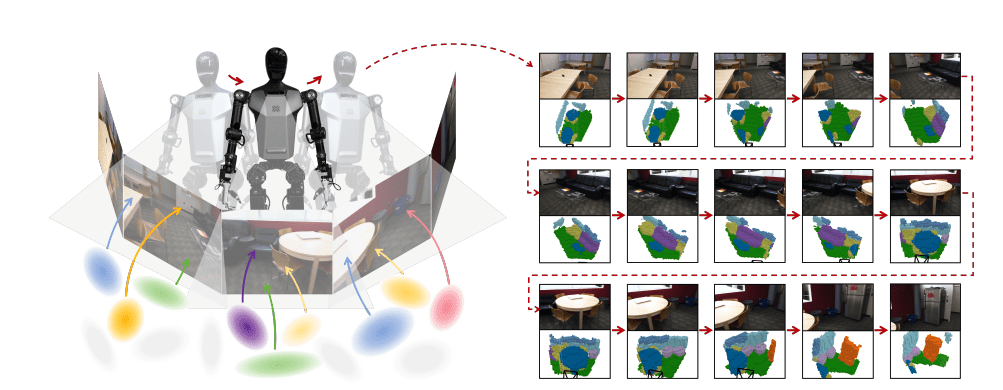
On April 20, 2025, researchers published a collaborative effort titled RoboOcc: Enhancing the Geometric and Semantic Scene Understanding for Robots. The effort introduced an advanced method to improve 3D occupancy prediction for robotics applications.
The paper introduces RoboOcc, a 3D occupancy prediction method that enhances scene understanding through an Opacity-guided Self-Encoder (OSE) and a Geometry-aware Cross-Encoder (GCE). It addresses limitations of existing Gaussian-based methods by improving semantic clarity and geometric modelling. Tested on Occ-ScanNet and EmbodiedOcc-ScanNet datasets, RoboOcc achieves state-of-the-art performance in both local and global camera settings. Ablation studies demonstrate superior performance with an 8.47 IoU and 6.27 mIoU margin over previous methods.
In robotics, accurately predicting 3D space occupancy from a single camera image is crucial for enabling robots to navigate and interact effectively with their environment. A recent paper introduces RoboOcc, an innovative method that enhances monocular vision-based 3D prediction, offering improvements in both accuracy and efficiency compared to existing approaches.
Monocular vision involves using a single camera to infer depth information, which presents inherent challenges due to the loss of depth cues when transitioning from 3D to 2D. This makes it difficult for robots to understand their environment’s spatial layout, particularly in complex or dynamic settings.
RoboOcc employs a transformer-based architecture, known for its ability to handle long-range dependencies and capture spatial relationships effectively. The method incorporates dual attention mechanisms—spatial and temporal. Spatial attention focuses on relevant areas within an image, while temporal attention can utilize video data to track changes over time, enhancing prediction accuracy by understanding motion or object persistence.
Testing on the Occ-ScanNet dataset, which features diverse indoor scenes, demonstrates that RoboOcc outperforms existing methods in both accuracy and efficiency. This efficiency suggests practicality for real-world applications, as it requires less computational power than previous approaches.
Beyond robotics, RoboOcc’s capabilities have potential applications in autonomous vehicles and augmented reality, where cost-effective sensing solutions are advantageous. A video demo showcases the method’s ability to handle complex scenes, highlighting its versatility across different environments.
While RoboOcc represents a significant advancement, challenges remain, particularly in areas with ambiguous depth cues. Potential improvements include incorporating prior knowledge of object sizes or uncertainty estimation. Further exploration into scalability across diverse environments, such as homes or warehouses, is promising but requires additional research.
RoboOcc marks a notable step forward in 3D occupancy prediction using monocular vision, addressing key limitations of existing methods and offering practical benefits for robotics and beyond. Its implementation in real-world scenarios will be pivotal in determining its impact and guiding future research directions.
👉 More information
🗞 RoboOcc: Enhancing the Geometric and Semantic Scene Understanding for Robots
🧠 DOI: https://doi.org/10.48550/arXiv.2504.14604


