
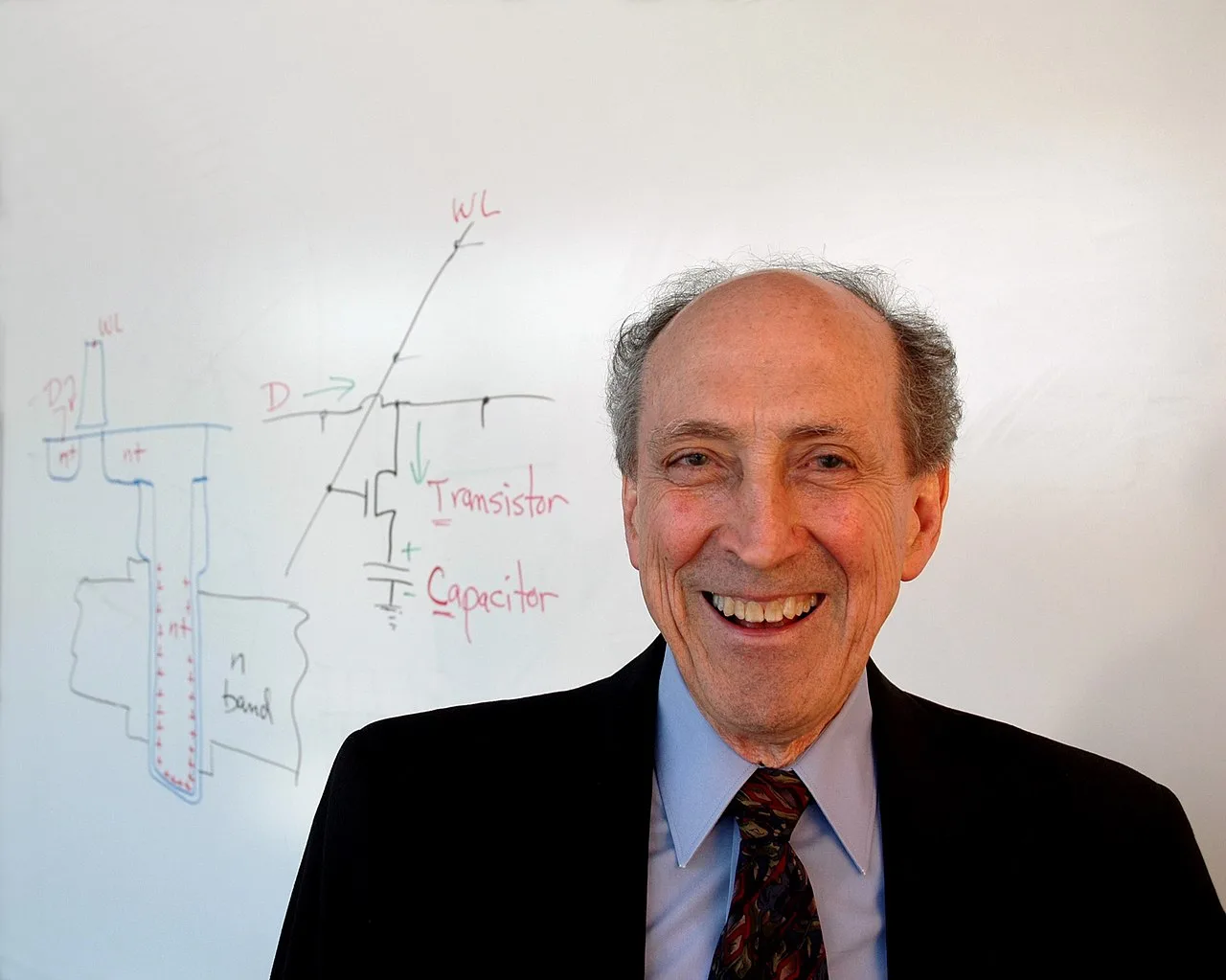
Robert Dennard, an IBM researcher, invented dynamic random-access memory (DRAM), a revolutionary memory cell used in nearly every computer and electronic device today. Dennard’s work also led to the formulation of Dennard’s law, which predicted that as transistors get smaller, their performance per watt would increase, enabling faster, more efficient computers. However, by 2005, as transistors began to leak and consume more energy, Dennard’s law broke down. Despite this, Dennard’s contributions have significantly shaped modern technology and the culture at IBM’s Thomas J. Watson Research Center. Dennard passed away in 2024 at the age of 91.
The Legacy of Robert Dennard: The Inventor of DRAM
Robert Dennard, an IBM researcher, is celebrated for his invention of dynamic random-access memory (DRAM), a revolutionary memory cell that has become a fundamental component in nearly every computer, server, and consumer electronic device today. Dennard’s journey from a farm in Texas to the forefront of technological innovation is a testament to his creativity and ingenuity.
Born in 1932, Dennard’s early life was far removed from the world of technology. His interest in electrical engineering was sparked by a guidance counselor’s suggestion and a scholarship to Southern Methodist University, where he studied the subject. Dennard’s fascination with the French horn led to his scholarship and was the first step towards his groundbreaking invention of DRAM.
The Birth of DRAM: A Leap in Computer Memory
Dennard’s work at IBM began in 1958, a time of technological ferment. He joined a microelectronics team in 1964, aiming to replace the large, slow, and power-hungry computer system known as magnetic-core random access memory (RAM). The team developed an alternative system using six MOS transistors to store 1 bit of information on an integrated circuit. However, Dennard sought a faster, more elegant, and cheaper solution.
His eureka moment came while pondering a presentation given by his peers. He wondered if he could store a bit of information in a single transistor. This insight led to the invention of DRAM, which quickly replaced earlier magnetic technologies and spearheaded dramatic progress in memory capacity and speed.

Dennard’s Law: The Framework for Technological Evolution
Beyond DRAM, Dennard made another significant contribution to the evolution of 21st-century technology. In 1972, he outlined a theory known as Dennard scaling, or Dennard’s law, which set the framework for computers to get smaller, faster, and more efficient every year.
Dennard’s law, based on Moore’s law, predicted that power consumption would drop as transistors were made smaller, enabling chipmakers to increase processor clock speed without increasing power draw. However, as engineers continued to reduce dimensions, transistors began to leak, causing the chip to heat up and consume more energy. By 2005, Dennard’s law broke down. Despite this, its impact on the ecosystem of newer, smaller, and ever-more-powerful memory chips endures.
A Career Fueled by Creativity
Dennard’s career at IBM was marked by a relentless commitment to innovation. His work ethic and ingenuity shaped the culture at IBM’s Thomas J. Watson Research Center in Yorktown Heights, New York. Dennard became a cornerstone of the institution, where he hatched 75 US patents.
Throughout his half-century career at IBM, Dennard won numerous awards in recognition of his seminal contributions. He was declared an IBM Fellow in 1979, received the US National Medal of Technology from President Reagan in 1988, was inducted into the US National Inventors Hall of Fame in 1997, and received the prestigious IEEE Medal of Honor in 2009. Most recently, in 2019, the Semiconductor Industry Association bestowed upon Dennard the Robert N. Noyce Award, the industry’s highest honor.
The End of an Era: Remembering Robert Dennard
Robert Dennard passed away on April 23, 2024, at the age of 91. His legacy, however, lives on in the countless devices that utilize his invention of DRAM. His belief that “there’s an end to scaling, but there’s no end to creativity” continues to inspire the next generation of inventors and innovators. Dennard’s life and work serve as a reminder of the transformative power of creativity and the enduring impact of technological innovation.
External Link: Click Here For More