

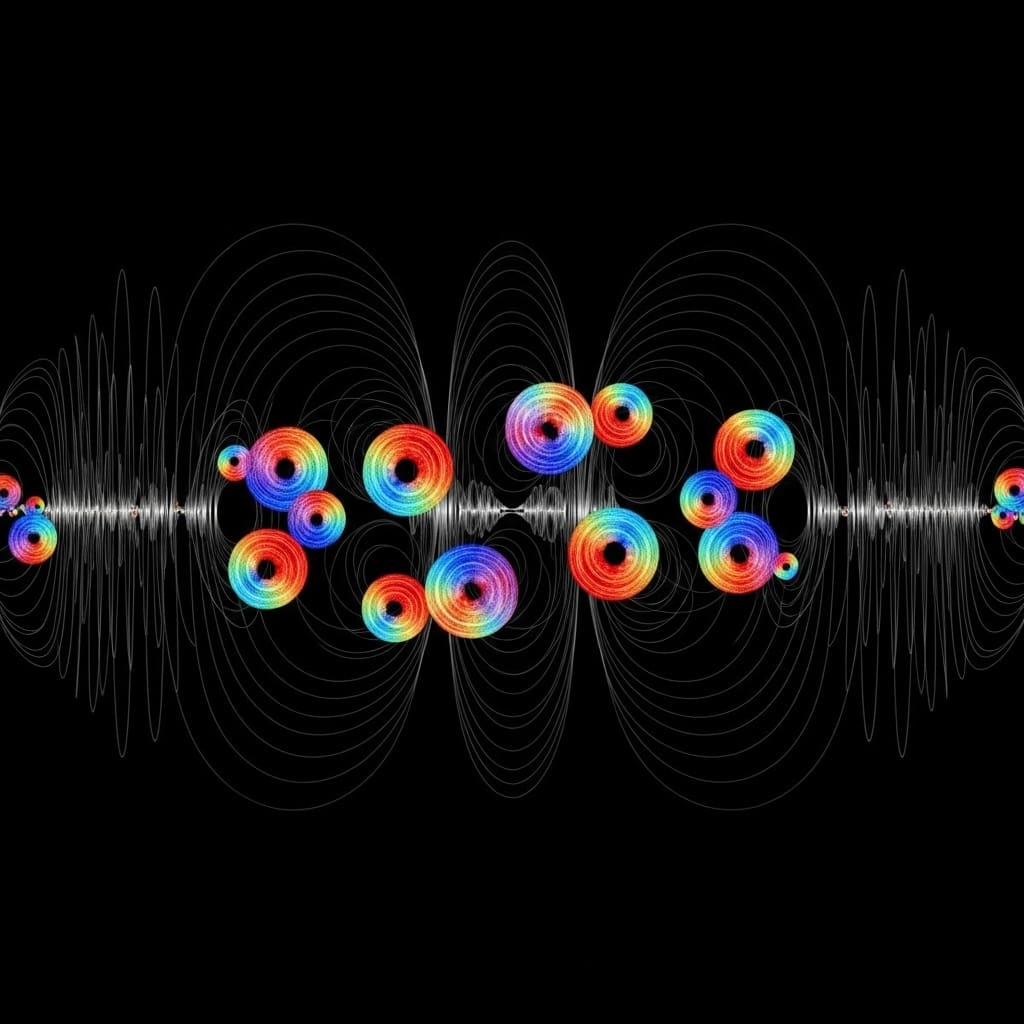
Researchers are increasingly focused on understanding how magnetic skyrmions interact, a critical step towards building advanced racetrack and logic devices. Xuchong Hu, Huaiyang Yuan (Institute for Advanced Study in Physics, Zhejiang University), and Xiangrong Wang (School of Science and Engineering, Chinese University of Hong Kong (Shenzhen)) et al., have now revealed that these skyrmion-skyrmion interactions exhibit surprising characteristics , they are intrinsic, anisotropic, and oscillate in a predictable manner. Their study demonstrates that the attractive and repulsive forces between skyrmions behave similarly to the well-known RKKY coupling found in metallic magnetism, explaining a previously unseen wavy tail in the skyrmion spin texture. This discovery establishes a universal principle applicable to all tilted skyrmions, paving the way for the design of novel skyrmion molecules and superstructures with significant potential for future spintronic applications.
Skyrmion Interactions Linked to RKKY Coupling are crucial
The study employed a comprehensive modelling approach, utilising the magnetic energy equation incorporating exchange, Dzyaloshinskii-Moriya interaction, anisotropy, magnetic dipolar energy, and Zeeman energy to simulate chiral magnetic films. Researchers varied key parameters, anisotropy constant, tilt angle, and external magnetic field, to explore different scenarios and meticulously analyse the resulting skyrmion behaviour. Numerical simulations were performed using the Mumax3 package, solving the Landau-Lifshitz-Gilbert (LLG) equation on 600nm x 600nm x 0.5nm films with a 1nm lateral mesh size and periodic boundary conditions, ensuring accurate and stable spin configurations. This rigorous methodology allowed for detailed examination of the energy landscape and identification of the oscillatory interaction patterns.
Experiments show that the energy surface between two skyrmions is anisotropic, with the interaction varying depending on the displacement between them. Along the x-axis, the energy decreases monotonically, indicating repulsion, while along the y-axis, the energy profile displays RKKY-like oscillations with minima at 66.5nm, 156.5nm, and 247.5nm, demonstrating alternating attraction and repulsion. Crucially, the analysis uncovered a periodic spin structure within the tail of an isolated in-plane skyrmion, aligning with the observed interaction period, and suggesting that coinciding tails reduce total energy, leading to attraction, while out-of-phase tails increase energy and cause repulsion. The discovery of RKKY-like interactions provides a pathway to engineer controllable collective behaviour in skyrmion-based devices, potentially leading to more efficient and versatile data storage and processing technologies. The team’s findings not only deepen our understanding of fundamental skyrmion physics but also pave the way for innovative designs in the rapidly evolving field of magnetic materials and nanotechnology.
Skyrmion Interactions and Energy Functional Modelling are crucial
Researchers modelled a chiral magnetic film of thickness d lying in the xy-plane, defining the magnetic energy E with components including the exchange energy Eₑₓ = A d² ∫ |∇m|² dx, where the exchange stiffness A was fixed at 30 pJ/m and m represents the magnetization direction with saturation magnetization Mₛ = 1 MA/m. The Dzyaloshinskii–Moriya interaction (DMI) was incorporated as Eᴰᴹ = D d² ∫ [m · (∇ × m)] dx, with a DMI strength D = 4 mJ/m². To accurately simulate skyrmion behaviour, the team engineered a system using the Mumax3 package to numerically solve the Landau–Lifshitz–Gilbert (LLG) equation on films measuring 600 nm × 600 nm × 0.5 nm. These simulations employed periodic boundary conditions in both the x and y directions, with a lateral mesh size of 1 nm, ensuring precise resolution of skyrmion spin textures.
The LLG equation, defined as ∂m/∂t = −γ m × Hₑff + α m × ∂m/∂t, governed the magnetization dynamics, where γ is the gyromagnetic ratio and α is the Gilbert damping parameter. The effective field Hₑff was calculated as −δE/δm, incorporating contributions from exchange, anisotropy, DMI, and external magnetic fields. Researchers determined the nature of skyrmion interactions by analysing the displacement dependence of the potential energy. One skyrmion was fixed at the sample centre (0, 0), while the other was positioned at (x, y), with both having a centre spin direction of m = (0, 1, 0) against a background spin state of m = (0, −1, 0). The study pioneered a method for mapping the energy surface E(x, y), revealing anisotropic behaviour and oscillatory interactions along the y-axis, exhibiting RKKY-like characteristics with energy minima at yₘᵢₙ = 66.5, 156.5, and 247.5 nm.
Oscillatory Skyrmion Interactions Reveal RKKY-like Coupling in magnetic
The team measured the potential energy between two skyrmions as a function of their displacement, fixing one skyrmion’s centre at the sample centre and varying the position of the second. Results demonstrate that the energy surface, E(x, y), is anisotropic, indicating direction-dependent interactions. Along the x-axis, the total energy decreased monotonically with distance, confirming repulsive forces between the skyrmions. Further analysis of the spin structure revealed the origin of these oscillatory interactions. Scientists compared the spin structure of isolated perpendicular and in-plane skyrmions, finding that perpendicular skyrmions exhibit isotropic spin variation, while in-plane skyrmions possess a stripy spin structure parallel to the x-axis.
The period of this stripy structure, observed in the inset of Figure 2(c), matches the observed oscillation period in the skyrmion-skyrmion interaction. When two skyrmions are aligned along this periodic direction and separated by an integer multiple of the period, their wavy tails coincide, reducing total energy and creating attraction. The study employed numerical simulations using the Mumax3 package to solve the Landau-Lifshitz-Gilbert (LLG) equation on 600nm × 600nm × 0.5nm films with a 1nm lateral mesh size. The magnetic energy, E, was modelled with components including exchange energy (A = 30 pJ/m), Dzyaloshinskii, Moriya interaction (D = 4 mJ/m2), anisotropy energy (K varied), magnetic dipolar energy, and Zeeman energy. Two cases were considered: one with controlled anisotropy (K = 1.256 MJ/m3, θ = 0) and another with varying K and θ with H = 0.
Skyrmion Interactions Reveal RKKY-like Oscillations and Tails
The authors observed that a bi-skyrmion molecule, bound by attraction, moves as a single entity when a spin-orbit torque is applied to only one skyrmion within the molecule. The study acknowledges that the period of the oscillatory interaction is proportional to the DMI constant divided by the DMI strength and inversely proportional to the sine of the tilt angle. The direction of the wavy tail structure is determined by the type of DMI interaction and the easy axis direction. Future research could focus on exploiting these anisotropic and oscillatory interactions to create more complex skyrmion arrangements and to further refine the control of skyrmion dynamics, potentially leading to novel spintronic devices.
👉 More information
🗞 RKKY-like interactions between two magnetic skyrmions
🧠 ArXiv: https://arxiv.org/abs/2601.17727

