
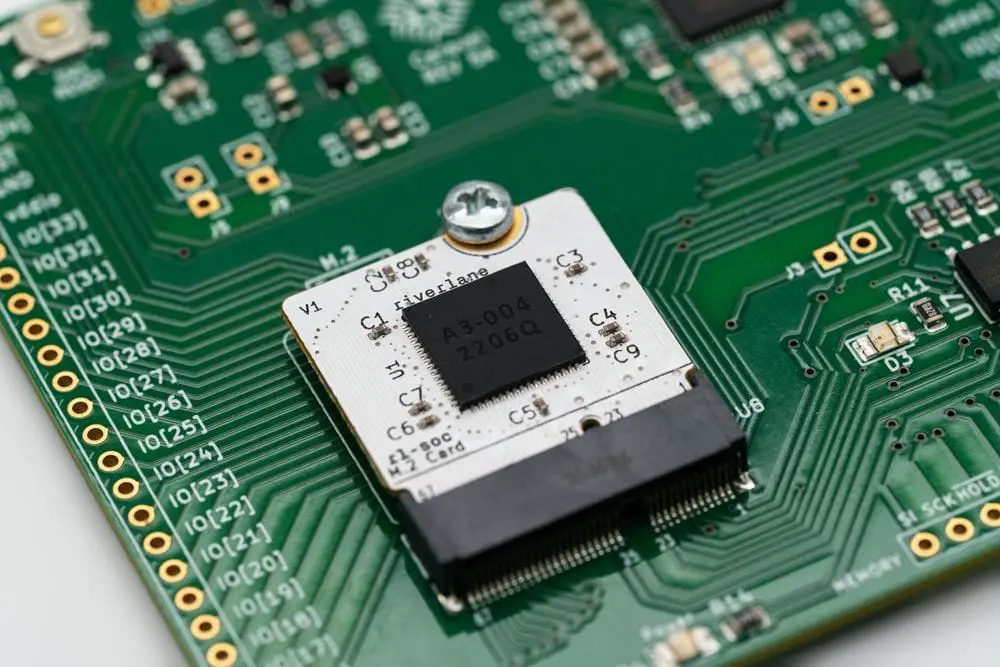
Riverlane has made a notable achievement in quantum computing with the publication of its research in Nature Electronics. The company’s flagship quantum error correction technology has been recognized as a crucial step towards fault-tolerant quantum computing.
Quantum error correction is a set of techniques used to protect information stored in qubits from errors and decoherence caused by noise. Earl Campbell, VP of Quantum Science at Riverlane, highlights the significance of their decoder chip, which can decode fast enough to keep up with a quantum computer while using minimal resources.
Professors Stephen Bartlett and Simon Benjamin from the University of Sydney and Oxford University respectively, have praised Riverlane’s work, noting its importance in realizing practical quantum computers.
Companies like Google, Quantinuum, and QuEra are also making advancements in quantum error correction. Google aims to reach a milestone of one million error-free quantum operations within the next few years. Riverlane is leading the charge with its Quantum Error Correction Stack, Deltaflow, which will help transform full-stack quantum computers into powerful machines.
Introduction to Quantum Error Correction
Quantum error correction (QEC) is crucial in developing reliable and efficient quantum computing systems. As quantum computers process vast amounts of data, they are prone to errors caused by noise and decoherence, rendering calculations useless. QEC techniques aim to protect the information stored in qubits from these errors, ensuring that quantum computations remain accurate and reliable. Riverlane‘s recent publication in Nature Electronics highlights a significant advance in QEC, demonstrating the first comprehensive hardware implementation of a decoder chip for quantum computing.
The importance of QEC cannot be overstated, as large-scale quantum computers need to generate high volumes of data every second, scaling to 100TB/s. To prevent errors from building up and rendering calculations useless, the system must decode this data faster than it accumulates. Riverlane’s research has shown that QEC can provide a viable route to fault-tolerant quantum computing by uniquely balancing speed, accuracy, and resource efficiency. The company’s decoder chip, which uses a novel Collision Clustering (CC) decoder, has set a new standard for quantum error correction.
The development of QEC is a rapidly evolving field, with companies like Google, Quantinuum, and QuEra making significant advancements in recent years. However, more work must be done before practical applications can be realized. The following important milestone in QEC is achieving a ‘MegaQuOp’ (one million error-free quantum operations), enabling quantum computing’s first practical use cases beyond the supercomputing threshold. Two key components are required to reach this goal: 1,000-10,000 physical qubits with physical error rates below the QEC breakeven point and a classical compute stack to process the QEC data in real time.
Quantum Error Correction Techniques
Quantum error correction techniques are designed to mitigate the effects of noise and decoherence on quantum computations. These techniques can be broadly classified into active and passive error correction. Active error correction involves using feedback control to correct errors as they occur, while passive error correction relies on the inherent properties of the quantum system to reduce the impact of mistakes. Riverlane’s decoder chip uses a novel Collision Clustering (CC) decoder, an example of an active error correction technique.
The CC decoder is a powerful tool for correcting errors in quantum computations. It works by identifying and correcting errors in real time, using a combination of classical and quantum processing. The decoder is designed to be highly efficient, with low latency and high throughput, making it suitable for large-scale quantum computing applications. The development of the CC decoder has been a significant breakthrough in QEC, enabling the creation of more reliable and efficient quantum computing systems.
In addition to the CC decoder, other QEC techniques are being developed and refined. These include surface codes, Shor codes, and topological codes, among others. Each of these techniques has its strengths and weaknesses, and researchers are working to optimize their performance and applicability. The development of new QEC techniques is an active area of research, with significant potential for breakthroughs in the coming years.
Achieving a MegaQuOp
Achieving a ‘MegaQuOp’ (one million error-free quantum operations) is a critical milestone in the development of practical quantum computing systems. To reach this goal, two key components are required: 1,000-10,000 physical qubits with physical error rates below the QEC breakeven point and a classical compute stack to process the QEC data in real-time. The team at Google, for example, has made significant progress towards achieving the first component, with 100 physical qubits at the breakeven point.
Riverlane is leading the charge towards achieving a MegaQuOp, with its Quantum Error Correction Stack (Deltaflow ™) designed to help hardware partners transform their full-stack quantum computers into ‘MegaQuop Machines’. The company’s second-generation QEC Stack (Deltaflow 2) is launching this March, which will provide significant advancements in QEC capabilities. With the development of more powerful QEC techniques and the creation of larger-scale quantum computing systems, the achievement of a MegaQuOp is expected to be realized within the next 2-3 years.
The implications of achieving a MegaQuOp are significant, enabling the first practical use cases for quantum computing beyond the supercomputing threshold. This will open up new opportunities for industries such as chemistry, materials science, and optimization, among others. The development of more reliable and efficient quantum computing systems will also drive innovation in fields such as artificial intelligence, machine learning, and cybersecurity.
Future Directions
The future of QEC is exciting and rapidly evolving. As researchers continue to develop and refine new techniques, the potential for breakthroughs in the coming years is significant. Riverlane’s publication in Nature Electronics highlights the importance of collaboration and innovation in driving progress in QEC. The company’s commitment to advancing QEC capabilities will help to drive the continued progress of the field, enabling the creation of more reliable and efficient quantum computing systems.
Developing new QEC techniques and creating larger-scale quantum computing systems will be critical to achieving a MegaQuOp. Researchers are working to optimize the performance of existing QEC techniques, while also exploring new approaches to error correction. The use of machine learning and artificial intelligence is also being investigated, with potential applications in QEC and quantum computing more broadly.
As the field of QEC continues to evolve, significant breakthroughs will likely be achieved in the coming years. The achievement of a MegaQuOp will be a major milestone, enabling the first practical use cases for quantum computing beyond the supercomputing threshold. With continued innovation and collaboration, the potential for quantum computing to transform industries and drive technological advancements is vast.
Conclusion
As the field of QEC continues to evolve, significant breakthroughs will likely be achieved in the coming years. The achievement of a MegaQuOp will be a major milestone, enabling the first practical use cases for quantum computing beyond the supercomputing threshold. With Riverlane leading the charge towards achieving a MegaQuOp, the future of QEC looks bright, with significant potential for innovation and advancement in the years to come.
External Link: Click Here For More