The emergence of robust ferroelectricity in twisted two-dimensional materials presents a significant challenge to current theoretical understanding, as established symmetry principles predict otherwise. Di Fan, Changming Ke, and Shi Liu from Westlake University now resolve this discrepancy by demonstrating that subtle ripples within these layered structures, rather than material defects, are the key to generating ferroelectric behaviour. Their large-scale simulations reveal how compressive strain induces out-of-plane bending, distorting the moire pattern and creating a four-state ferroelectric system. Crucially, the team identifies nanoscale ‘nanobubbles’ as individually addressable bits within the moire lattice, paving the way for ultra-high-density, rewritable memory and offering a novel method for precisely controlling the material’s electronic properties at the nanoscale.
Strain-Induced Ferroelectricity in Twisted Bilayer h-BN
This research explores the potential of twisted bilayer hexagonal boron nitride (h-BN) as a platform for ferroelectric materials and devices. Scientists demonstrate that while pristine twisted bilayer h-BN does not exhibit spontaneous polarization, it can be engineered to display ferroelectricity through the application of strain and the introduction of nanobubbles. This work establishes that strain plays a crucial role in inducing and controlling polarization, challenging previous theories focused on defects. The team discovered that compressive strain within the material induces out-of-plane bending, which breaks the symmetry necessary for ferroelectricity.
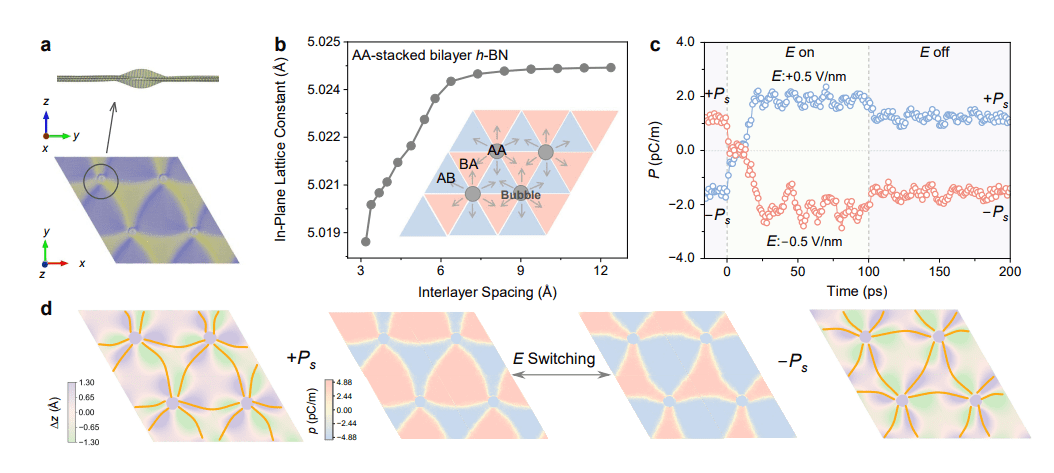
This strain-induced rippling creates spatially varying interlayer sliding and distorts the network of moiré domain walls, resulting in a unique four-state ferroelectric system. Importantly, carbon-boron defects do not induce ferroelectricity, even at higher concentrations, confirming that the observed polarization arises from a different source. Key to this discovery is the understanding of the moiré pattern, which emerges from the twisting of the two h-BN layers. The research demonstrates that buckling, or bending, of the layers is critical for polarization, with the direction of buckling influencing the polarization state. Two distinct switching mechanisms were identified: electrical switching, which reverses polarization within a fixed buckling state, and mechanical switching, which reverses the buckling direction itself, leading to a different polarization state.
Compressive Strain Drives Twisted Bilayer Ferroelectricity
Scientists demonstrate a novel mechanism driving ferroelectricity in twisted bilayer hexagonal boron nitride. The research establishes that out-of-plane bending, induced by compressive strain within the material, is the key symmetry-breaking factor. Molecular dynamics simulations reveal this strain-induced rippling creates spatially varying interlayer sliding and distorts the network of moiré domain walls, resulting in a unique four-state ferroelectric system. Experiments show that increasing compressive strain also increases the minimum electric field required to reverse polarization, indicating stronger remanent polarization accompanies higher coercivity.
Analysis of the system reveals two distinct and asymmetric hysteresis loops, corresponding to upward and downward buckled configurations, each with a corresponding switch between different polarization states. Combining electrical and mechanical stimuli allows full access to all four states, with localized force reversing the sign of the buckling and enabling switching between polar states of equal magnitude. Simulations at 300 Kelvin reveal a strong energetic preference for nanobubbles to migrate and pin at the AA stacking sites, coinciding with the local C3 rotational axes of the moiré pattern. A single nanobubble stabilizes at an AA site because it locally increases interlayer separation, reducing repulsive interactions and compressing adjacent regions. Remarkably, a moiré supercell patterned with nanobubbles supports two degenerate polar states, each featuring bent domain walls and local C3 rotational symmetry, and these states can be reversibly switched with stable remanent polarization persisting after the field is removed.
Strain-Induced Ferroelectricity and Nanoscale Control
This research establishes a clear understanding of how ferroelectricity arises in twisted bilayer materials, resolving a long-standing conflict between theoretical predictions and experimental observations. Scientists demonstrate that compressive strain within these materials induces out-of-plane rippling, which breaks the symmetry necessary for ferroelectricity. Large-scale simulations reveal that this rippling bends domain walls, stabilizing a net polarization and creating a four-state ferroelectric system. Importantly, the team discovered a method for harnessing this mechanism at the nanoscale, using nanobubbles to locally control the moiré lattice and create independently addressable ferroelectric bits.
This approach promises improved scalability and spatial resolution for ultra-high-density memory devices. Simulations of an 884556-atom supercell demonstrate spatially decoupled control of individual bits, where localized electric fields can switch the polarization of one region without affecting others. This achievement not only provides a blueprint for advanced memory technologies but also establishes a geometry-driven paradigm for manipulating the emergent correlated and topological phases within these remarkable materials. The authors suggest that future work could focus on precisely engineering these nanobubbles using trapped nanoparticles to further refine control over the moiré potential.
👉 More information
🗞 Rippled Moire Superlattices for Decoupled Ferroelectric Bits
🧠 ArXiv: https://arxiv.org/abs/2510.13568