Researchers from RIKEN, Japan, have explored the concept of two-dimensional discrete time quasicrystals (DTQCs), a type of prethermal state in quantum physics. Using the IBM Quantum Heron processor, the team studied the relaxation dynamics of these quasicrystals in a kicked Ising model. They identified a prethermal regime characterized by magnetization measurements oscillating at twice the period of the Floquet cycle.
The study enhances understanding of DTQCs and highlights the utility of digital quantum computers for simulating quantum many-body systems. The findings could open up new avenues for exploring out-of-equilibrium dynamics in quantum systems.
What are Two-Dimensional Discrete Time Quasicrystals?
Two-dimensional discrete time quasicrystals are a fascinating concept in the field of quantum physics. They are a type of prethermal state, which is a metastable state that a system may pass through before reaching thermal equilibrium. These quasicrystals are not commonly observed in equilibrium, making them an intriguing platform for exploring out-of-equilibrium dynamics.
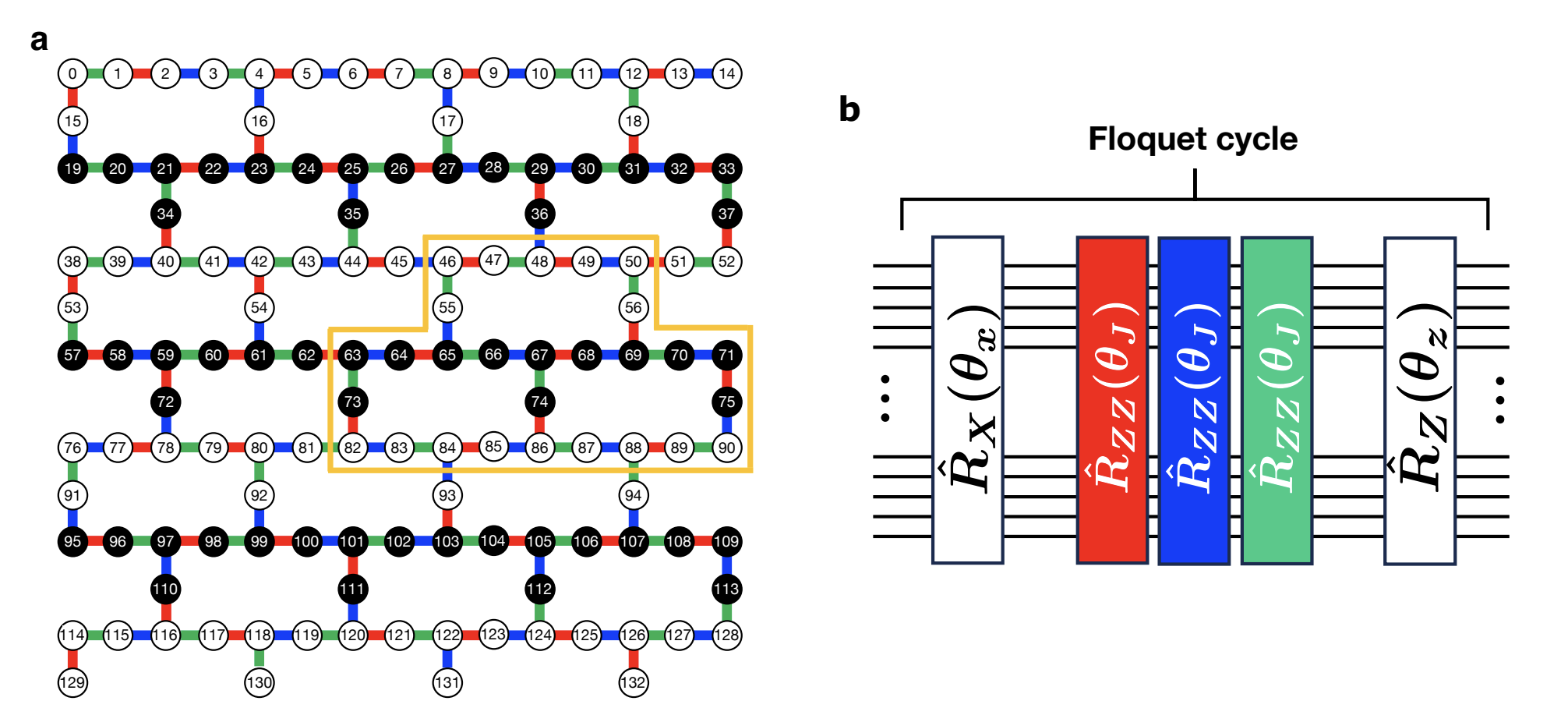
The concept of two-dimensional discrete-time quasicrystals was investigated by a team of researchers from the Computational Quantum Matter Research Team, Quantum Computational Science Research Team, Computational Materials Science Research Team, and the Computational Condensed Matter Physics Laboratory at RIKEN, Japan. The team used the IBM Quantum Heron processor, which comprises 133 superconducting qubits arranged on a heavy-hexagonal lattice, to study the relaxation dynamics of initially prepared product states under periodic driving in a kicked Ising model.
The researchers identified the presence of a prethermal regime characterized by magnetization measurements oscillating at twice the period of the Floquet cycle. They also demonstrated its robustness against perturbations to the transverse field. Their results provide evidence supporting the realization of a period-doubling discrete time crystal (DTC) in a two-dimensional system.
How are Discrete Time Quasicrystals Formed?
Discrete time quasicrystals (DTQCs) are formed in periodically driven Floquet systems. These systems host novel phases of matter that are inaccessible in thermal equilibrium. Notably, discrete time crystals (DTCs) represent genuine out-of-equilibrium phases of matter feasible in Floquet systems. A DTC is characterized by subharmonic responses breaking discrete time-translational symmetry imposed by the periodic drive.
However, sustaining DTCs as transient metastable states faces challenges due to thermalization, where many-body interactions drive low-entangled states to highly entangled high-energy states. Overcoming this obstacle requires imparting a many-body localized nature to the dynamics. One strategy to circumvent rapid thermalization in driven systems is by introducing disorder in the Floquet Hamiltonian, inducing many-body localization (MBL) to break ergodicity.
What is the Role of Digital Quantum Computers in Studying DTQCs?
Digital quantum computers play a crucial role in studying the dynamics of quantum many-body systems, including DTCs and DTQCs. Recent advancements in noisy intermediate-scale quantum devices have introduced digital quantum computers as another tool to investigate out-of-equilibrium phases of matter.
In the study conducted by the RIKEN team, they used an IBM Quantum Heron processor to simulate the dynamics of a kicked Ising model on a 133-qubit system. They applied periodic driving to initial product states in the model, involving both transverse and longitudinal fields, and measured local magnetization to observe its subharmonic response. The results were validated by showing agreement with both tensor-network simulations of the 133-qubit system and state-vector simulations of a 28-qubit system for up to 50 time steps.
What are the Findings and Implications of the Study?
The study’s findings not only enhance our understanding of clean DTCs in two dimensions but also highlight the utility of digital quantum computers for simulating the dynamics of quantum many-body systems. The researchers observed a subharmonic period-doubling response of local magnetization persisting for at least 100 time steps, confirming its stability against perturbations to the transverse field. This provides evidence for the realization of clean DTCs in two dimensions.
Furthermore, they observed other longer-period subharmonic responses with frequencies incommensurate with the driving period, thus identified as discrete time quasicrystals (DTQCs). These observations are further validated through comparison with tensor-network and state-vector simulations. The findings address challenges faced by state-of-the-art classical simulations and open up new avenues for exploring out-of-equilibrium dynamics in quantum systems.
What is the Future of Quantum Many-Body Systems Research?
The research on quantum many-body systems, particularly on DTCs and DTQCs, is still in its early stages. However, the findings of the RIKEN team provide a promising direction for future studies. The realization of clean DTCs in two dimensions and the identification of DTQCs are significant milestones in the field.
The use of digital quantum computers for simulating the dynamics of quantum many-body systems also presents exciting possibilities. As quantum computing technology continues to advance, it is expected to play an increasingly important role in exploring novel phases of matter and out-of-equilibrium dynamics. The findings also highlight the need for further research to fully understand the properties and potential applications of DTCs and DTQCs.
Publication details: “Unveiling clean two-dimensional discrete time quasicrystals on a digital
quantum computer”
Publication Date: 2024-03-25
Authors: Kazuya Shinjo, Koh‐ichi Seki, Tomonori Shirakawa, Rong-Yang Sun, et al.
Source: arXiv (Cornell University)
DOI: https://doi.org/10.48550/arxiv.2403.16718