
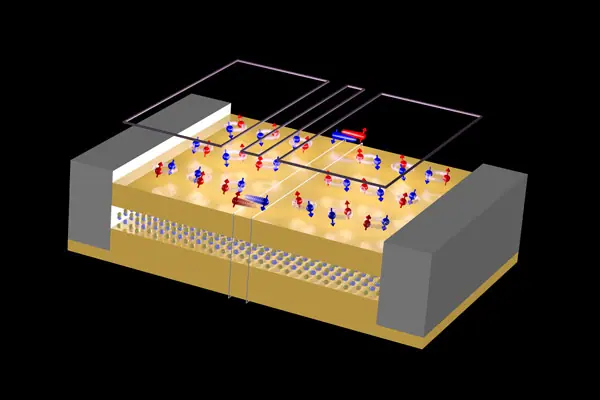
Physicists at RIKEN and Fujitsu, led by Michael Randle, have developed a 2D electronic quantum device that could be useful for quantum computation. The device, a Josephson junction, is made entirely from a single crystal of monolayer 2D tungsten telluride, a material known to be a quantum spin Hall insulator.
This material exhibits different properties when reduced to an ultrathin layer, giving rise to exotic states that could be harnessed in electronic devices. The team’s work provides a framework for understanding complex superconductivity in 2D systems, but further research is needed to fully realise the potential of these systems.
Quantum Sandwich: A New Development in Quantum Computation
Physicists at RIKEN, a Japanese research institute, have developed a quantum device that hosts unusual states of matter, which could one day be useful for quantum computation. The device, known as a Josephson junction, is made entirely from a single 2D material, a quantum spin Hall insulator. This development is significant because when a material exists as an ultrathin layer, it has different properties from thicker samples of the same material.
The Role of 2D Materials in Quantum Computation
2D materials, which are only a few atoms thick, have unique properties due to the confinement of electrons to a 2D plane. This gives rise to exotic states, including quantum spin Hall insulators, which conduct electricity along their edges but electrically insulate in their interiors. These materials are promising for harnessing new phenomena in electronic devices, particularly in the field of quantum computation.
The Creation of a 2D Josephson Junction
The team at RIKEN, led by Michael Randle and including collaborators from Fujitsu, created a 2D Josephson junction using a single crystal of monolayer 2D tungsten telluride. This material was previously shown to exhibit both a superconducting state and a quantum spin Hall insulator state. The team fabricated the junction entirely from monolayer tungsten telluride, exploiting its ability to be tuned into and out of the superconducting state using electrostatic gating.
The Challenges and Future Steps
While this development provides a framework for understanding complex superconductivity in 2D systems, further work is required to clearly identify the more exotic physics the systems promise. One of the challenges is that tungsten telluride is difficult to process into devices due to the rapid oxidization of its surface under ambient conditions. This requires all fabrication to be performed in an inert environment.
The Next Steps in Quantum Computation
The next step in this research involves the implementation of ultraflat pre-patterned gate structures using techniques such as chemical–mechanical polishing. If this is achieved, the team hopes to form Josephson junctions with precisely tailored geometries and to use their cutting-edge microwave resonator experiment techniques to observe and investigate the exciting topological nature of the devices. This could potentially open up new avenues in the field of quantum computation as a qubit for example, the heart of a quantum computer.
“We fabricated the junction entirely from monolayer tungsten telluride,” says Randle. “We did this by exploiting its ability to be tuned into and out of the superconducting state using electrostatic gating.”
“The next step involves the implementation of ultra flat pre-patterned gate structures by using, for example, chemical–mechanical polishing,” explains Randle. “If this is achieved, we hope to form Josephson junctions with precisely tailored geometries and to use our cutting-edge microwave resonator experiment techniques to observe and investigate the exciting topological nature of the devices.”
Summary
Physicists at RIKEN have developed an electronic device using a single 2D material, which could potentially be used in quantum computation. The device, a 2D Josephson junction, was created from a single crystal of monolayer 2D tungsten telluride, a material known to exhibit both a superconducting state and a quantum spin Hall insulator state, which could be key in harnessing new phenomena in electronic devices.
- In collaboration with Fujitsu, Physicists at RIKEN have developed an electronic device that could be useful for quantum computation.
- The device, known as a 2D Josephson junction, is made entirely from a single material, tungsten telluride, which exhibits both a superconducting state and a quantum spin Hall insulator state.
- The team, led by Michael Randle, exploited the material’s ability to be tuned into and out of the superconducting state using electrostatic gating.
- The device was connected using thin palladium layers to the sides of a tungsten telluride layer, surrounded and protected by boron nitride.
- The team observed an interference pattern when measuring the sample’s magnetic response, characteristic of a Josephson junction with 2D superconducting leads.
- The next step involves implementing ultra flat pre-patterned gate structures to form Josephson junctions with precisely tailored geometries.
- However, tungsten telluride is difficult to process into devices due to rapid oxidisation under ambient conditions, requiring all fabrication to be performed in an inert environment.