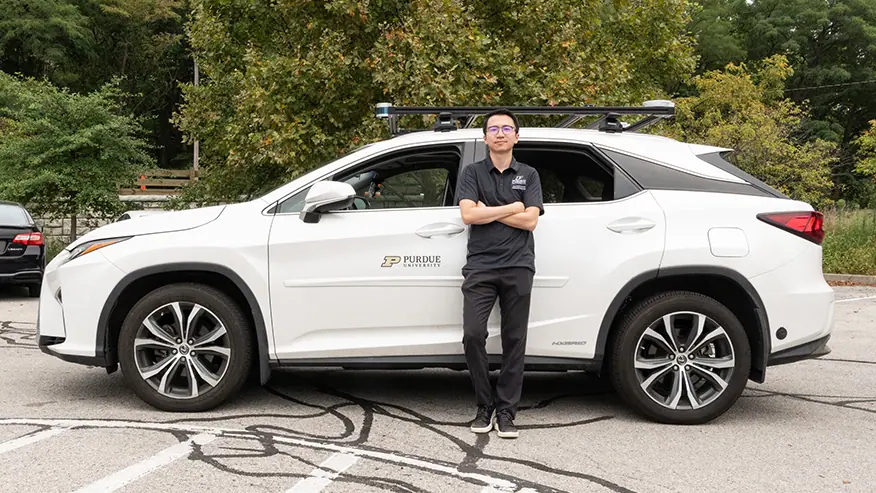
Researchers at Purdue University have made significant progress in integrating large language models into autonomous vehicles (AVs). Led by Wang, a team of researchers tested the ability of AVs to respond to voice commands using large language models like ChatGPT. The results showed that the AV outperformed all baseline values, even when responding to commands it hadn’t already learned.
The study found that the AV allowed for an average of 1.6 seconds to process a passenger’s command, which is considered acceptable in non-time-critical scenarios. However, this response time needs to be improved for situations where the AV needs to respond faster. Toyota Motor North America supported the experiments through gift funding. The researchers are now exploring other large language models, such as Google’s Gemini and Meta’s Llama AI assistants, and studying their use in extreme winter weather conditions.
In a groundbreaking study, researchers from Purdue University have successfully integrated large language models into an autonomous vehicle (AV), resulting in improved safety and comfort for passengers. The innovative approach leverages the capabilities of advanced language models, such as ChatGPT, to enhance the decision-making process of AVs.
The research team, led by Dr. Wang, conducted experiments where participants sat in the driver’s seat of a test autonomous vehicle and provided voice commands, while a researcher monitored the large language models and camera feeds from the backseat. The results showed that passengers expressed lower discomfort rates with the decisions made by the AV compared to traditional level four AVs without language model assistance.
Moreover, the study found that the AV outperformed baseline values for safe and comfortable rides, including reaction times and acceleration/deceleration rates. This achievement demonstrates the potential of large language models in improving the overall driving experience.
However, the researchers acknowledge that there are still challenges to overcome before integrating these models into commercial AVs. For instance, large language models can “hallucinate” or misinterpret learned information, leading to incorrect responses. Additionally, processing times need to be improved for time-critical scenarios.
To address these concerns, Wang’s team is continuing their research, evaluating other public and private chatbots based on large language models. They are also exploring the possibility of enabling AVs to communicate with each other, such as at four-way stops, and studying the use of large vision models to aid driving in extreme weather conditions.
Toyota Motor North America supported the study, which has implications for the development of safer and more efficient autonomous vehicles. As the industry continues to advance, this breakthrough could pave the way for a new generation of AVs that prioritize passenger comfort and safety.
External Link: Click Here For More