

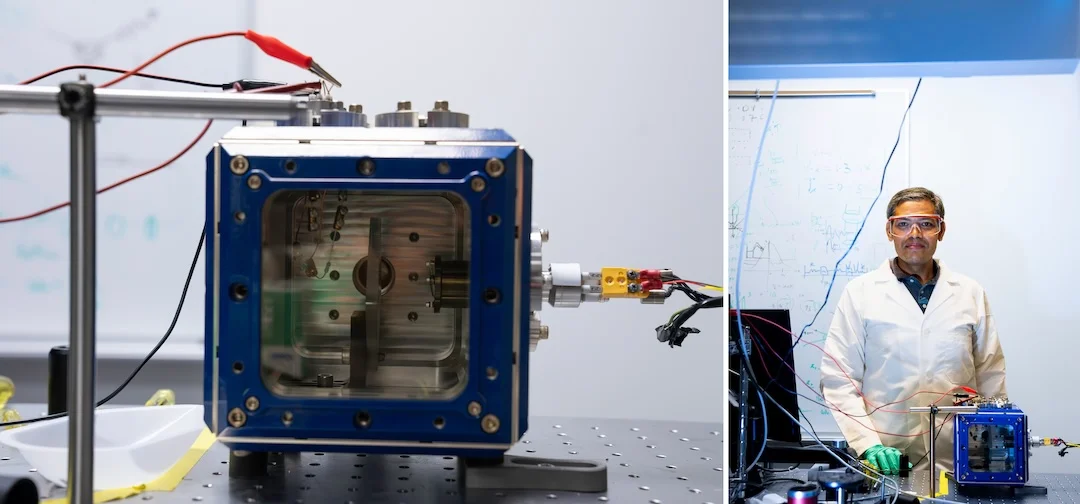
Researchers at Rice University have made a breakthrough in thermophotovoltaic (TPV) systems, which convert heat into electricity via light. Led by engineer Gururaj Naik and his former Ph.D. student Ciril Samuel Prasad, now a postdoctoral research associate at Oak Ridge National Laboratory, the team has designed a thermal emitter to deliver high efficiencies within practical design parameters. This innovation could inform the development of thermal-energy electrical storage, a promising alternative to batteries for grid-scale energy storage.
Efficient TPV technologies could also facilitate renewable energy growth and recoup waste heat from industrial processes, making them more sustainable. The new thermal emitter, composed of a tungsten metal sheet, a thin layer of spacer material, and a network of silicon nanocylinders, promises efficiencies of over 60%. This achievement has significant implications for industries that generate large amounts of waste heat, such as nuclear power plants and manufacturing facilities, and could also be used in space applications like powering rovers on Mars.
Quantum-Inspired Design Boosts Efficiency of Heat-to-Electricity Conversion
Researchers at Rice University have made a significant breakthrough in thermophotovoltaic (TPV) systems, which convert heat into electricity via light. By taking an unconventional approach inspired by quantum physics, the team has designed a thermal emitter to deliver high efficiencies within practical design parameters.
The TPV system involves two main components: photovoltaic (PV) cells that convert light into electricity and thermal emitters that turn heat into light. While efforts to optimize these components have focused more on the PV cell, the Rice University researchers have demonstrated a new thermal emitter that promises efficiencies of over 60%. This achievement has significant implications for industries that generate large amounts of waste heat, such as nuclear power plants and manufacturing facilities.
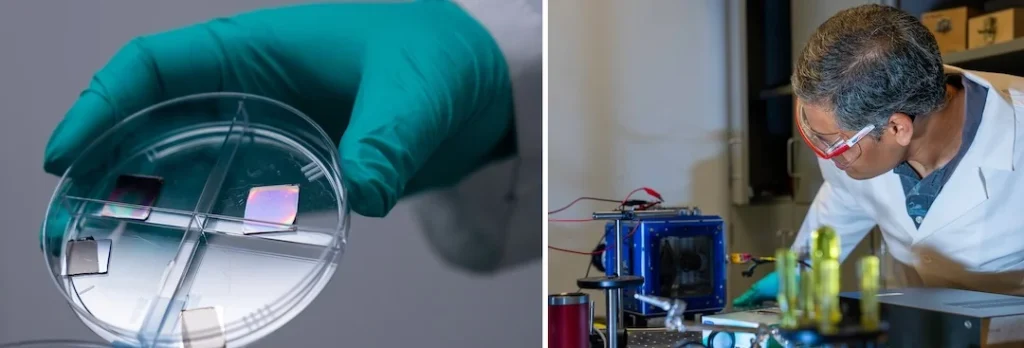
The new thermal emitter comprises a tungsten metal sheet, a thin layer of a spacer material, and a network of silicon nanocylinders. When heated, the base layers accumulate thermal radiation, which can be considered a bath of photons. The tiny resonators sitting on top “talk” to each other in a way that allows them to “pluck photon by photon” from this bath, controlling the brightness and bandwidth of the light sent to the PV cell.
Unconventional Approach Inspired by Quantum Physics
The researchers’ unconventional approach was inspired by quantum physics. Instead of focusing on the performance of single-resonator systems, they considered how these resonators interact, which opened up new possibilities. This gave them control over the photons’ storage and release, allowing for selective emission that maximizes energy conversion.
This selective emission, achieved through insights from quantum physics, allows for higher efficiencies than previously possible, operating at the limit of the materials’ properties. To improve on the newly achieved 60% efficiency, new materials with better properties would need to be developed or discovered.
Implications for Energy Storage and Conversion
The gains made by the Rice University researchers could make TPV a competitive alternative to other energy storage and conversion technologies like lithium-ion batteries, particularly in scenarios where long-term energy storage is needed. The innovation has significant implications for industries that generate large amounts of waste heat, such as nuclear power plants and manufacturing facilities.
Moreover, the technology could also be used in space applications such as powering rovers on Mars. If the approach could increase efficiency from 2% to 5% in such systems, that would represent a significant boost for missions that rely on efficient power generation in extreme environments.
Potential Applications and Future Directions
The research has significant implications for developing thermal-energy electrical storage, which holds promise as an affordable, grid-scale alternative to batteries. More broadly, efficient TPV technologies could facilitate renewable energy growth, an essential component of the transition to a net-zero world.
In addition, the technology could be used to recoup waste heat from industrial processes, making them more sustainable. Up to 20-50% of the heat used to transform raw materials into consumer goods ends up being wasted, costing the United States economy over $200 billion annually.
The researchers’ approach has opened up new possibilities for TPV systems, and future directions could involve exploring new materials with better properties or developing more efficient PV cells. As the team’s technology continues to evolve, it is likely to have a significant impact on various industries and applications.
External Link: Click Here For More


