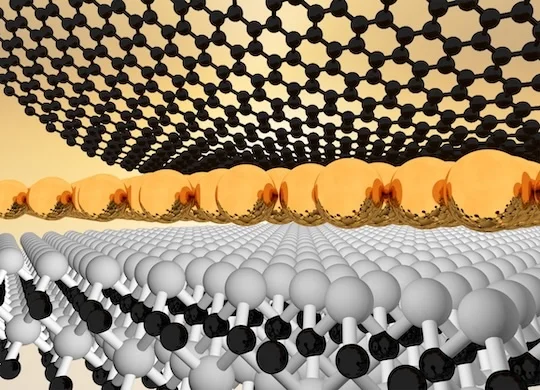
Researchers at Rice University, led by an unspecified team, have demonstrated a strong form of quantum interference between phonons – the vibrational quanta of heat or sound – achieving Fano resonance with an interference magnitude two orders of magnitude greater than previously reported, as published in Science Advances. This was accomplished through confinement heteroepitaxy, intercalating few-layer silver between graphene and silicon carbide to create a tightly bound interface, triggering and strengthening interference between vibrational modes; Raman spectroscopy revealed sharply asymmetric line shapes and antiresonance patterns characteristic of intense interference, demonstrating high sensitivity to silicon carbide surface terminations and single dye molecule presence, enabling label-free single-molecule detection. The observed phonon-only quantum interference, confirmed through low-temperature experiments excluding electron contributions, is specific to this 2D metal/silicon carbide system and is not observed in bulk metals, with exploration of alternative 2D metals like gallium or indium suggesting potential for tailored quantum properties through compositional fine-tuning, offering a potentially simpler and more sensitive sensing method compared to conventional techniques.
Phonon Interference Discovery
Researchers at Rice University, in collaboration with affiliated institutions, have demonstrated a substantial enhancement of phonon interference, a phenomenon known as Fano resonance, exceeding previously reported levels by two orders of magnitude. The findings, published in Science Advances, detail the observation of strong interference between phonons – the quantized vibrational modes within a material representing units of heat or sound – and represent a significant step towards harnessing phonons for advanced technologies. This interference, analogous to wave interference observed with light or sound, holds promise for applications in quantum sensing and molecular detection. The experimental setup involved a meticulously crafted two-dimensional metal layer – specifically, several layers of silver – intercalated between graphene and a silicon carbide substrate. This configuration, achieved through a technique termed confinement heteroepitaxy, creates a tightly bound interface exhibiting remarkable quantum properties. The silver layer serves to trigger and amplify the interference between different vibrational modes within the silicon carbide, leading to the observed record levels of interference. The researchers employed Raman spectroscopy, a technique measuring vibrational modes, which opens avenues for highly sensitive sensing applications. Crucially, the researchers rigorously confirmed that the observed interference originates solely from phonon interactions, excluding any contribution from electronic processes. This was established through low-temperature experiments, where electronic effects are suppressed, and the phonon interference remains prominent. This distinction is vital, as many materials exhibit both electronic and vibrational excitations, making it challenging to isolate the contribution -based quantum technologies, and the ongoing research by [researcher names and affiliations] is expected to further refine and expand these capabilities.
More information
External Link: Click Here For More