

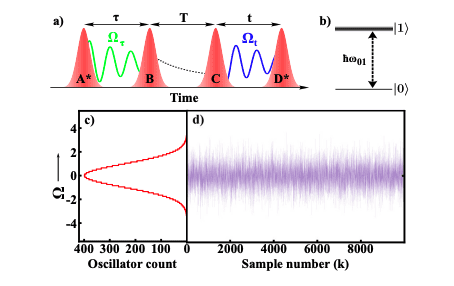
On April 11, 2025, researchers led by Bhaskar De published Quantitative Lineshape Analysis for Arbitrary Inhomogeneity in Two-Dimensional Coherent Spectroscopy, introducing a novel method to analyze non-Gaussian inhomogeneity in quantum materials. Their framework, demonstrated using GaAs wells, expands the capabilities of two-dimensional coherent spectroscopy for studying complex systems with arbitrary linewidth distributions.
Two-dimensional coherent spectroscopy (2DCS) enables simultaneous measurement of homogeneous and inhomogeneous linewidths via lineshape analysis. Conventional methods assume Gaussian inhomogeneity, limiting their use for non-Gaussian systems. Researchers developed a new quantitative approach incorporating arbitrary inhomogeneity using a bivariate spectral distribution function in 2DCS simulations. An algorithm extracts homogeneous linewidths and arbitrary inhomogeneous distributions from experimental 2D spectra. This method was validated on GaAs wells with non-Gaussian inhomogeneity, broadening the scope of lineshape analysis for systems with complex inhomogeneity.
In the field of quantum materials research, scientists have long sought more accurate methods to study the intricate electronic properties of these materials. These properties are pivotal for emerging technologies such as quantum computing and advanced semiconductors. However, a significant challenge has been the issue of inhomogeneous broadening, which refers to variations in energy levels among particles within the material, complicating precise measurements.
A novel method addresses this challenge through two-dimensional coherent spectroscopy. This technique captures detailed information about energy transitions, offering a more comprehensive view than previous methods that often struggled with the complexities of inhomogeneous broadening. The method involves analyzing cross-diagonal slices of 2D spectra, which allows researchers to extract specific data points.
Instead of relying on Gaussian distributions, which assume symmetry and certain statistical properties, this approach employs arbitrary functions. This shift is advantageous because real-world data may not always conform neatly to Gaussian curves, enabling more precise modelling. Key findings from this research include improved agreement between simulations and experiments when using the new method. It also uncovers previously unnoticed correlations in energy transitions, enhancing our understanding of quantum materials.
These insights are crucial for developing accurate models essential for technological advancements. While the specifics of how cross-diagonal slices work remain somewhat technical, the broader impact is clear: this method provides a more precise tool for studying quantum materials. The potential applications extend beyond spectroscopy, hinting at improvements in areas like semiconductors and qubits for quantum computing.
In conclusion, this research marks a significant step forward by offering enhanced precision in studying complex materials. It underscores the importance of detailed spectroscopy and accurate modeling, which are critical for advancing quantum technologies and understanding material behavior more clearly.
👉 More information
🗞 Quantitative Lineshape Analysis for Arbitrary Inhomogeneity in Two-Dimensional Coherent Spectroscopy
🧠 DOI: https://doi.org/10.48550/arXiv.2504.08297


