

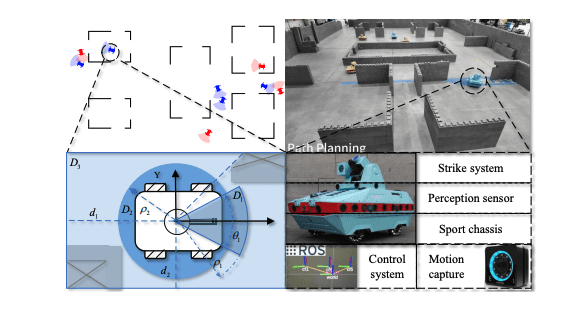
On April 23, 2025, researchers Qizhen Wu, Lei Chen, Kexin Liu, and Jinhu Lü published Bidirectional Task-Motion Planning Based on Hierarchical Reinforcement Learning for Strategic Confrontation, addressing the inefficiencies of traditional task-motion planning methods. Their novel approach integrates bidirectional hierarchical reinforcement learning to enhance adaptability in dynamic environments, achieving a 80% win rate and sub-0.01 second decision times, demonstrating significant advancements in robotics efficiency.
The study addresses decision-making in swarm robotics during confrontation scenarios by proposing a bidirectional hierarchical reinforcement learning approach. This method integrates task allocation and path planning dynamically, overcoming the limitations of traditional unidirectional methods. A trajectory prediction model bridges abstract tasks with actionable plans. Experimental results demonstrate an over 80% win rate and under 0.01 seconds of decision time, outperforming existing approaches. Large-scale tests validate the method’s adaptability and practicality in dynamic environments.
Recent advancements in robotics are revolutionizing the field by enabling machines to perform complex tasks with unprecedented precision and adaptability. Researchers have integrated cutting-edge algorithms, such as hierarchical reinforcement learning and swarm intelligence, to push the boundaries of what robots can achieve. These innovations are transforming industries and preparing robots for operation in dynamic and unpredictable environments.
A significant breakthrough in robotics is the development of hierarchical reinforcement learning (HRL). This method allows robots to decompose complex tasks into smaller, manageable sub-tasks, enhancing their ability to learn and adapt efficiently. For example, bipedal robots can use HRL to master agile movements by first learning basic motions before progressing to more advanced skills.
This approach has been successfully applied in real-world scenarios, such as drone racing, where robots must navigate through cluttered environments at high speeds. By combining reinforcement learning with proactive model predictive control, drones can predict human motion and adjust their trajectories in real time, achieving near-champion-level performance.
Another notable advancement is the use of swarm intelligence, which enables groups of robots to operate as a cohesive unit without centralized control. Inspired by natural phenomena such as bird flocking or ant colonies, this approach allows swarms of unmanned aerial vehicles (UAVs) to coordinate their actions effectively.
Researchers have developed algorithms, such as hierarchical attention actor-critic, to enhance the decision-making capabilities of large-scale UAV swarms. This innovation has significant implications for applications like search and rescue missions, where swarms can quickly locate targets in challenging environments.
The integration of these technologies is already yielding impressive results. For instance, bipedal robots equipped with deep reinforcement learning have demonstrated the ability to perform complex tasks, including balancing and obstacle navigation, with unprecedented accuracy. Similarly, UAV swarms have shown remarkable potential in surveillance, environmental monitoring, and disaster response.
Despite these advancements, challenges remain. Researchers must address issues such as energy efficiency, scalability, and ethical considerations to ensure responsible deployment of these technologies. Additionally, the development of more robust algorithms will be crucial for enabling robots to operate in even more complex and unpredictable environments.
👉 More information
🗞 Bidirectional Task-Motion Planning Based on Hierarchical Reinforcement Learning for Strategic Confrontation
🧠 DOI: https://doi.org/10.48550/arXiv.2504.15876


