

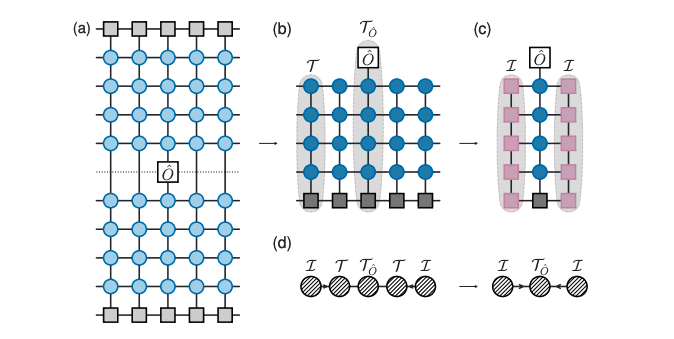
On April 9, 2025, a study titled “Simulating quantum dynamics in two-dimensional lattices with tensor network influence functional belief propagation” was published. The research introduced a novel method that combines tensor networks with belief propagation to efficiently simulate quantum systems in two dimensions. This approach addresses challenges related to entanglement and demonstrates improved performance over existing techniques through numerical experiments on specific models, such as the kicked Ising model and the 2D transverse field Ising model.
The study extends the tensor network influence functional (TN-IF) method to simulate local observable dynamics on two-dimensional lattices using a belief propagation algorithm (IF-BP). While IF-BP introduces approximations on arbitrary graphs, it accurately captures long-time dynamics for locally tree-like structures. Numerical simulations of the kicked Ising model demonstrate superior performance compared to traditional tensor network methods. The temporal entanglement entropy grows logarithmically with time, enabling polynomial-cost computations. A cluster expansion of IF-BP further improves accuracy by incorporating loop correlations, as shown in quench dynamics simulations of the 2D transverse field Ising model.
Quantum computing has emerged as a transformative field with the potential to revolutionize various industries, from cryptography to drug discovery. Recent advancements have brought us closer to realizing the practical applications of quantum technologies. This article explores key developments in error correction, simulation capabilities, algorithm design, and experimental progress, highlighting how these innovations are shaping the future of quantum computing.
One of the most significant challenges in quantum
One of the most significant challenges in quantum computing is maintaining the integrity of quantum states amidst environmental interference. Researchers have made strides in developing robust error correction techniques that enhance the reliability of quantum computations. These methods involve sophisticated protocols that detect and correct errors without disrupting the delicate quantum state, thereby improving the accuracy of results.
Quantum computers excel at simulating complex quantum systems, which are often intractable for classical computers. Recent studies have demonstrated the ability to simulate intricate chemical reactions and materials with unprecedented precision. These simulations provide insights into molecular structures and electronic properties, paving the way for advancements in chemistry and materials science.
Developing efficient quantum algorithms is crucial for harnessing the power of quantum computing. Researchers have introduced novel algorithms tailored for specific tasks, such as optimization problems and database searches. These algorithms leverage quantum parallelism to offer exponential speedups over classical counterparts, making them invaluable for solving complex real-world challenges.
Experimental progress has been remarkable, with quantum processors achieving higher qubit counts and improved coherence times. Notable experiments have showcased the ability to perform error-corrected computations at scale, demonstrating practical utility beyond theoretical models. These achievements underscore the rapid evolution of quantum hardware and its readiness for real-world applications.
The convergence of these advancements positions quantum computing
The convergence of these advancements positions quantum computing as a disruptive force across multiple sectors. As error correction becomes more efficient and algorithms grow in complexity, we can anticipate breakthroughs in fields ranging from artificial intelligence to healthcare. The continued development of robust quantum systems will be pivotal in unlocking their full potential and driving innovation in the years to come.
🗞 Simulating quantum dynamics in two-dimensional lattices with tensor network influence functional belief propagation
🧠 DOI: https://doi.org/10.48550/arXiv.2504.07344


