
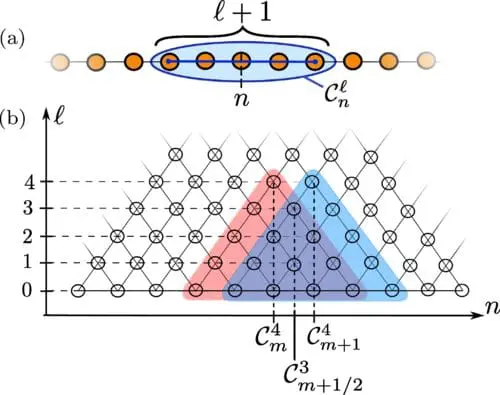
Simulating many-body quantum systems is a significant challenge due to the rapid spread of entanglement, which induces quantum correlations that cannot be broken down into local parts. A local-information approach for time evolution, however, can address this issue by removing large-scale quantum information while preserving local observables. This approach uses an information lattice to organize quantum information into different scales, allowing for the systematic discarding of long-range quantum correlations. The resulting algorithm, local-information time evolution, could have significant implications for the study of quantum dynamics.
What is the Challenge with Simulating Many-Body Quantum Systems?
The simulation of many-body quantum systems presents a significant challenge, often limiting the analysis to small-scale systems. The obstacle lies in the rapid spreading of entanglement through the system during time evolution. Entanglement can induce quantum correlations between arbitrarily distant-in-space degrees of freedom that cannot be decomposed into local parts. The exact representation of generic quantum states demands an exponentially large number of parameters. This is related to the exponential growth of the Hilbert space with the system size. However, for states exhibiting solely local correlations such as local product states or Gibbs states, efficient representation becomes feasible. This efficiency stems from the possibility of parametrizing them exclusively through local observables. Notably, the parametrization of the local observables entails a linear growth of the number of parameters with the system size, ensuring scalability.
How Does the Local-Information Approach Address This Challenge?
The local-information approach for time evolution, introduced in a previous study, addresses this challenge. Central to this approach is the fundamental question: how does the emergence of long-range entanglement during time evolution affect local observables? The researchers found that quantum information tends to flow towards larger scales without returning to local scales. This means that its detailed large-scale structure does not directly affect local observables. This allows for the removal of large-scale quantum information in a way that preserves all local observables and gives access to large-scale and large-time quantum dynamics.
What is the Information Lattice and How Does It Help?
The researchers used the recently introduced information lattice to organize quantum information into different scales. This allowed them to define local information and information currents. They employed these to systematically discard long-range quantum correlations in a controlled way. Their approach relies on decomposing the system into subsystems up to a maximum scale and time evolving the subsystem density matrices by solving the subsystem von Neumann equations in parallel. Importantly, the information flow needs to be preserved during the discarding of large-scale information.
How is Large-Scale Information Discarded Without Making Assumptions?
To discard large-scale information without making assumptions about the microscopic details of the information current, the researchers introduced a second scale at which information is discarded. They used the state at the maximum scale to accurately obtain the information flow. The resulting algorithm, which they call local-information time evolution, is highly versatile and suitable for investigating many-body quantum dynamics in both closed and open quantum systems with diverse hydrodynamic behaviors.
What are the Potential Applications of This Research?
The researchers presented results for the energy transport in the mixed-field Ising model and the magnetization transport in the XX-spin chain with onsite dephasing. They accurately determined the power-law exponent and the diffusion coefficients. Furthermore, the information lattice framework employed in this research promises to offer insightful results about the spatial and temporal behavior of entanglement in many-body systems. This could have significant implications for the study and understanding of quantum dynamics.
Publication Date: 2024-06-04
Authors: Claudia Artiaco, Christoph Fleckenstein, David Aceituno Chávez, Thomas Klein Kvorning, et al.
Source: PRX Quantum 5, 020352
DOI: https://doi.org/10.1103/PRXQuantum.5.020352