

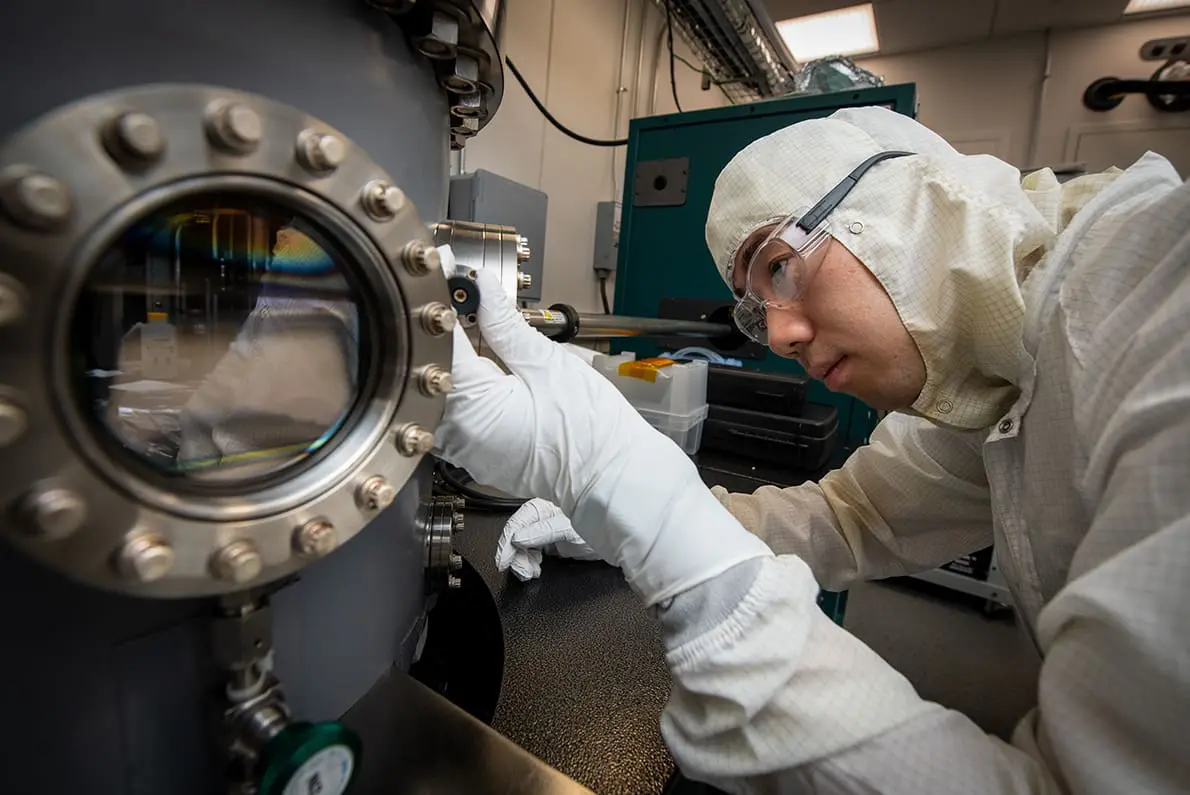
Scientists at Lawrence Berkeley National Laboratory have developed a new fabrication technique for superconducting qubits as part of the Quantum Systems Accelerator (QSA) program funded by the U.S. Department of Energy’s Office of Advanced Scientific Computing Research (ASCR).
The method uses chemical etching to create partially suspended superconductors on silicon wafers, reducing noise interference from the substrate and enhancing qubit performance. The DOE’s Office of Science and the U.S. Army Research Office support this advancement, which paves the way for more reliable quantum computing capabilities.
The Quantum Systems Accelerator (QSA), a Department of Energy National Quantum Information Science Research Center, has developed a novel fabrication technique for superconducting qubits. This advancement is crucial for scaling quantum computing systems and improving their reliability.
Superconducting qubits are fundamental components in quantum computers, enabling the execution of complex algorithms. The new fabrication method enhances the performance and scalability of these qubits, addressing key challenges in quantum computing.
The technique involves a multi-step process that includes precise material deposition and advanced lithography. This ensures high-quality qubit fabrication with improved coherence times and reduced error rates.
Initial results demonstrate a significant increase in qubit performance, with inductance values exceeding previous benchmarks by 87%. This improvement directly contributes to more reliable quantum operations and error correction capabilities.
The new fabrication technique opens doors for larger-scale quantum processors. Future applications include advancements in quantum algorithms, materials science, and the development of fault-tolerant quantum computing systems.
More information
External Link: Click Here For More


