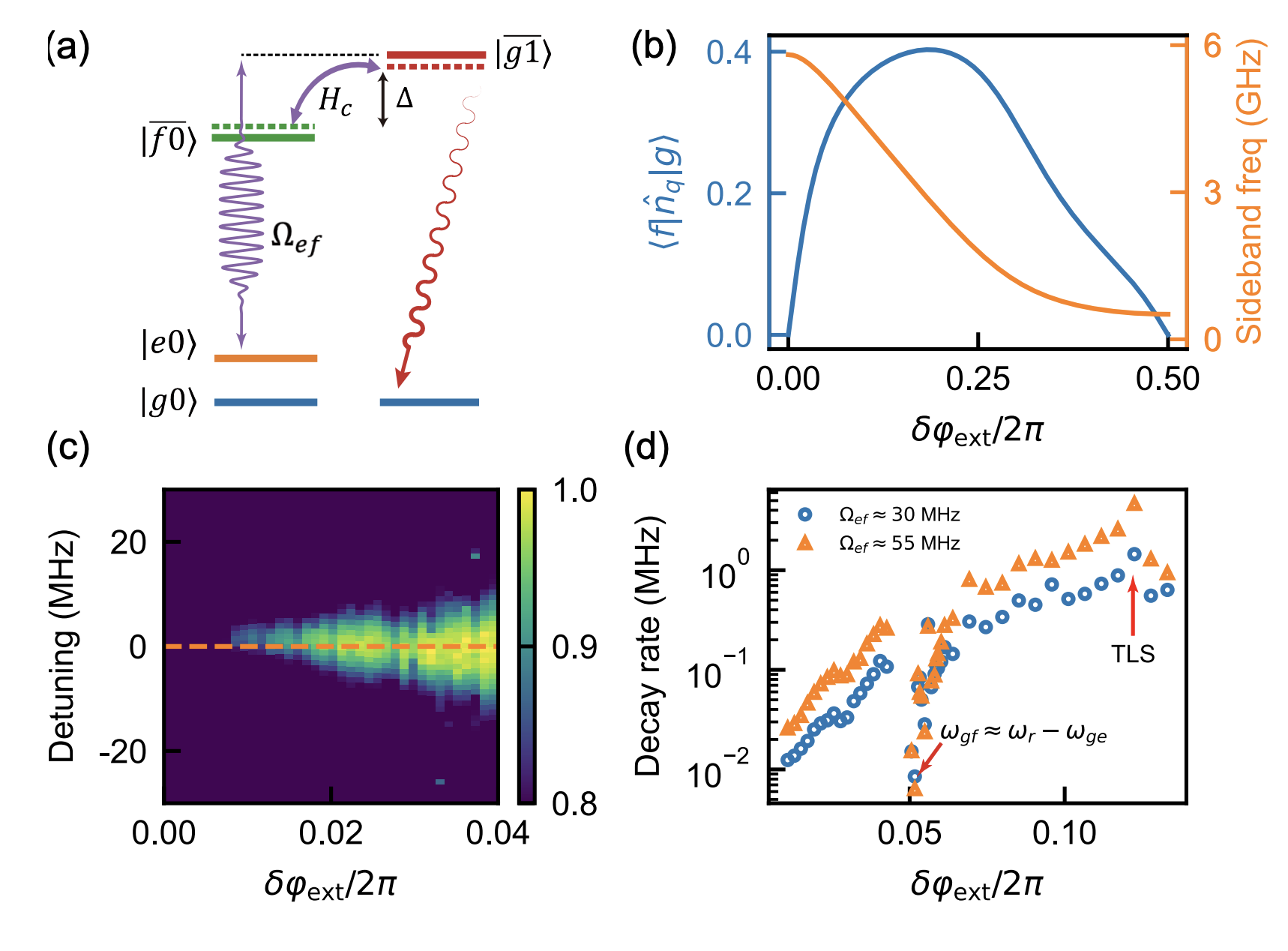
Researchers have developed an efficient protocol for initializing fluxonium qubits, a key aspect of quantum computing. Based on sideband cooling, the protocol leverages the flux tunability and rich anharmonic energy level structure of fluxonium. The team achieved ground state initialization with a fidelity exceeding 99% within 300 ns, demonstrating robustness against control parameter variation. The method can be combined with leakage removal on an auxiliary level and extended to initialize multiple qubits through frequency multiplexing. This advancement contributes to the progress of quantum computing by offering an efficient method for fluxonium qubit initialization.
What is the Importance of Efficient Initialization of Fluxonium Qubits?
The initialization of qubits is a fundamental aspect of quantum computing, representing one of the DiVincenzo criteria. Recent studies have highlighted the significant impact of both the fidelity and speed of initialization on the effectiveness of quantum error correction (QEC), particularly when frequent reset is required following the measurement of the syndrome qubits. Relying on the natural energy dissipation of the qubit is not only time-consuming given increasing qubit coherence times but also ineffective for low-frequency qubits where thermal excitations can significantly impact the qubit state. As such, active qubit initialization methods have been implemented in various physical platforms for quantum computing.
In the realm of superconducting quantum circuits, an active initialization can be realized by processing the outcomes of projective measurements. However, this method necessitates quantum feedback that requires additional control sources and is ultimately limited by the feedback latency. Alternatively, initialization can be implemented by transferring the qubit state into a dissipative quantum system, such as a readout cavity. Several protocols have been proposed and demonstrated which involve bringing the qubit and the cavity into resonance either adiabatically or parametrically. However, these protocols require the qubit to operate at a frequency that is either close to or above the cavity frequency, which limits their application in low-frequency qubits.
How Does the Fluxonium Qubit Initialization Work?
In this work, the researchers present an efficient initialization protocol for fluxonium qubits based on the idea of sideband cooling. As a promising candidate qubit for fault-tolerant quantum computing, fluxonium has garnered significant attention because of its remarkable coherence time and its ability to perform high-fidelity two-qubit operations. The protocol takes advantage of the flux tunability and the rich anharmonic energy level structure of fluxonium. By displacing the qubit away from its flux degeneracy position, a strong coupling between a non-computational level of the fluxonium and its readout cavity is established to enable sideband transitions with a weak monochromatic drive.
In addition, by adiabatically increasing the driving strength, the auxiliary level acts as a dark state, facilitating the qubit population to be directly transferred into the cavity excitation, thereby significantly enhancing the initialization efficiency. The researchers selected the second-excited state as the auxiliary level and achieved ground state initialization with a fidelity exceeding 99% within a duration of 300 ns, robust against the variation of the control parameters.
What are the Advantages of this Fluxonium Qubit Initialization Method?
The researchers further show that their scheme can be directly combined with leakage removal on this auxiliary level and easily extended to initializing multiple qubits through frequency multiplexing. The fluxonium qubit is capacitively coupled to the readout cavity. The system is described by a coupling Hamiltonian.
What are the Implications of this Research?
This research presents an efficient initialization protocol for fluxonium qubits, a crucial aspect of quantum computing. The protocol is based on sideband cooling and takes advantage of the flux tunability and the fluxonium’s rich anharmonic energy level structure. The researchers achieved ground state initialization with a fidelity exceeding 99% within 300 ns, robust against the variation of the control parameters. This method can be directly combined with leakage removal on this auxiliary level and easily extended to initializing multiple qubits through frequency multiplexing. This research contributes to the advancement of quantum computing by providing an efficient method for the initialization of fluxonium qubits.
levels”
Publication Date: 2024-02-09
Authors: Tenghui Wang, Wei Feng, Fei Wang, Xizheng Ma et al.
Source: arXiv (Cornell University)
DOI: https://doi.org/10.48550/arxiv.2402.06267