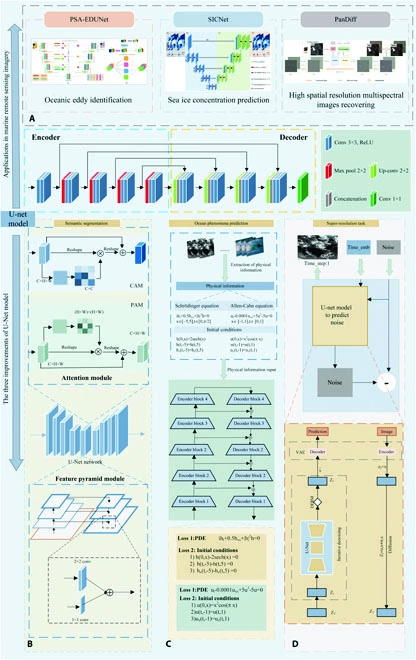
High-resolution satellite images are crucial for understanding oceanic conditions, but acquiring them can be costly and challenging. To address this issue, researchers have developed the U-Net model, which learns to identify similar features between low and high-resolution images, enabling super-resolution reconstruction of remote sensing images. However, traditional U-Net models have limitations in feature extraction, leading to blurring issues.
Recently, noise-removal diffusion models have gained popularity in computer vision, offering a solution to these limitations. By integrating diffusion modeling with U-Net, researchers can enhance image quality and utility in ocean remote sensing. For example, Han et al. developed a multi-level U-Net network for image super-resolution reconstruction, while Meng et al. utilized diffusion models to enhance the clarity of remote-sensing images through panchromatic sharpening. These advancements hold significant potential for improving data processing in ocean remote sensing and may lead to further innovations in the field.
The integration of differential equations and constraint formulas into U-Net’s loss function is a game-changer. By imposing strong physical constraints on the forecasting model, we can ensure that the results are not only accurate but also physically meaningful. The success of this approach in inferring velocity and pressure fields, as well as its speed advantage over numerical solvers, is truly impressive.
The application of U-Net to super-resolution reconstruction of remote sensing images is another area where I see tremendous potential. By learning the correlation between low and high-resolution images, U-Net can identify similar features across both resolutions, enabling the enhancement of image quality and utility in ocean remote sensing. The use of diffusion models to address blurring issues in traditional U-Net models is a clever approach, as it allows for the modeling of complex probability distributions and the inference of missing information.
The article highlights several exciting directions for future research, including the integration of domain-specific knowledge into data-driven models, the use of diffusion models to solve blurring problems, and the combination of U-Net with generative adversarial networks (GANs). I’m particularly intrigued by the potential of diffusion models in remote sensing, as demonstrated by Meng et al.’s PanDiff model for panchromatic sharpening.
As we continue to push the boundaries of what’s possible with U-Net and its variants, I’m confident that we’ll see even more innovative applications in the oceanic domain. The future of ocean remote sensing is bright indeed!
DOI: https://spj.science.org/doi/10.34133/remotesensing.0196