

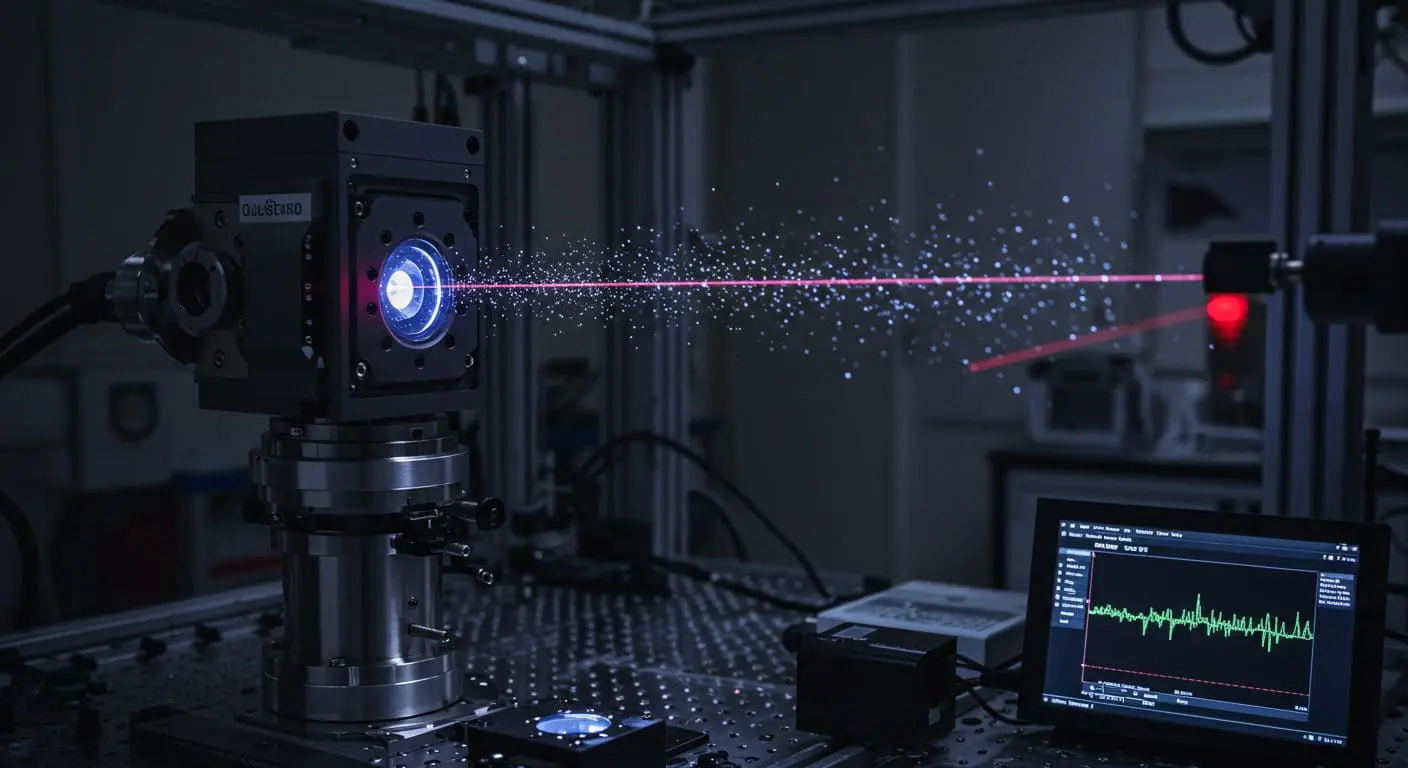
Researchers demonstrated a novel approach to creating quantum light sources with configurable photon lifetimes by leveraging parity-time (PT) symmetry, enabling precise control over intracavity photon density of states and paving the way for advanced applications in programmable computing and high-speed communication.
Researchers developed chip-scale light sources using parity-time (PT) symmetry to achieve configurable photon lifetimes. By coupling two microresonators with distinct circumferences, they enabled selective tuning of intracavity photon density of states. The device achieved a 38-fold photon lifetime range (4–158 ps), with shortest lifetimes near PT-symmetric exceptional points. It generated energy-time entangled photon pairs with 87.1 ± 1.1% interference visibility and a heralded second-order autocorrelation of g_h^(2)(0) = 0.069 ± 0.001, demonstrating potential for high-speed communication, programmable computing, and coherent tomography.
The Quantum Leap: Revolutionizing Communication with PT-Symmetric Microresonators
In the ever-evolving landscape of quantum technology, researchers have made a groundbreaking discovery that could redefine how we secure communication in the digital age. By harnessing the principles of PT-symmetric microresonators, scientists have developed a novel method to control photon lifetimes, paving the way for more efficient and secure quantum key distribution (QKD). This innovation not only enhances data security but also promises faster transmission rates, addressing critical challenges in modern communication systems.
Harnessing Symmetry: The Science Behind the Breakthrough
At the heart of this advancement lies the concept of PT symmetry—parity-time symmetry—a phenomenon where light can be manipulated to exhibit unique behaviors. Researchers have designed coupled microresonators, consisting of a main ring and an auxiliary ring, which interact in a way that allows precise control over photon lifetimes. By applying thermal tuning through voltage adjustments, they can dynamically alter the resonance detuning between the rings, effectively extending or shortening how long photons remain within the system.
This control is achieved by exploiting spontaneous four-wave
This control is achieved by exploiting spontaneous four-wave mixing (SFWM), a process where light waves interact to generate pairs of correlated photons. These photon pairs are crucial for QKD, as they enable the secure exchange of encryption keys. The ability to adjust photon lifetimes dynamically opens new possibilities for optimizing quantum communication protocols, ensuring that systems can adapt to varying operational needs.
Experimental Validation: From Theory to Practice
The success of this approach was demonstrated through a series of experiments where researchers observed significant changes in photon lifetimes by applying thermal tuning. Without any voltage, the photons exhibited a coherent time of approximately 240 picoseconds (ps). However, when a voltage of 6.6 volts was applied, this time drastically reduced to around 91 ps. This marked reduction highlights the system’s responsiveness and the potential for real-time adjustments in practical applications.
The experiments also revealed that adjusting photon lifetimes directly impacts data rates in QKD systems. Shorter lifetimes allow for higher data transmission speeds, which is a critical factor in scaling up quantum communication networks. Moreover, the ability to control these lifetimes dynamically enhances security by making it more challenging for potential eavesdroppers to intercept and decode the transmitted information.
Implications for Quantum Communication
The implications of this research are profound. By enabling precise control over photon lifetimes, PT-symmetric microresonators offer a pathway to overcome current limitations in QKD systems. Traditional methods often face trade-offs between data rate, distance, and security. This new approach provides a means to optimize these parameters simultaneously, leading to more robust and scalable quantum communication networks.
Furthermore, the ability to dynamically adjust photon lifetimes
Furthermore, the ability to dynamically adjust photon lifetimes opens up possibilities for adaptive protocols that can respond to changing network conditions or threats in real time. This adaptability is essential as quantum communication moves from laboratory demonstrations to real-world deployments, where operational environments are often unpredictable and security threats evolve continuously.
Looking Ahead: The Future of Secure Communication
As researchers continue to refine this technology, the potential applications extend beyond QKD into other areas of quantum information science. Enhanced control over photon lifetimes could also benefit quantum computing and sensing technologies, contributing to a broader revolution in quantum-enabled systems.
In conclusion, the development of PT-symmetric microresonators represents a significant milestone in quantum communication research. By offering unprecedented control over photon lifetimes, this innovation not only enhances the security and efficiency of QKD but also underscores the importance of fundamental physics in driving technological progress. As we stand on the brink of a new era in secure communication, such breakthroughs remind us that the future of technology is as bright as it is promising.
Quantum light sources with configurable lifetime leveraging parity-time symmetry
🧠 DOI: https://doi.org/10.48550/arXiv.2504.01413


