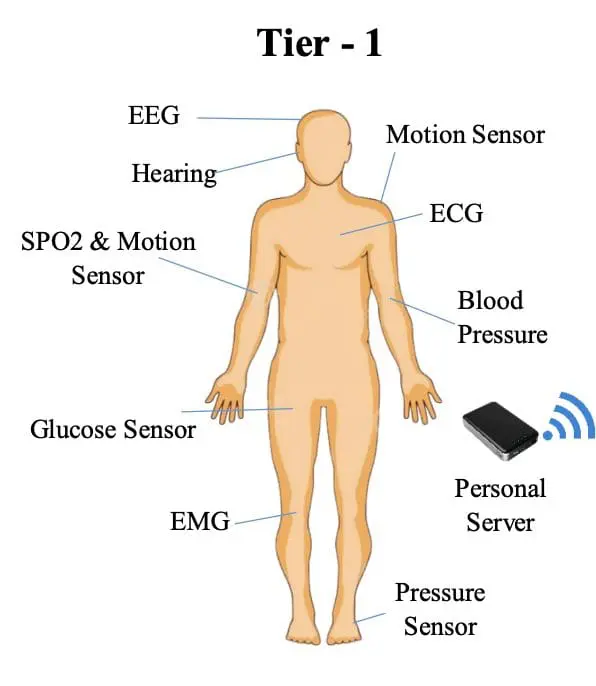
The emergence of Wireless Body Sensor Network (WBSN) technology is transforming the healthcare sector by providing a promising solution for medical monitoring equipment. WBSNs are dense networks of sensors that process and transmit data based on ambient circumstances, offering numerous advantages such as limited size, cost, power consumption, low maintenance requirements, and ease of installation.
However, these networks also present several challenges due to their restricted resources, including finite power supplies, mobility in the network, computational power, storage capacity, and communication capabilities. To address these challenges, researchers have proposed a hybrid Improved Unequal Secure Cluster-based Distributed Routing Protocol with Quantum Key Distribution (IUSCD-RPQKD) for WSN.
This protocol leverages quantum cryptography to safeguard the distribution of symmetric encryption keys, ensuring secure communication between the source and destination. The use of Quantum Key Distribution (QKD) provides a robust and unbreakable security to the network, protecting against various types of attacks.
The benefits of using QKD in WBSNs include improved security, high-speed data transmission rates, and real-time monitoring and control applications. As WBSNs continue to advance, several future directions are expected to emerge, including improved energy efficiency, enhanced security, and real-time monitoring and control applications.
Ultimately, the use of QKD in WBSNs has significant implications for the development and deployment of these networks, including improved security, high-speed data transmission rates, and real-time monitoring and control applications.
What is the Wireless Body Sensor Network (WBSN) and its Importance?
The Wireless Body Sensor Network (WBSN) is a dense network of sensors that processes and transmits data based on ambient circumstances. This technology has significant potential in the entertainment and healthcare sectors, particularly in areas where traditional wired networks are impractical or difficult to manage. WBSNs offer several advantages, including limited size, cost, power consumption, low maintenance requirements, and ease of installation. However, they also present challenges due to their restricted resources, such as finite power supplies, mobility in the network, computational power, storage capacity, and communication capabilities.
The WBSN technology has numerous applications in healthcare, particularly in medical monitoring equipment. These devices are not location-dependent and can be easily handled using wireless networks. However, traditional wired networks often pose difficulties due to their complexity and maintenance requirements. The development of WBSNs aims to address these challenges by providing a reliable, efficient, and secure communication system.
The proposed hybrid Improved Unequal Secure Cluster-based Distributed Routing Protocol with Quantum Key Distribution (IUSCD-RPQKD) for WSN is designed to improve energy efficiency while enhancing reliability and security. This protocol utilizes quantum key distribution (QKD) to provide direct and confidential communication between the source and destination, eliminating the need for initial secret key exchange.
What are the Challenges Faced by Wireless Body Sensor Networks?
Wireless Body Sensor Networks (WBSNs) face several challenges due to their restricted resources. These limitations include finite power supplies, mobility in the network, computational power, storage capacity, and communication capabilities. The WBSN’s limited resources make it difficult to maintain a reliable and efficient communication system.
The WBSN’s energy efficiency is a significant concern, as it directly affects the network’s overall performance. The proposed IUSCD-RPQKD protocol aims to address this challenge by improving energy effectiveness while simultaneously boosting reliability and security. However, the development of such protocols requires careful consideration of the WBSN’s resource constraints.
The WBSN’s mobility in the network is another significant challenge. As nodes move within the network, their positions change, affecting communication between them. This mobility can lead to packet loss, delay, or even complete disconnection from the network. The proposed protocol aims to mitigate these effects by providing a robust and reliable communication system.
What is Quantum Key Distribution (QKD) and its Role in WBSN?
Quantum Key Distribution (QKD) is a quantum mechanics-based mechanism for safeguarding the distribution of symmetric encryption keys. QKD provides security against all attacks, as it uses the quantum key and hence impostors will not be able to predict or catch the secret key. This robust and unbreakable security is essential in WBSNs, where sensitive medical data is transmitted.
The proposed IUSCD-RPQKD protocol applies QKD to provide a secure communication system for WBSNs. By using QKD, the network can ensure direct and confidential communication between the source and destination, eliminating the need for initial secret key exchange. This approach provides an additional layer of security against potential attacks on the network.
What are the Benefits of Using Quantum Key Distribution in WBSN?
The use of Quantum Key Distribution (QKD) in Wireless Body Sensor Networks (WBSNs) offers several benefits. QKD provides a robust and unbreakable security system, ensuring that sensitive medical data is transmitted securely. This approach eliminates the need for initial secret key exchange, reducing the risk of packet loss or delay.
The proposed IUSCD-RPQKD protocol aims to improve energy efficiency while enhancing reliability and security in WBSNs. By using QKD, the network can ensure direct and confidential communication between the source and destination, providing an additional layer of security against potential attacks.
What is the Proposed Hybrid Improved Unequal Secure Cluster-based Distributed Routing Protocol?
The proposed hybrid Improved Unequal Secure Cluster-based Distributed Routing Protocol (IUSCD-RPQKD) for WSN aims to improve energy efficiency while enhancing reliability and security. This protocol utilizes quantum key distribution (QKD) to provide direct and confidential communication between the source and destination, eliminating the need for initial secret key exchange.
The IUSCD-RPQKD protocol is designed to address the challenges faced by WBSNs, including finite power supplies, mobility in the network, computational power, storage capacity, and communication capabilities. By improving energy effectiveness while simultaneously boosting reliability and security, this protocol aims to provide a robust and efficient communication system for WBSNs.
What are the Future Directions of Research on WBSN?
The development of Wireless Body Sensor Networks (WBSNs) is an active area of research, with significant potential in healthcare and other fields. The proposed IUSCD-RPQKD protocol aims to improve energy efficiency while enhancing reliability and security in WBSNs.
Future research directions for WBSNs include the development of more efficient communication protocols, such as those using QKD or other quantum mechanics-based mechanisms. Additionally, researchers should focus on addressing the challenges faced by WBSNs, including finite power supplies, mobility in the network, computational power, storage capacity, and communication capabilities.
The use of WBSNs has numerous applications in healthcare, particularly in medical monitoring equipment. As this technology continues to evolve, it is essential to ensure that these networks are reliable, efficient, and secure. The proposed IUSCD-RPQKD protocol provides a promising approach to addressing these challenges and ensuring the success of WBSNs in various fields.
Publication Date: 2024-08-01
Authors: P. Muthusamy, Senthil Kumar S, K. Kanagalakshmi, N. Saravanan, et al.
Source: International Journal of Computer Networks And Applications
DOI: https://doi.org/10.22247/ijcna/2024/26