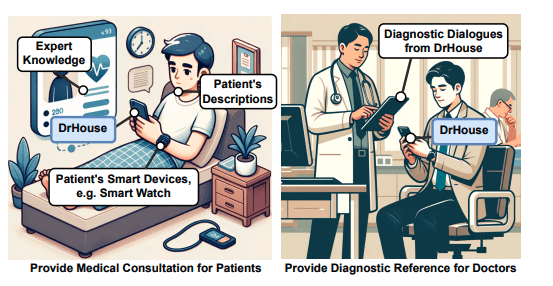
DrHouse, is poised to transform the field of digital healthcare by providing accurate diagnoses through a novel combination of sensor data and expert knowledge. Developed by researchers at the Chinese University of Hong Kong, DrHouse utilizes smart device data to enhance accuracy and reliability in diagnosis, outperforming current Large Language Model (LLM) based virtual doctors.
With its multiturn consultation feature, DrHouse can achieve up to a 31.5% increase in diagnosis accuracy over state-of-the-art baselines, making it a valuable tool for healthcare professionals and patients alike. By leveraging continuously updating medical knowledge bases and concurrently evaluating potential diseases and their likelihood, DrHouse is set to revolutionize the way healthcare is delivered.
What is DrHouse and How Does it Work?
DrHouse is a novel LLM-based multiturn consultation virtual doctor system that has the potential to transform digital healthcare. It incorporates three significant contributions: utilizing sensor data from smart devices in the diagnosis process, leveraging continuously updating medical knowledge bases, and introducing a novel diagnostic algorithm that concurrently evaluates potential diseases and their likelihood.
The system works by using sensor data from smart devices to enhance accuracy and reliability in diagnoses. This is achieved through multiturn interactions with DrHouse, which determines the next steps such as accessing daily data from smart devices or requesting in-lab tests and progressively refines its diagnoses. The system’s diagnostic algorithm evaluates potential diseases and their likelihood, facilitating more nuanced and informed medical assessments.
DrHouse’s approach to diagnosis is distinct from current methods that rely on patients’ subjective descriptions of symptoms, which can lead to increased misdiagnosis. By incorporating sensor data and continuously updating medical knowledge bases, DrHouse aims to provide more accurate diagnoses and improve patient outcomes.
The Benefits of Using Sensor Data in Diagnosis
The use of sensor data in diagnosis is a significant contribution of DrHouse. This approach enhances accuracy and reliability by providing objective data that can be used to inform diagnostic decisions. By leveraging sensor data from smart devices, DrHouse can access a wealth of information about patients’ health, including vital signs, medical history, and lifestyle factors.
The benefits of using sensor data in diagnosis are numerous. It can help reduce misdiagnosis rates, improve patient outcomes, and enhance the overall quality of care. Additionally, the use of sensor data can also help identify potential health risks and prevent complications from arising.
DrHouse’s approach to using sensor data is innovative and has the potential to revolutionize the way diagnoses are made. By incorporating this technology into its diagnostic algorithm, DrHouse can provide more accurate and reliable diagnoses than current methods.
The Importance of Continuously Updating Medical Knowledge Bases
Another significant contribution of DrHouse is its ability to leverage continuously updating medical knowledge bases. This ensures that the system’s model remains at the forefront of diagnostic standards, providing the most up-to-date information available.
The importance of continuously updating medical knowledge bases cannot be overstated. As new research emerges and medical understanding evolves, it is essential that diagnostic systems like DrHouse stay current with the latest developments. By doing so, DrHouse can provide diagnoses that are informed by the most recent scientific evidence, improving patient outcomes and reducing misdiagnosis rates.
DrHouse’s approach to updating its knowledge bases is proactive and ensures that the system remains relevant and effective in a rapidly changing medical landscape. This commitment to staying current with the latest research and developments sets DrHouse apart from other diagnostic systems and underscores its potential to transform digital healthcare.
The Diagnostic Algorithm of DrHouse
The diagnostic algorithm of DrHouse is a novel approach that concurrently evaluates potential diseases and their likelihood, facilitating more nuanced and informed medical assessments. This algorithm is a key component of the system’s diagnostic process and has been designed to provide accurate diagnoses in a timely manner.
The diagnostic algorithm of DrHouse works by evaluating multiple factors, including sensor data from smart devices, medical history, and lifestyle factors. By considering these variables simultaneously, the algorithm can identify potential diseases and their likelihood, providing healthcare professionals with valuable insights into patient care.
The benefits of DrHouse’s diagnostic algorithm are numerous. It can help reduce misdiagnosis rates, improve patient outcomes, and enhance the overall quality of care. Additionally, the use of this algorithm can also help identify potential health risks and prevent complications from arising.
Evaluations and Results
Evaluations on three public datasets and our self-collected datasets show that DrHouse can achieve up to a 31.5% increase in diagnosis accuracy over state-of-the-art baselines. The results of a 32-participant user study also demonstrate that medical experts and test subjects are willing to use DrHouse, with 75% of medical experts and 91.7% of test subjects expressing interest in using the system.
These results are promising and suggest that DrHouse has the potential to transform digital healthcare. By providing accurate diagnoses and improving patient outcomes, DrHouse can help reduce misdiagnosis rates and enhance the overall quality of care.
Conclusion
DrHouse is a novel LLM-based multiturn consultation virtual doctor system that can transform digital healthcare. Its approach to diagnosis incorporates sensor data from smart devices, continuously updating medical knowledge bases, and a novel diagnostic algorithm that concurrently evaluates potential diseases and their likelihood.
The benefits of using DrHouse are numerous, including reduced misdiagnosis rates, improved patient outcomes, and enhanced overall quality of care. Additionally, this system can help identify potential health risks and prevent complications.
As healthcare professionals continue to seek innovative solutions to improve patient care, DrHouse is an exciting development that has the potential to revolutionize the way diagnoses are made. By providing accurate diagnoses and improving patient outcomes, DrHouse can help reduce misdiagnosis rates and enhance the overall quality of care.
Publication details: “DrHouse: An LLM-empowered Diagnostic Reasoning System through Harnessing Outcomes from Sensor Data and Expert Knowledge”
Publication Date: 2024-11-21
Authors: Bufang Yang, Siyang Jiang, Lilin Xu, Kaiwei Liu, et al.
Source: Proceedings of the ACM on Interactive Mobile Wearable and Ubiquitous Technologies
DOI: https://doi.org/10.1145/3699765