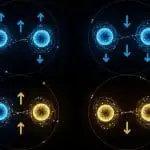
Quantum computing has the potential to revolutionize computation by combining computer science and quantum physics. This cutting-edge field employs quantum bits, or qubits, which can exist in multiple states simultaneously, enabling calculations that are not possible with classical computers.
In this article, we’ll explore the power of superposition, entanglement, and their role in processing intricate computations at previously unheard-of rates. We’ll also examine the vast potential of quantum computing to factor enormous numbers, optimize complex systems, and simulate chemical structures for drug development.
From medicine to finance, climate modeling, and beyond, the applications of quantum computing are vast and varied. However, there are many challenges that must be overcome before it can become a reality, including the need for highly specialized hardware and software, highly trained professionals, and technical advancements in protecting qubits from environmental noise.
As researchers continue to develop new technologies and algorithms, we can expect to see more powerful and practical quantum computers in the years to come. With its vast potential and promise, the future of quantum computing is bright and full of exciting developments ahead.
What is Quantum Computing?
Quantum computing is a cutting-edge field that combines computer science and quantum physics to revolutionize computation. Unlike classical computers, which use bits as the lowest unit of information, quantum computers employ quantum bits, also known as qubits. These qubits are capable of conducting calculations that are not possible for conventional computers.
In classical computing, a bit can be in one of two states: 0 or 1. However, a qubit is able to exist in both states simultaneously, a phenomenon known as superposition. This capability increases the computing capacity of quantum systems exponentially. For example, a quantum computer can process several possibilities at once, whereas a classical computer can only process one possible answer at a time.
Superposition is a fundamental idea in quantum computing that enables quantum computers to perform calculations that are not possible for conventional computers. Quantum computers can factor enormous numbers, optimize intricate systems, and simulate chemical structures for drug development thanks to entanglement and superposition.
The Power of Superposition
The concept of superposition is crucial to understanding the power of quantum computing. In classical computing, a bit can only be in one of two states: 0 or 1. However, a qubit can exist in both states simultaneously, which allows for exponential increases in computing capacity. This capability enables quantum computers to perform calculations that are not possible for conventional computers.
For example, consider a simple calculation where you need to find the sum of two numbers. A classical computer would have to perform this calculation sequentially, one step at a time. However, a quantum computer can perform this calculation simultaneously, using superposition to process multiple possibilities at once. This allows quantum computers to solve complex problems much faster than classical computers.
The Role of Entanglement
Entanglement is another fundamental concept in quantum computing that enables the processing of intricate computations at previously unheard-of rates. When qubits entangle, their states are directly correlated with one another, independent of their distance from each other. This allows quantum computers to perform calculations that involve multiple qubits simultaneously.
For example, consider a complex optimization problem where you need to find the optimal solution among many possible solutions. A classical computer would have to perform this calculation sequentially, one step at a time. However, a quantum computer can perform this calculation simultaneously, using entanglement to process multiple possibilities at once. This allows quantum computers to solve complex problems much faster than classical computers.
The Potential of Quantum Computing
The potential of quantum computing is vast and varied. Quantum computers can factor enormous numbers, optimize intricate systems, and simulate chemical structures for drug development. They can also perform calculations that are not possible for conventional computers, such as simulating the behavior of complex systems or optimizing complex algorithms.
In addition to these technical applications, quantum computing has the potential to revolutionize many fields, including medicine, finance, and climate modeling. For example, quantum computers could be used to develop new medicines by simulating the behavior of molecules at a molecular level. They could also be used to optimize financial portfolios or simulate complex weather patterns.
The Challenges of Quantum Computing
Despite the vast potential of quantum computing, there are many challenges that must be overcome before it can become a reality. One of the biggest challenges is the need for highly specialized hardware and software that can handle the unique properties of qubits.
Another challenge is the need for highly trained professionals who understand both computer science and quantum physics. This requires a deep understanding of complex mathematical concepts, as well as the ability to design and implement complex algorithms.
Finally, there are many technical challenges that must be overcome before quantum computers can become widely available. For example, qubits are extremely sensitive to their environment and can easily become “decoherent” or lose their quantum properties. This requires the development of new materials and technologies that can protect qubits from environmental noise.
The Future of Quantum Computing
The future of quantum computing is bright and full of promise. As researchers continue to develop new technologies and algorithms, we can expect to see more powerful and practical quantum computers in the years to come.
In addition to these technical advancements, we can also expect to see more widespread adoption of quantum computing in many fields. For example, quantum computers could be used to develop new medicines by simulating the behavior of molecules at a molecular level. They could also be used to optimize financial portfolios or simulate complex weather patterns.
Overall, the future of quantum computing is full of promise and potential. As we continue to push the boundaries of what is possible with qubits and entanglement, we can expect to see many exciting developments in the years to come.
Publication details: “Exploring Quantum Computing: Principles and Applications”
Publication Date: 2024-08-30
Authors: SIDAK BAWA
Source:
DOI: https://doi.org/10.36676/jqst.v1.i3.27