Researchers at the AWS Center for Quantum Computing, including Harry Levine and Arbel Haim, have developed a new type of qubit that converts most errors into “erasure errors.” This development could significantly reduce the overhead of error correction in quantum computing. The team’s work, published in Physical Review X, demonstrates initial steps towards implementing this strategy using existing quantum hardware based on superconducting quantum circuits. This could potentially accelerate the development of practical quantum computers. The researchers’ next steps include completing the error-correction toolbox with these new qubits and scaling to larger systems.
Quantum Computing: The Challenge of Error Correction
Quantum computers, which operate based on the fundamental laws of quantum mechanics first observed at the atomic-scale, are an emerging technology that is capable of computational tasks out of the reach of classical digital computers. Potential applications of quantum computers range from physical simulation – like calculating electronic energies of complex molecules – to cryptography – such as cracking RSA encryption. However, quantum computers are extremely sensitive to noise introduced through environmental interactions. This noise leads to computational errors, and today’s quantum computers are too error-prone to compute the answers to problems that are of practical utility where they outperform their classical digital counterparts.
Quantum Error Correction: A Powerful Tool
Quantum error correction is a powerful tool for combating the effects of noise. As with error correction in classical systems, quantum error correction can exponentially suppress the rate of errors by encoding information redundantly. Redundancy protects against noise, but it comes at a price: an increase in the number of physical quantum bits (qubits) used for computation and an increase in the complexity and duration of computations. The overhead associated with error correction can be significant when implemented using the error-prone hardware of a quantum computer. This has led to increasing interest in so-called “hardware-efficient” strategies for quantum error correction.
AWS Center for Quantum Computing: A New Type of Qubit
In this post, we dive into the results of one of our latest experiments at the AWS Center for Quantum Computing. We introduce a type of qubit developed at AWS that converts most errors into a class of errors called “erasure errors”. Erasure error detection and correction, under the right circumstances, can lead to significant reductions in error-correction overhead. Our work demonstrates initial steps towards implementing this strategy using existing quantum hardware based on superconducting quantum circuits and indicates a potential accelerated path forward for building quantum computers of practical utility.
Understanding Qubit Errors
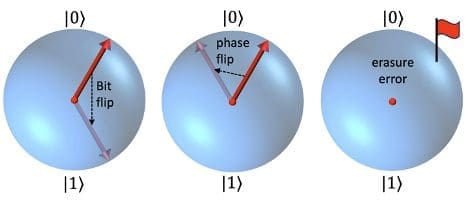
When we talk about protecting quantum computers from errors, what types of errors are we talking about? Quantum computers are built from qubits, which can be in one of two quantum states (often labeled |0⟩ or |1⟩), or any superposition of these states. Just like a classical bit can accidentally flip from 0 to 1 or from 1 to 0, a quantum bit can also experience a so-called “bit-flip” error where |0⟩ flips to |1⟩ or vice versa. But unlike classical bits, quantum bits can also suffer from “phase-flip” errors, where a superposition |0⟩ + |1⟩ flips to |0⟩ – |1⟩. The difficulty of correcting both bit-flip and phase-flip errors is one reason why error correction is much harder for quantum computers than for classical computers.
The Concept of “Erasure Qubit”
An “erasure qubit” is a qubit which is designed to be primarily limited by erasure errors, with only a minimal contribution of bit-flip or phase-flip errors. To build such a qubit, we need to encode our qubit in a protected way such that the physical processes that drive errors in our hardware can only cause erasure errors. Our approach at the AWS Center for Quantum Computing was to build erasure qubits out of standard qubit components, called transmons. Transmons are superconducting circuit elements whose discrete quantum states can be controlled and used for computation.

Erasure Qubit Performance and Conclusion
To test the use of the dual-rail system as an erasure qubit, our team at the AWS Center for Quantum Computing designed and fabricated a device composed of three transmons – two of which encode the dual-rail qubit, while the third is used as an ancilla for detecting and flagging erasure errors. This device was cooled down to 10 millikelvin in a dilution fridge. These experiments, described in our recent publication, complete the picture of our dual-rail qubit as an “erasure qubit” – most errors that occur are indeed erasure errors, and those erasure errors can be detected without introducing new errors into the system. This work is just the beginning of an exciting path with transmon-based erasure qubits, with major next steps needed to complete the error-correction toolbox with these new qubits and scale up to larger systems.

External Link: Click Here For More