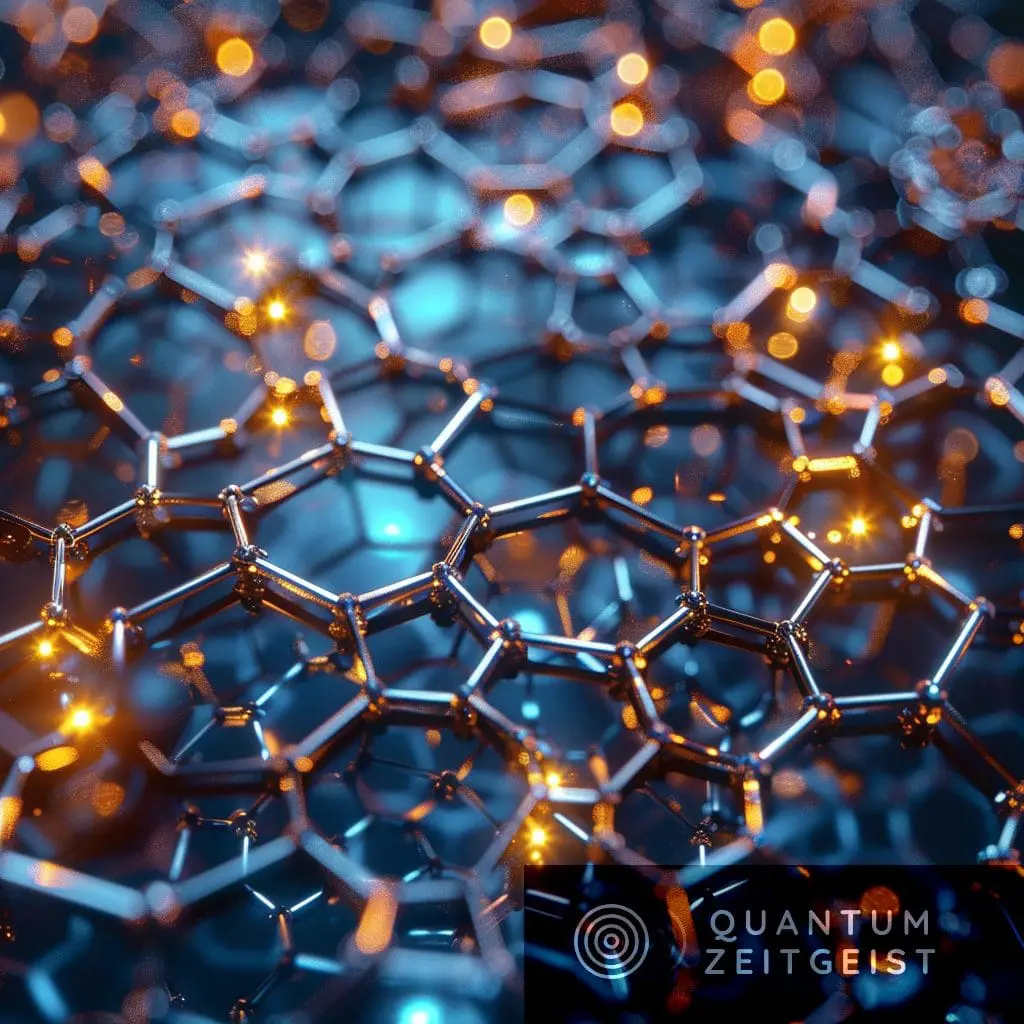
Researchers from the Würzburg-Dresden Cluster of Excellence ct.qmat have developed a protective film for 2D quantum materials, potentially revolutionizing the future of electronics. As silicon-based computer chips reach their physical limits, alternative materials are needed. The team discovered a way to protect quantum semiconductors, like indenene, from environmental influences without compromising their quantum properties. This breakthrough could enable the use of these atomic layers in ultrathin electronic components. The protective layer was created using van der Waals materials and graphene. The findings were published in Nature Communications.
Innovative Protective Film for 2D Quantum Materials
A team of researchers from the Würzburg-Dresden Cluster of Excellence ct.qmat has made a significant advancement in materials research. They have developed a protective film for two-dimensional (2D) quantum materials, which could potentially revolutionize the future of electronics. As silicon-based computer chips are nearing their physical limitations, the search for alternative materials that can function at atomic scales has become a pressing scientific challenge. The team’s innovative protective film could shield quantum semiconductor layers, which are only one atom thick, from environmental influences without compromising their unique quantum properties. This development brings the application of these fragile atomic layers in ultrathin electronic components closer to reality.
The Need for 2D Quantum Materials
The relentless pursuit of faster and more powerful computer chips has led to the miniaturization of transistors, their fundamental components, to increasingly smaller sizes. In a few years, these transistors will measure just a few atoms across, pushing the miniaturization of the currently used silicon technology to its physical limits. This necessitates the search for alternative materials with entirely new properties for future technological advancements. In 2021, scientists from the Cluster of Excellence ct.qmat made a significant discovery: topological quantum materials such as indenene, which hold great promise for ultrafast, energy-efficient electronics. These extremely thin quantum semiconductors are composed of a single atom layer and act as topological insulators, conducting electricity virtually without resistance along their edges.
The Challenge of Protecting 2D Quantum Materials
The production of such a single atomic layer requires sophisticated vacuum equipment and a specific substrate material. To utilize this two-dimensional material in electronic components, it would need to be removed from the vacuum environment. However, exposure to air, even briefly, leads to oxidation, destroying its revolutionary properties and rendering it useless. The ct.qmat Würzburg team has now managed to solve this problem. They dedicated two years to finding a method to protect the sensitive indenene layer from environmental elements using a protective coating. The challenge was ensuring that this coating did not interact with the indenene layer, as this interaction could chemically react at the atomic level, changing the material.
The Solution: A Protective Coating
The search for a viable protective layer led the team to explore van der Waals materials, named after the Dutch physicist Johannes Diderik van der Waals. These two-dimensional van der Waals atomic layers are characterized by strong internal bonds between their atoms, while only weakly bonding to the substrate. Using sophisticated ultrahigh vacuum equipment, the Würzburg team experimented with heating silicon carbide (SiC) as a substrate for indenene, exploring the conditions needed to form graphene from it. They then vapor-deposited indium atoms, which are immersed between the protective graphene layer and the silicon carbide substrate. This is how the protective layer for the two-dimensional quantum material indenene was formed.
The Future of Atomic Layer Electronics
This breakthrough opens up possibilities for applications involving highly sensitive semiconductor atomic layers. The manufacture of ultrathin electronic components requires them to be processed in air or other chemical environments. This has been made possible thanks to the discovery of this protective mechanism. The team in Würzburg is now focused on identifying more van der Waals materials that can serve as protective layers. However, despite graphene’s effective protection of atomic monolayers against environmental factors, its electrical conductivity poses a risk of short circuits. The Würzburg scientists are working on overcoming these challenges and creating the conditions for tomorrow’s atomic layer electronics.
External Link: Click Here For More