Researchers from the University of Chicago’s Pritzker School of Molecular Engineering, Argonne National Laboratory, and the University of Modena and Reggio Emilia have developed a computational tool to understand how atoms in quantum materials behave when they absorb and emit light. The tool, part of the open-source software package WEST, was developed by a team led by Prof. Marco Govoni. The tool, known as WEST-TDDFT, can be applied to a wide range of materials and can run on multiple high-performance architectures. The research was led by Giulia Galli, Liew Family Professor of Molecular Engineering.
Advanced Computational Tool for Quantum Materials
The tool has been tested for accuracy in studying three different semiconductor-based materials, but it can be applied to a wide range of related materials. The software developed can run at scale on multiple high-performance architectures. This development broadens the ability of scientists to study materials for quantum technologies, according to Giulia Galli, Liew Family Professor of Molecular Engineering and senior author of the paper.
The fundamental units of information underlying new, powerful quantum technologies are qubits. Unlike the bits used in classical computing, which use only 0s and 1s to encode data, qubits can also exist in states of superposition, representing both 0 and 1 simultaneously. Miniscule defects within materials, such as a missing or substituted atom in the structured lattice of a crystal, can take on quantum states and be used as qubits. These qubits are extremely sensitive to the electric, optical, and magnetic properties of their surroundings, giving them the ability to be used as sensors.
Understanding exactly how these “point defects” interact with photons of light to change their energy states can let researchers better manipulate them or design materials that use the qubits as sensors or data-storage units. Until now, researchers could predict both the absorption and the emission of light by point defects, but could not fully explain some of the atomic processes that happened within the material while in its excited state, especially in the case of large and complex systems.
Streamlining Complex Calculations
The quantum mechanical equations that must be solved to determine the atomic properties of materials are incredibly complex and require a large amount of computing power. In the new work, Galli’s team encoded a new way of solving such equations more efficiently than in the past while proving that they were still accurate. The increased speed and efficiency at which the equations can now be solved means that they can be applied more easily to larger systems.
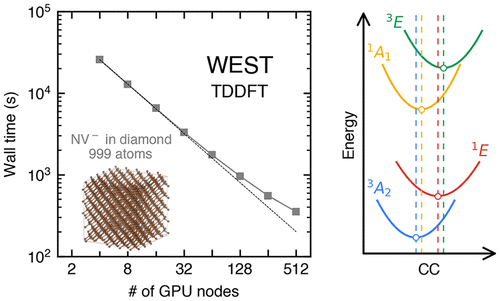
The efficient approach developed by the team can run on two different computer architectures — central processing units (CPUs) and graphics processing units (GPUs). The researchers used it to study the excited state properties of point defects within three materials: diamond, 4H silicon carbide, and magnesium oxide. They found that the tool could effectively calculate the properties of these systems even when they had hundreds or thousands of atoms.
Broader Goals and Applications
The MICCoM team developing WEST includes Dr. Victor Yu, Yu Jin, and Prof. Marco Govoni. The group is continuing to apply and fine-tune the algorithms available in the package, including WEST-TDDFT, to study broad classes of materials, not only for quantum technologies but also for low power and energy applications.
The new tool fits with the broader goal of the Galli lab to study and design new quantum materials. They have also published new results showing how spin defects close to the surface of a material behave differently than those deeper within a material, depending on how the surface is terminated. Their results have implications for the design of quantum sensors that rely on spin defects.
Funding and Support
This work was supported by the Midwest Integrated Center for Computational Materials (MICCoM), which is funded through the U.S. Department of Energy. The work also used the resources of the National Energy Research Scientific Computing Center (NERSC) and the University of Chicago Research Computing Center.
“What we’ve done is broaden the ability of scientists to study these materials for quantum technologies,” said Giulia Galli, Liew Family Professor of Molecular Engineering and senior author of the paper, published in Journal of Chemical Theory and Computation. “We can now study systems and properties that were really not accessible, on a large scale, in the past.”
“How these materials are absorbing and emitting light is critical to understanding how they are functioning for quantum applications,” said Galli. “Light is how you interrogate these materials.”
“With these methods, we can study the interaction of light with materials in systems that are quite large, meaning that these systems are closer to the experimental systems actually being used in the laboratory,” said graduate student Yu Jin, the first author of the new paper. “These systems are closer to the experimental systems actually being used in the laboratory.”
“We’ve found a way to solve the equations describing light emission and absorption more efficiently so that they can be applicable to realistic systems,” said Govoni. “We showed that the method is both efficient and accurate.”
Summary
Researchers have developed a new computational tool that enhances the understanding of how atoms within quantum materials behave when they absorb and emit light, which could aid in the development of new materials for quantum technologies. The tool, known as WEST-TDDFT, has proven accurate in studying various semiconductor-based materials and can be applied to a wide range of related materials, potentially enabling the study of systems and properties previously inaccessible due to their scale.
- Researchers from the University of Chicago’s Pritzker School of Molecular Engineering, Argonne National Laboratory, and the University of Modena and Reggio Emilia have developed a new computational tool to study the behaviour of atoms within quantum materials when they absorb and emit light.
- The tool, known as WEST-TDDFT, is part of the open-source software package WEST, developed by the Midwest Integrated Center for Computational Materials (MICCoM) led by Prof. Marco Govoni.
- The tool has been tested on three different semiconductor-based materials and can be applied to a wide range of related materials.
- The fundamental units of information in quantum technologies are qubits, which can exist in states of superposition, representing both 0 and 1 simultaneously.
- The tool can help researchers better understand and manipulate these “point defects” or design materials that use the qubits as sensors or data-storage units.
- The team has found a way to solve the equations describing light emission and absorption more efficiently, making them applicable to realistic systems.
- The work was supported by the Midwest Integrated Center for Computational Materials (MICCoM), funded through the U.S. Department of Energy.