

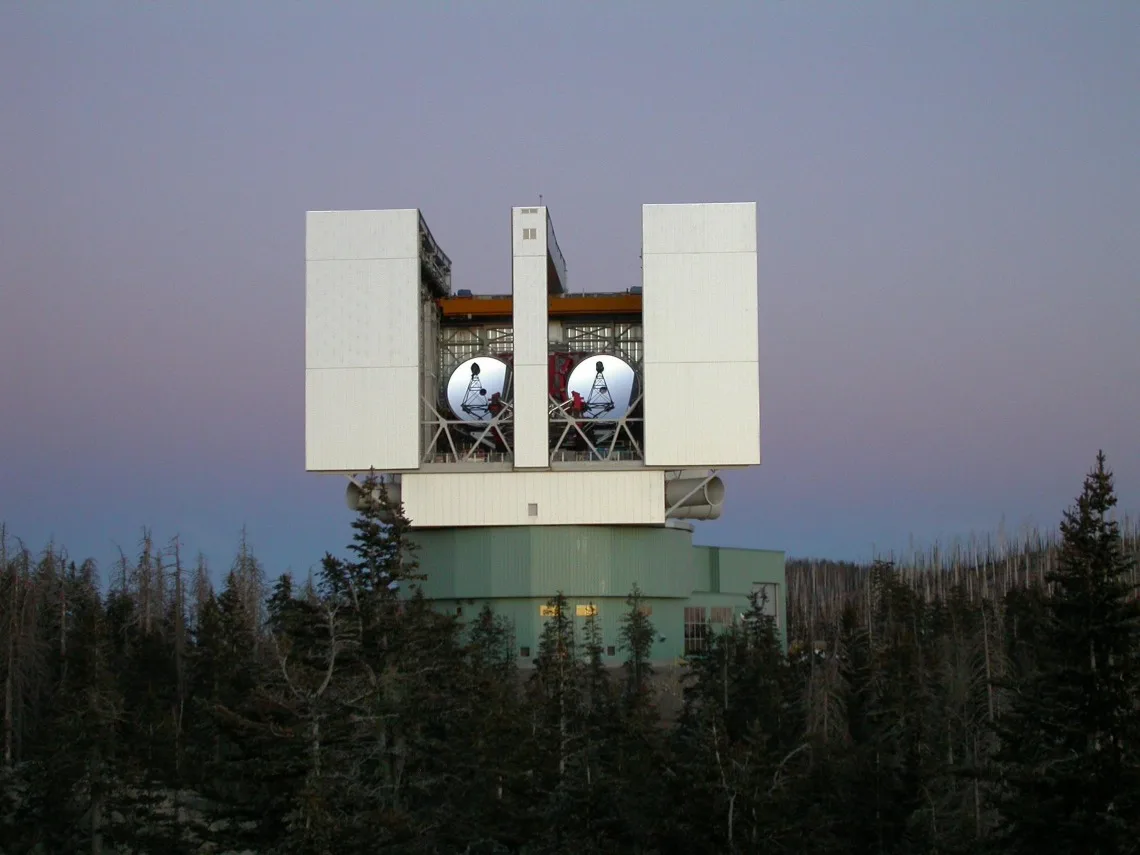
The Large Binocular Telescope on Mount Graham, managed by the University of Arizona, has captured the highest resolution images of Jupiter’s moon Io, using a new high-contrast optical imaging instrument, SHARK-VIS. The images reveal surface features as small as 50 miles across, previously only achievable with spacecraft. The research, led by Al Conrad, associate staff scientist at the Large Binocular Telescope Observatory, identified a major resurfacing event around one of Io’s most prominent volcanoes, Pele. The SHARK-VIS instrument was built by the Italian National Institute for Astrophysics and installed in 2023.
Unprecedented Glimpses of Jupiter’s Moon Io
The Large Binocular Telescope (LBT) on Mount Graham in Arizona has captured new images of Jupiter’s moon Io, offering the highest resolution ever achieved with an Earth-based instrument. The images reveal surface features as small as 50 miles across, a spatial resolution previously only achievable with spacecraft sent to Jupiter. This is equivalent to capturing an image of a dime-sized object from 100 miles away, according to the research team.
The LBT, managed by the University of Arizona, is unique with its two 27-foot mirrors mounted side by side. Its powerful adaptive optics system compensates for blurring introduced by atmospheric turbulence, making it one of the most powerful Earth-based observatories in the world. The new high-contrast optical imaging instrument, SHARK-VIS, and the telescope’s adaptive optics system made these observations possible.
Io’s Volcanic Activity: A Unique Opportunity for Research
Io, slightly larger than Earth’s moon, is the most volcanically active body in the solar system. Its surface is studded with volcanoes, and the eruptions on Io dwarf their contemporaries on Earth. According to Al Conrad, the paper’s first author and associate staff scientist at the Large Binocular Telescope Observatory, Io presents a unique opportunity to learn about the mighty eruptions that helped shape the surfaces of the Earth and the moon in their distant pasts.
Conrad added that studies like this one will help researchers understand why some worlds in the solar system are volcanic but not others. They also may someday shed light on volcanic worlds in exoplanet systems around nearby stars.
Gravitational Tug of War: The Cause of Io’s Volcanic Activity
Io is the innermost of Jupiter’s Galilean moons, which also include Europa, Ganymede, and Callisto. It is locked in a gravitational “tug of war” among Jupiter, Europa, and Ganymede, leading to constant squeezing. This results in frictional heat buildup in its interior, believed to be the cause for its sustained and widespread volcanic activity.
By monitoring the eruptions on Io’s surface, scientists hope to gain insights into the heat-driven movement of material underneath the moon’s surface, its internal structure, and ultimately, on the tidal heating mechanism responsible for Io’s intense volcanism.
SHARK-VIS: A New Era in Earth-Based Observations
The SHARK-VIS instrument, built by the Italian National Institute for Astrophysics at the Rome Astronomical Observatory, has played a crucial role in these observations. Installed in 2023, it works in tandem with the LBT’s adaptive optics system to capture slow-motion footage that freezes the optical distortions caused by atmospheric turbulence. The data is then post-processed to an unprecedented sharpness.
The instrument houses a fast, ultra-low-noise camera that allows it to observe the sky in “fast imaging” mode. Gianluca Li Causi, data processing manager for SHARK-VIS at the Italian National Institute for Astrophysics, explained how it works: “We process our data on the computer to remove any trace of the sensor’s electronic footprint. We then select the best frames and combine them using a highly efficient software package called Kraken, developed by our colleagues Douglas Hope and Stuart Jefferies from Georgia State University. Kraken allows us to remove atmospheric effects, revealing Io in incredible sharpness.”
Future Observations with SHARK-VIS
Simone Antoniucci, SHARK-VIS instrument scientist, anticipates new observations to be made of objects throughout the solar system. “The keen vision of SHARK-VIS is particularly suited to observing the surfaces of many solar system bodies, not only the moons of giant planets but also asteroids,” he said. “We have already observed some of those, with the data currently being analyzed, and are planning to observe more.”
External Link: Click Here For More


