

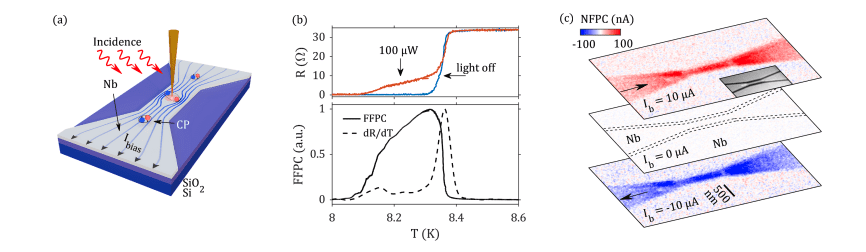
On April 20, 2025, researchers presented BOSON, a novel imaging platform that integrates bolometric detection at superconducting transition edges with near-field optical techniques. This advancement enables unprecedented spatial resolution and photon sensitivity for nanoscale applications, paving the way for innovative sensing technologies.
Researchers developed BOlometric Superconducting Optical Nanoscopy (BOSON), a platform integrating bolometric detection at superconducting transition edges with near-field optical techniques. BOSON enables mapping of photoinduced changes in superconductivity with unprecedented spatial resolution and photon sensitivity. It achieves polariton imaging at nanowatt excitation levels with low-dimensional materials—four orders of magnitude lower than previous experiments. This advancement opens possibilities for sensing applications using single-polariton detection and provides deeper insights into quasiparticle dynamics.
Quantum sensors represent a cutting-edge advancement in technology, offering exceptional precision in measuring physical quantities such as magnetic fields, electric fields, and temperature. These devices exploit quantum phenomena to achieve sensitivity beyond classical limits, making them indispensable for applications from medical imaging to fundamental physics research.
Recent progress in materials science has unlocked new possibilities for quantum sensors using iron chalcogenide superconductors, known for their unique electronic properties. Central to this innovation is the discovery of topological superconductivity in compounds like FeSe₁₋ₓTeₓ. These materials exhibit strong spin-orbit coupling and unconventional superconducting states, critical for quantum sensing.
The breakthrough involves FeSeTe thin films, where quasi-2D superconducting states demonstrate high sensitivity to external perturbations. This combination of sensitivity and robustness makes FeSeTe an ideal candidate for next-generation quantum sensors.
To unlock FeSeTe’s potential, researchers used advanced techniques like angle-resolved photoemission spectroscopy (ARPES) and scanning tunneling microscopy (STM). These methods revealed the material’s topological nature and Dirac surface states. Experiments showed that FeSeTe-based devices can detect magnetic fields with unprecedented precision due to their sensitivity to spin fluctuations.
Ultrafast pump-probe spectroscopy further demonstrated that superconductivity in these materials can be melted on femtosecond timescales, enabling real-time monitoring of dynamic quantum processes.
The discovery of topological superconductivity in FeSeTe opens new possibilities for quantum sensing. Researchers are developing sensors with unparalleled sensitivity and stability by leveraging its unique electronic properties. As this field evolves, it promises to transform industries from healthcare to telecommunications while deepening our understanding of quantum phenomena.
In conclusion, FeSeTe-based quantum sensors represent a significant advancement in sensing technology. With continued research and development, these devices could revolutionize how we measure and interact with the world.
👉 More information
🗞 Bolometric Superconducting Optical Nanoscopy (BOSON)
🧠 DOI: https://doi.org/10.48550/arXiv.2504.14547


