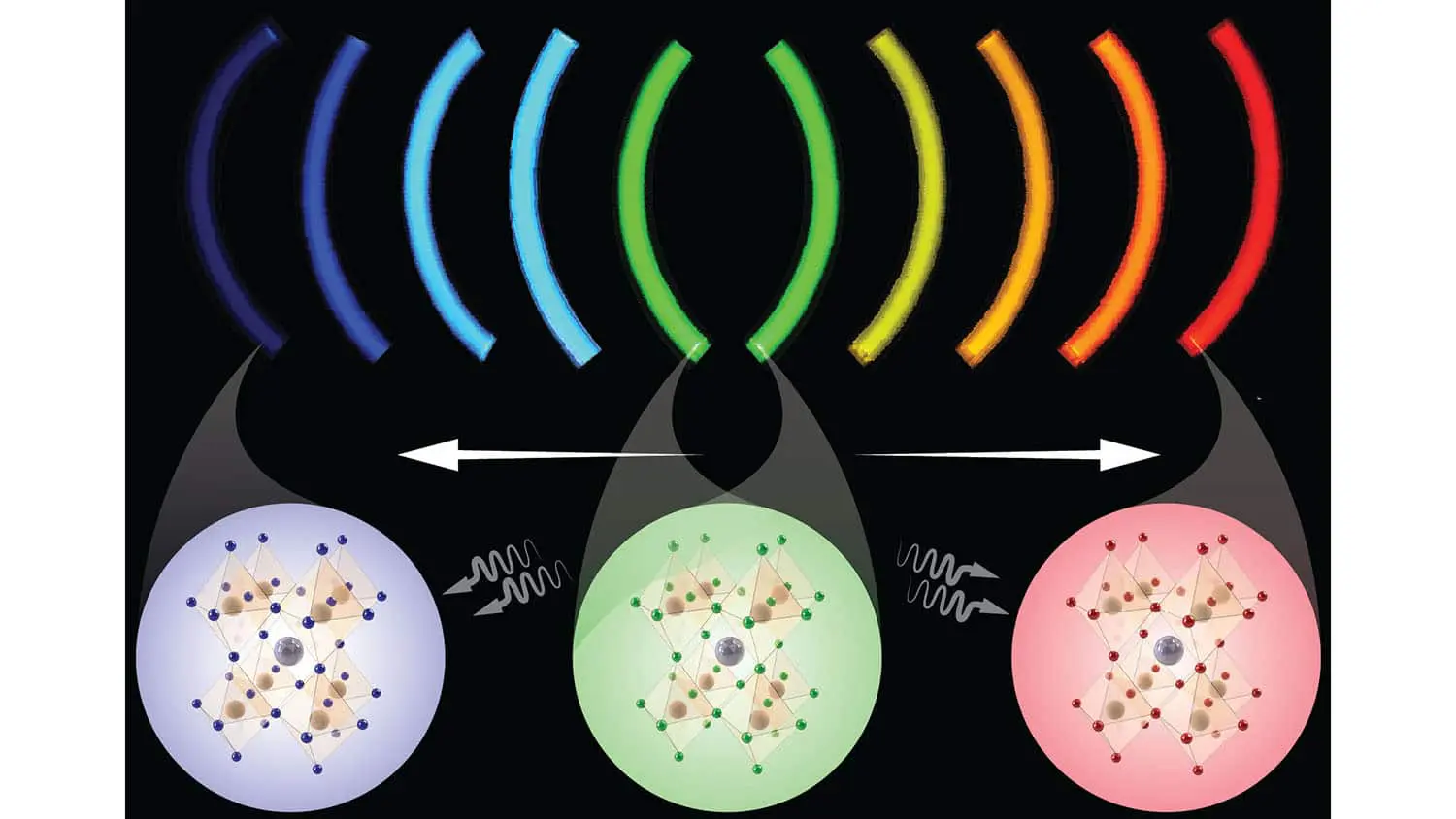
Researchers at North Carolina State University have developed a novel technique to tune the optical properties of quantum dots using light, making the process faster, more energy-efficient, and environmentally sustainable. The discovery, published in Advanced Materials, could revolutionize the production of perovskite quantum dots for optoelectronic devices.
Led by Milad Abolhasani, an ALCOA Professor of Chemical and Biomolecular Engineering at NC State, the team started with green-emitting perovskite quantum dots and placed them in a solution containing either chlorine or iodine. By running this solution through a microfluidic system that incorporates a light source, they were able to control the bandgap of the quantum dots by introducing precise amounts of energy via light.
This new approach allows for more efficient and sustainable production of high-quality perovskite quantum dots, which are crucial components in LEDs, solar cells, displays, quantum technologies, and other applications. The team is now scaling up their process to create perovskite quantum dots for use in optoelectronic devices.
The Challenge: Energy-Intensive Bandgap Tuning
Quantum dots, which earned the Nobel Prize in Chemistry in 2023, are integral to numerous applications due to their tunable optical properties. However, existing methods for bandgap tuning of perovskite quantum dots rely on chemical modifications or high-temperature reactions, both of which are energy-intensive and can introduce inconsistencies in the final material properties.
The Solution: Light-Driven Bandgap Tuning
The new approach, pioneered by Milad Abolhasani, ALCOA Professor of Chemical and Biomolecular Engineering at NC State, uses light to drive the reaction, requiring less energy and allowing for precise tuning. The process begins with green-emitting perovskite quantum dots placed in a solution containing either chlorine or iodine. This solution is then run through a microfluidic system that incorporates a light source.
The microfluidic environment ensures uniform light exposure across small solution volumes, approximately 10 microliters per reaction droplet. This precision is crucial as the small volume solution allows the light to penetrate the entire sample, triggering the anion exchange reaction.
The Impact: A Greener Future for Quantum Dots
The light-driven bandgap tuning method offers several advantages over traditional methods. It reduces material consumption by 100-fold compared to conventional batch processes and accelerates the anion exchange rate 3.5-fold. Moreover, it paves the way for the tailored design of perovskite-based optoelectronic materials.
This study, led by Pragyan Jha and colleagues at NC State, elucidates the underlying mechanisms driving photo-induced bandgap engineering in lead halide perovskite nanocrystals (NCs) through an advanced microfluidic platform. The findings could significantly impact the future of quantum dot technology, making it more energy-efficient and environmentally friendly.
External Link: Click Here For More