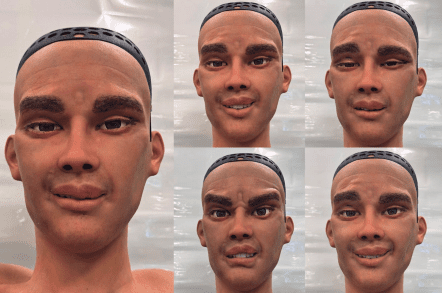
On April 19, 2025, researchers Dong Zhang, Jingwei Peng, Yuyang Jiao, Jiayuan Gu, Jingyi Yu, and Jiahao Chen published ExFace: Expressive Facial Control for Humanoid Robots with Diffusion Transformers and Bootstrap Training, detailing a novel method that enhances the precision and realism of facial expressions in humanoid robots through advanced machine learning techniques.
The paper introduces ExFace, a novel method using Diffusion Transformers for precise mapping of human facial blendshapes to bionic motor control. By employing an innovative model bootstrap training strategy, it achieves high-quality facial expressions with improved accuracy and smoothness. Experimental results show superior performance compared to previous methods in accuracy, frame per second (FPS), and response time. The ExFace dataset, derived from human facial data, enables excellent real-time performance and natural expression rendering in applications like performances and human interactions, offering a new solution for bionic interaction.
Facial expressions are a cornerstone of human communication, conveying emotions, intentions, and social cues with remarkable precision. For bionic robots—machines designed to mimic human appearance and behavior—the ability to replicate these expressions is critical for fostering meaningful interaction. However, current systems often fall short, producing movements that feel unnatural or overly mechanical. This disconnect arises from a fundamental mismatch between the design of human faces and robotic mechanisms. While humans possess intricate facial muscles capable of subtle, nuanced movements, bionic robots rely on motor-driven actuators to simulate these actions. Translating complex human expressions into machine-compatible commands is no small feat, particularly when aiming for real-time performance and accuracy.
To address these challenges, researchers have developed the ExFace system, an innovative approach that leverages advanced machine learning techniques to map human facial expressions onto bionic robots with unprecedented precision. At its core, ExFace employs a diffusion transformer network, an artificial intelligence model designed to generate high-quality outputs by progressively refining data. The system operates by analyzing human facial blendshapes—standardized representations of facial movements—and translating them into motor control values suitable for robotic systems. This process ensures that the resulting expressions are not only accurate but also tailored to the specific design and capabilities of the robot in question. By incorporating prior knowledge about bionic robot mechanics, ExFace reduces reliance on large datasets while maintaining high fidelity in expression generation.
The ExFace system begins by capturing human facial expressions through a combination of video data, blendshape analysis, and motor control inputs. These inputs are then processed by the diffusion transformer network, which refines them into commands that can be executed by the robot’s actuators. A key innovation in ExFace is its model bootstrap training strategy, which allows the system to iteratively improve its performance over time. By continuously refining its mapping of human expressions to robotic movements, ExFace ensures that each generated expression becomes increasingly natural and contextually appropriate.
The implications of this advancement are significant. Bionic robots with more lifelike facial expressions could enhance human-robot interaction in various settings, from customer service to healthcare. For instance, robots equipped with nuanced facial expressions might better convey empathy or understanding, fostering trust and improving communication outcomes. Additionally, the ability to generate contextually appropriate expressions could make bionic robots more effective in roles that require social intelligence, such as companionship for elderly individuals or support for children with autism spectrum disorder.
Looking ahead, the development of systems like ExFace underscores the potential for robotics to become more integrated into our daily lives. As technology continues to evolve, researchers are likely to explore even more sophisticated methods for replicating human expressions and behaviors. This could lead to bionic robots that not only mimic human appearance but also possess a deeper understanding of human emotions and social dynamics. Such advancements would bring us closer to realizing the vision of robots that can seamlessly interact with humans in ways that feel natural and intuitive.
In conclusion, the ExFace system represents an important step forward in the field of bionic robotics. By enabling more lifelike facial expressions, it has the potential to enhance human-robot interaction across a wide range of applications. As researchers continue to refine this technology, we can expect to see even greater advancements that bring us closer to the goal of creating robots that are not only functional but also emotionally engaging.
👉 More information
🗞 ExFace: Expressive Facial Control for Humanoid Robots with Diffusion Transformers and Bootstrap Training
🧠 DOI: https://doi.org/10.48550/arXiv.2504.14477