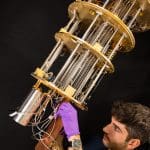
Scientists from King’s College London, Harvard University, UC Berkeley, and other institutions have developed a cosmic radio detector designed to identify dark matter within 15 years. The device, known as an Axion quasiparticle (AQ), operates by detecting the frequency of axions—tiny particles hypothesized to constitute up to 85% of the universe’s mass. By matching the AQ’s frequency with that of axions, the detector emits light upon detection. Constructed from manganese bismuth telluride (MnBi2Te4), a material sensitive to air and shaved into thin layers, the AQ is expected to be operational within five years. Researchers anticipate another decade of scanning high-frequency ranges before potentially discovering dark matter.
The cosmic radio detector, known as AQ (Axion quasiparticle), represents a novel approach to detecting dark matter. Designed to operate at high terahertz frequencies, the AQ detector aligns with the expected range of axion emissions. When a potential axion signal is detected, the device emits light, providing a measurable indication of its presence. This mechanism relies on the unique properties of manganese bismuth telluride (MnBi2Te4), a material engineered into thin, two-dimensional layers to enhance sensitivity and optimize interactions with quantum entities like axions.
Axions as Dark Matter Candidates
Axions are hypothetical elementary particles proposed as a solution to the strong CP problem in quantum chromodynamics. These weakly interacting particles are theorized to emit radiation at specific frequencies along the electromagnetic spectrum, ranging from kilohertz to terahertz. Detecting axions requires specialized instruments capable of identifying these characteristic signals.
The AQ (Axion Quasiparticle) detector is designed to operate at high terahertz frequencies, aligning with the expected range of axion emissions. By emitting light when a potential axion signal is detected, the device provides a measurable indication of its presence. This advancement represents an innovative approach to dark matter detection, offering a potential pathway to confirming the existence of axions and advancing our understanding of the universe’s unseen mass.
Designing the AQ Detector
The AQ (Axion Quasiparticle) detector is engineered to operate at high terahertz frequencies, matching the expected range of axion emissions. Its design incorporates manganese bismuth telluride (MnBi2Te4), a material optimized for sensitivity and interaction with quantum entities like axions. When a potential axion signal is detected, the device emits light, providing a measurable indication of its presence.
The development of the AQ detector is divided into two phases. The first five years focus on constructing a larger-scale prototype, refining the device’s design, and optimizing its sensitivity to detect faint axion signals. The subsequent decade is dedicated to scanning the high-frequency spectrum where axions are hypothesized to reside. This phase requires meticulous calibration and adaptation of the detector to account for variations in signal strength and frequency.
The AQ (Axion Quasiparticle) detector’s success hinges on its ability to match the expected frequencies of axions, a task made possible by the unique properties of manganese bismuth telluride (MnBi2Te4). Engineered into thin, two-dimensional layers, this material enhances sensitivity and optimizes interactions with quantum entities like axions. The use of MnBi2Te4 allows for enhanced sensitivity, enabling the device to detect faint signals that would otherwise be difficult to observe.
By refining the device’s design and optimizing its sensitivity during the initial phase, researchers aim to create a robust tool for identifying axion signals. This advancement represents an innovative approach to dark matter detection, offering a potential pathway to confirming the existence of axions and advancing our understanding of the universe’s unseen mass.
More information
External Link: Click Here For More