Researchers at the University of Arizona, led by Nico Deshler, have developed a novel coronagraph utilizing spatial mode sorters to enhance exoplanet detection. This device works by isolating and eliminating starlight, allowing fainter exoplanet light to be captured more effectively.
Published in Optica, a journal by Optica Publishing Group, the study highlights the potential of this technology to detect planets that are too dim or close to their stars for current telescopes. The coronagraph’s ability to separate starlight from planet light using unique optical modes could significantly advance exoplanet research, aiding in the discovery of biosignatures and improving our understanding of planetary systems beyond our solar system.
Introducing the Challenge of Detecting Faint Exoplanets
Detecting faint exoplanets presents significant challenges due to their proximity to much brighter stars and extreme brightness contrasts, often exceeding 10^6 or higher. Traditional imaging methods struggle under such conditions, as they lack sufficient resolution or contrast suppression capabilities.
A novel approach employs spatial mode sorters combined with quantum optics principles in a quantum-optimal coronagraph. This system enhances detection by separating starlight from planetary light through advanced optical processing, achieving better performance than conventional techniques in handling high-contrast scenarios while preserving resolution.
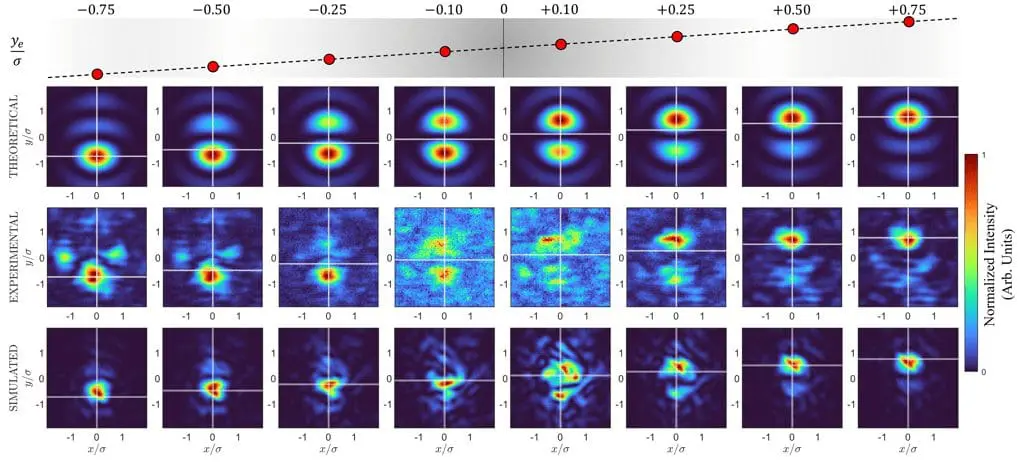
The experimental setup involves simulating conditions akin to those encountered when observing exoplanets. By using a combination of spatial mode sorters and quantum optics principles, researchers can isolate planetary light from the overwhelming glare of the host star. This method has shown promise in improving detection accuracy while maintaining high-resolution imaging capabilities.
Crosstalk in optical mode sorting is a critical challenge for high-contrast imaging systems like quantum-optimal coronagraphs used in exoplanet detection. This interference occurs when light leaks between modes during separation, reducing the effectiveness of starlight suppression. To mitigate crosstalk, improving the precision and fidelity of mode separation is essential.
Improving mode sorter performance involves enhancing both hardware and software components. Upgrading sensors and control systems can reduce overlap and leakage between modes. Additionally, implementing real-time feedback mechanisms allows for continuous monitoring and adjustment, further minimizing crosstalk.
While initially developed for exoplanet detection, the advancements in mode sorter technology have broader applications. These include enhancing quantum sensing capabilities, improving medical imaging precision, and advancing communication systems. By addressing crosstalk and optimizing mode alignment, researchers can unlock new possibilities across multiple scientific domains.
The journey from identifying challenges in exoplanet detection to developing innovative solutions highlights the importance of interdisciplinary research. By tackling issues like crosstalk and optimizing mode sorter performance, scientists not only advance astronomy but also pave the way for breakthroughs in other fields. This collaborative effort underscores the boundless potential of scientific exploration and technological innovation.
More information
External Link: Click Here For More