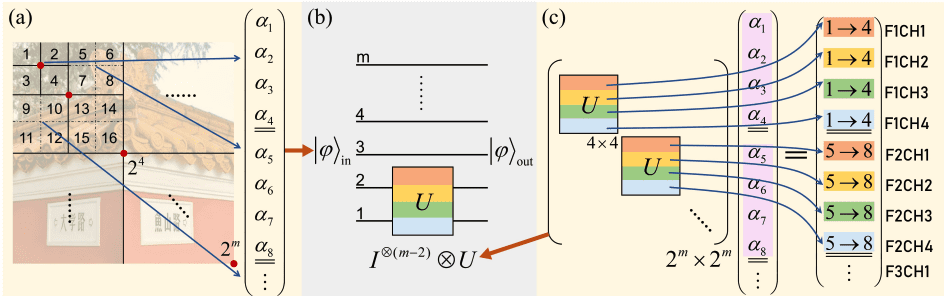
A recent study titled The inherent convolution property of quantum neural networks, published on April 11, 2025, by researchers Guangkai Qu and colleagues, reveals how quantum neural networks can perform convolutions with a single gate operation—a stark contrast to classical methods requiring exponentially more operations. Their research introduces novel architectures that leverage this intrinsic capability, validated through experiments in image classification.
The study reveals a fundamental convolution property in quantum neural networks (QNNs), enabling a single gate to perform a convolutional layer, unlike classical methods requiring 2^n operations. Existing QCNNs have underutilized this potential, limiting their ability to replicate key features of classical CNNs. The researchers propose novel QCNN architectures that leverage QNNs’ inherent convolution capabilities and validate these designs through experiments in multiclass image classification, demonstrating significant advancements in QCNN development and efficient data processing.
Quantum Convolutional Neural Networks: A Hybrid Approach to Enhancing Machine Learning
Recent research has introduced a novel approach by integrating Quantum Convolutional Neural Networks (QCNNs) into classical machine learning frameworks. This hybrid model aims to leverage quantum computing’s unique computational advantages to enhance traditional tasks such as image recognition.
The study introduces parameterized quantum circuits as a quantum layer within classical deep learning models. These circuits are adjustable during training, enabling them to process information in ways that classical computers cannot. While classical layers handle feature extraction and classification, the quantum layer is designed to capture complex patterns more effectively than classical methods alone.
Experiments conducted on benchmark datasets like MNIST and Fashion-MNIST demonstrated improved accuracy compared to traditional CNNs. This suggests that the quantum layer may excel at identifying intricate features or data structures challenging for classical models. The integration of dilated convolutions, which enhance multi-scale context aggregation, further supports this hypothesis by allowing the model to handle various image details more effectively.
The study utilized VQNet 2.0, a quantum computing framework, underscoring the importance of specific tools in achieving credible results and facilitating replication. However, questions remain about the scalability and practicality of this approach, given the current limitations of quantum computing technology.
Key contributions include demonstrating that hybrid models can outperform classical approaches, potentially paving the way for future advancements in AI and quantum computing. While optimistic about the potential, researchers acknowledge that these findings are still in the research phase, with challenges such as quantum noise and limited qubit counts yet to be fully addressed.
In conclusion, this study presents a promising direction by combining classical and quantum methods to enhance machine learning models. It highlights the potential for QCNNs to outperform classical CNNs in specific tasks, though further research is needed to understand the full scope of their capabilities and limitations. This work marks an exciting step towards leveraging quantum computing’s strengths in AI applications.
👉 More information
🗞 The inherent convolution property of quantum neural networks
🧠 DOI: https://doi.org/10.48550/arXiv.2504.08487