Researchers are investigating the strong CP problem and the potential role of axions, hypothetical particles proposed as a solution. This work explores connections between generalized symmetries, including those beyond traditional continuous symmetries, and Topological Quantum Field Theories, offering a modern perspective on this long-standing puzzle. A key focus is the exploration of non-invertible symmetries, a relatively recent development in theoretical physics with significant implications for understanding fundamental symmetries. The research also considers how these theoretical frameworks can be connected to experimental observations, proposing specific models and considering how they might be tested through collider searches and other experiments. Instantons, solutions to the classical equations of motion with unique topological properties, are used to understand the strong CP problem and the properties of axions.
SU(9) Unification Resolves Strong CP Problem
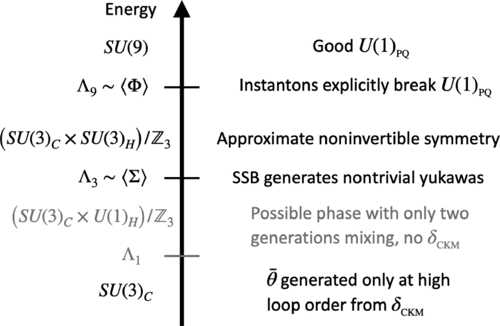
Researchers have engineered a novel theoretical framework to address the strong CP problem, linking quark color and flavor through generalized symmetries beyond the Standard Model. The approach centers on an SU(9) unified theory, embedding the Standard Model within a larger gauge structure to naturally suppress contributions to the strong CP violating term. This unification requires no additional fermions, instead leveraging the existing symmetries of quark fields. To implement flavor breaking and generate realistic quark masses, scientists introduced several scalar fields transforming under the SU(9) symmetry. These scalar fields break down the symmetry in stages, generating the desired quark mass textures and a complex CP-violating phase crucial for explaining observed flavor mixing. Additional fields, including a sterile fermion and a fundamental scalar, ensure the absence of strong CP violation and pave the way for detailed analysis of threshold corrections and renormalization effects.
Symmetries Link Neutrino Mass and Tau Lepton
This research presents a new theoretical framework addressing the strong CP problem and the origin of small neutrino masses, building upon the concept of generalized symmetries. The authors propose a model where quark color and flavor are linked, potentially resolving a long-standing puzzle by reviving a solution involving massless quarks. The framework naturally accommodates small Dirac neutrino Yukawas, arising from instanton effects within a proposed ultraviolet theory, and avoids the need for fine-tuning of parameters. The study demonstrates how symmetries can protect these small Yukawa couplings, linking them to the mass of the tau lepton and offering a pathway to explain the observed values without requiring unnatural adjustments. While the model relies on a specific ultraviolet completion, it provides a concrete mechanism for generating the observed pattern of neutrino masses and addresses the strong CP problem within a technically natural framework.
👉 More information
🗞 Noninvertible Peccei-Quinn Symmetry and the Massless Quark Solution to the Strong $CP$ Problem
🧠 DOI: http://link.aps.org/doi/10.1103/PhysRevX.15.031011