

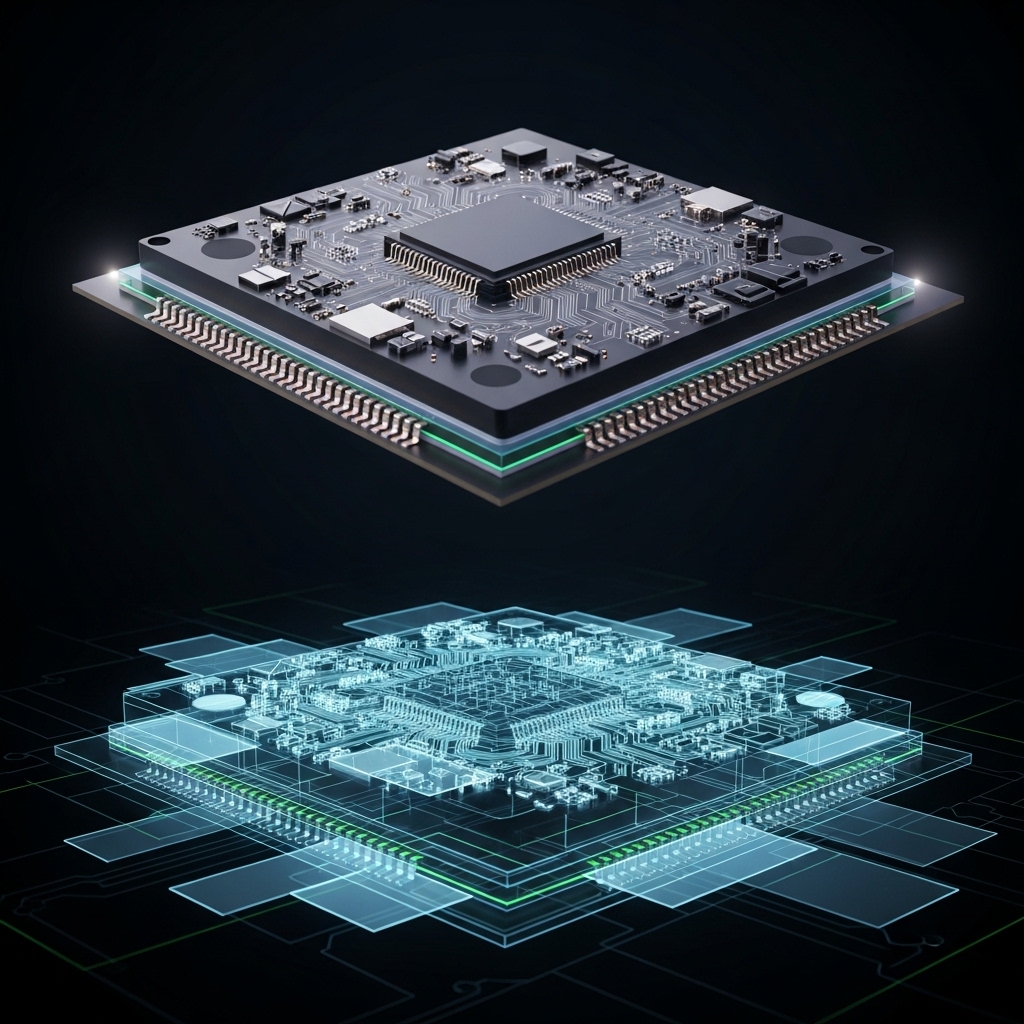
Researchers are tackling the complex challenges of thermal management and reliability in three-dimensional integrated circuit (3D IC) packaging, a cornerstone of modern semiconductor scaling. Gourab Datta, Sarah Safura Sharif, and Yaser Mike Banad, all from the School of Electrical and Computer Engineering at the University of Oklahoma, et al, present a critical review distinguishing between conventional simulation and the development of truly dynamic Digital Twins. This work is significant because it clarifies the ambiguities surrounding Digital Twin terminology and proposes a unified hybrid architecture leveraging physics-informed machine learning to overcome limitations in data and processing speed. By synthesising advances in physics-based modelling, data-driven paradigms, and in-situ sensing, the authors outline a roadmap towards autonomous, self-optimising Digital Twins for both 3D IC manufacturing and operational use.
Real-time reliability prediction via hybrid Digital Twin architectures for 3D ICs enables proactive failure analysis
Scientists have demonstrated a critical advancement in managing the complexities of three-dimensional integrated circuit (3D IC) packaging and heterogeneous integration, technologies central to modern semiconductor scaling. The research addresses the challenges posed by tightly coupled physical effects, thermal hotspots, warpage-induced stresses, and interconnect aging, within stacked architectures, which demand monitoring and control beyond traditional offline methods.
This study unveils a unified hybrid Digital Twin (DT) architecture designed for real-time reliability management, distinguishing itself from existing approaches by clarifying the hierarchy of digital models, shadows, and true twins. The team achieved this breakthrough by synthesizing three foundational technologies: physics-based modeling, data-driven paradigms, and in-situ sensing.
They emphasize a shift from computationally intensive finite-element analysis (FEA) to real-time surrogate models, enabling faster and more agile simulations. Furthermore, the work highlights virtual metrology (VM) for inferring critical, yet latent, metrics within the 3D IC stack. This in-situ sensing component functions as a “nervous system,” continuously coupling the physical stack to its virtual counterpart, facilitating a closed-loop feedback system.
This research establishes a novel hybrid DT architecture leveraging physics-informed machine learning, specifically Physics-Informed Neural Networks (PINNs), to overcome limitations imposed by data scarcity and latency constraints. The global market for 2.5D and 3D packaging is projected to grow from 5 billion to over 20 billion by 2033, yet current reliability management relies heavily on offline metrology, which can be slow, destructive, and unable to detect transient defects.
The team’s work addresses this gap, noting that defect density in advanced packaging has increased by more than 35% relative to 2D integration, and thermal power densities are projected to surpass 1kW/cm2. The research team clarified the Digital Twin hierarchy, distinguishing between digital models, shadows, and true twins to resolve terminological ambiguity. This work detailed three foundational enabling pillars: physics-based modeling, data-driven paradigms, and in-situ sensing, forming the basis for a unified hybrid Digital Twin architecture.
Researchers emphasised a shift from computationally intensive finite-element analysis (FEA) to real-time surrogate models for physics-based modeling. The study pioneered the use of physics-informed neural networks (PINNs) to reconcile data scarcity with latency constraints, enabling faster and more efficient simulations.
Data-driven paradigms were explored, highlighting virtual metrology for inferring latent metrics not directly measurable through physical inspection. Experiments employed a comprehensive review of existing literature alongside the development of a novel hybrid architecture. The methodology involved analysing thermo-mechanical mismatch and warpage, which can trigger delamination and cracking in 3D ICs, alongside interconnect fatigue and electromigration.
Scientists assessed the limitations of traditional offline physical metrology techniques like scanning acoustic microscopy (SAM) and X-ray computed tomography (CT), noting their throughput limitations and inability to detect transient defects. The research synthesises three foundational elements: physics-based modelling, data-driven paradigms, and in-situ sensing, to enable real-time reliability management.
Experiments revealed a shift from computationally intensive finite-element analysis (FEA) to real-time surrogate models for improved efficiency. The team measured structural assurance and virtual sample preparation using terahertz time-domain spectroscopy (THz-TDS) coupled with finite-element modelling.
This framework reconstructs layer-resolved structural and density information, simulating mechanical response during slicing and polishing. Results demonstrate the ability to predict stress and warpage evolution, recommending optimal sectioning planes and process parameters, reducing preparation-induced cracking.
The approach improved confidence in identifying true root causes of defects, rather than laboratory-induced artefacts. Researchers modelled thermo-oxidative degradation in epoxy moulding compounds, adopting a core, shell representation where an “oxidized skin” layer grows during high-temperature aging at 150°C.
By iteratively calibrating model parameters against experimental warpage measurements, the Twin captured time-dependent curvature evolution, including a reported warpage sign reversal. This illustrates the essential Digital Twin capability of synchronising a deterministic model with evolving material state.
Furthermore, scientists developed a high-fidelity framework incorporating viscoelastic constitutive behaviour to predict transient and residual stress evolution in advanced memory stacks. By calibrating Prony-series parameters to dynamic mechanical analysis (DMA) data, the model achieved improved predictive agreement for both transient thermal gradients and long-term residual stresses.
These stresses are directly linked to delayed interconnect failures, such as cracks initiating after prolonged field exposure. Industrial implementation frameworks, like Altair SimLab, instantiate the computational core, supporting automated coupling between electrical inputs and thermo-mechanical solvers. A unified hybrid Digital Twin architecture was proposed, leveraging physics-informed machine learning to balance data limitations with latency requirements.
This work establishes a principled foundation for lifecycle reliability tracking in advanced packaging by embedding physics-informed surrogates within modular, standards-aligned workflows. Future research should focus on developing uncertainty-aware decision logic for machine learning surrogates and implementing closed-loop validation frameworks to address non-stationarity in both physics and data.
👉 More information
🗞 Toward Digital Twins in 3D IC Packaging: A Critical Review of Physics, Data, and Hybrid Architectures
🧠 ArXiv: https://arxiv.org/abs/2601.23226


