
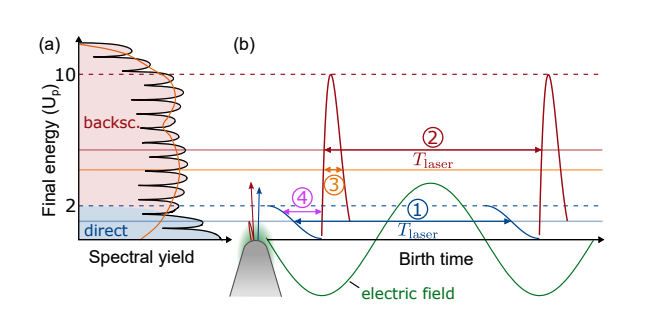
Understanding how electrons behave in solids presents a significant challenge in physics, and researchers have long sought to observe interference effects in electron emission from metallic surfaces. Anne Herzig, Peter Hommelhoff, and Eleftherios Goulielmakis, alongside colleagues at the University of Rostock and Ludwig Maximilian University Munich, now demonstrate this interference in single-cycle electron emission from metal needle tips. The team explores the behaviour of electrons using both classical trajectory calculations and quantum mechanical simulations, revealing that direct and backscattered electrons interfere to create distinct patterns. This discovery encodes information about the timing of electron birth and acceleration, potentially paving the way for new techniques in ultrafast solid-state physics and electron source development.
Laser Control of Nanoscale Electron Emission
This research details an investigation into controlling electron emission from nanometric needle tips using intense laser pulses. The core finding is the observation of interference effects in the emitted electrons, demonstrating the potential for manipulating electron dynamics at the nanoscale. Researchers are exploring how to manipulate electron emission from nanostructures using intense laser fields, relevant to fields like attosecond science, microscopy, and potentially novel electronic devices. They focus on nanometric needle tips because these structures amplify the laser-matter interaction, aiming to understand and control the quantum mechanical wave nature of the emitted electrons.
Experiments reveal clear interference patterns, indicating the emitted electrons behave as waves and interfere with each other. The interference patterns are sensitive to the characteristics of the laser pulse, meaning researchers can manipulate electron emission by controlling these characteristics, demonstrating coherent control of electron dynamics at the nanoscale. Experimental results are supported by theoretical calculations that model electron dynamics and explain the observed interference patterns. The research provides a deeper understanding of the fundamental processes governing electron emission from nanostructures, with implications for attosecond science, nanoscale devices, and advanced microscopy. The ability to control electron emission with attosecond precision opens up new possibilities for studying ultrafast electron dynamics, potentially leading to the development of novel nanoscale devices and improving the resolution of electron microscopy techniques.
Cross-Process Interference in Photoemission Revealed
Researchers have, for the first time, demonstrated a pathway to understanding interference patterns in photoemission from solid materials, a phenomenon previously observed only in atoms and molecules. The team successfully modeled the behavior of electrons emitted from sharp metal needle tips when exposed to single-cycle pulses of light, revealing a complex interplay between directly emitted and backscattered electrons. Experiments and theoretical modeling confirm that interference between these electron pathways creates distinct fringe patterns, encoding information about the timing of electron birth and the dynamics of acceleration within the solid. The research establishes that these interference patterns arise from specific conditions related to the energy and phase of the emitted electrons.
By comparing results from detailed simulations with a simplified model, scientists pinpointed that these fringes become visible only when a sufficient contrast exists between direct and backscattered electrons and a rapid evolution of their relative phase occurs with energy. This means constructive and destructive interference alternate rapidly, creating the observed fringe patterns. Importantly, the study reveals that the spacing of these fringes does not correspond to the energy of the photons driving the process, indicating a more complex underlying mechanism. Analysis of the phase evolution demonstrates the significant contribution of three factors: the birth time of the electrons, their kinetic energy, and a previously overlooked near-field effect, arising from the localized electromagnetic environment at the needle tip. These findings open new avenues for investigating ultrafast dynamics within solids and provide a theoretical framework for analyzing these fringes, potentially leading to new methods for controlling and manipulating electron emission from nanoscale materials.
Electron Interference Reveals Near-Field Dynamics
This research demonstrates that interference between electrons emitted directly from and backscattered by sharp metal needle tips occurs when these tips are exposed to single-cycle light pulses. The study reveals that this interference creates distinct patterns, encoding information about the dynamics of electron acceleration near the metal surface. Importantly, the analysis shows that the evolution of these patterns is influenced by three key factors: the birth time of the electrons, their kinetic energy, and a previously overlooked near-field effect. The findings extend beyond conventional understanding of strong-field photoemission, highlighting the significance of the near-field effect, which does not cancel out as it does in longer pulse scenarios. By comparing results from detailed simulations with a simplified model, researchers were able to explain the origin of these fringes and demonstrate how they can be used to investigate the near-field driven acceleration of electrons. While the current work provides a theoretical framework for analyzing these phenomena, further research is needed to develop reconstruction approaches for characterizing these dynamics experimentally, building upon existing knowledge of attosecond physics and strong-field nano-optics.
👉 More information
🗞 Cross-process interference in single-cycle electron emission from metal needle tips
🧠 ArXiv: https://arxiv.org/abs/2509.01524