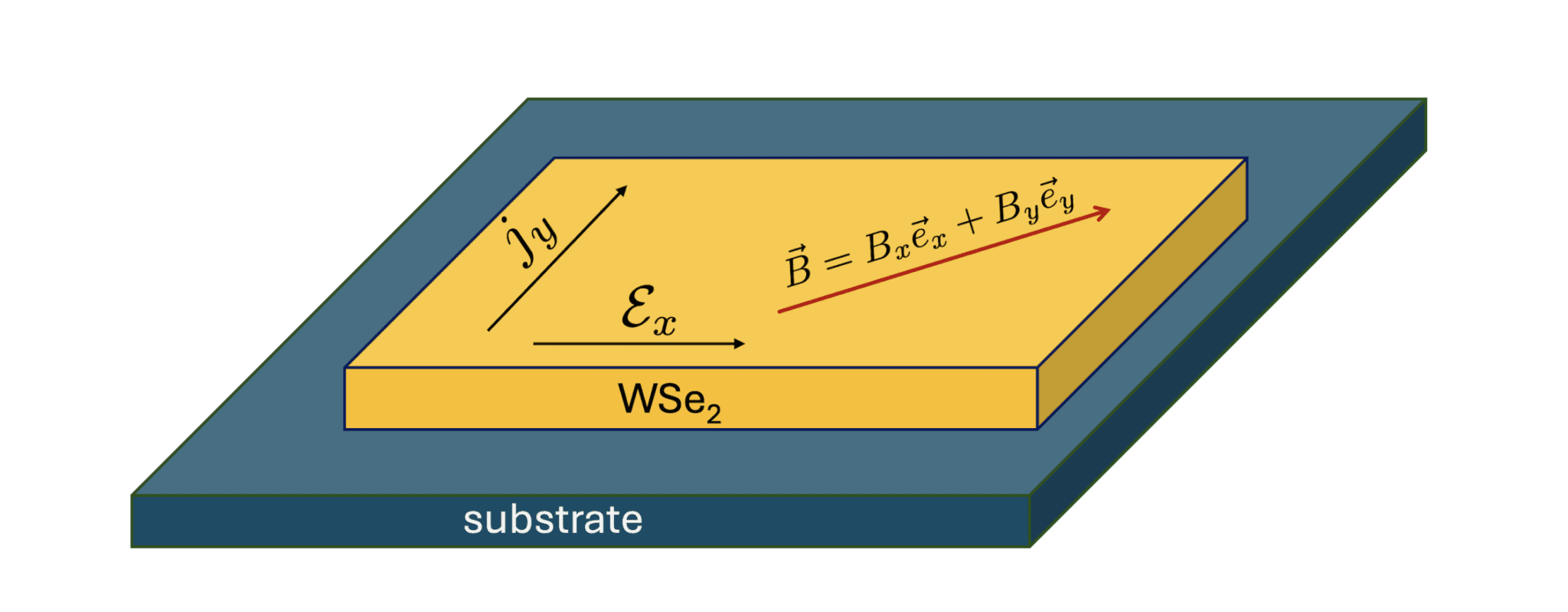
The unusual behaviour of electrons in certain materials holds promise for next-generation electronics, and recent research explores a specific phenomenon called the nonlinear Hall effect in topological Dirac semimetals. Maxim Dzero from Kent State University, Maxim Khodas from The Hebrew University of Jerusalem, Alex Levchenko from University of Wisconsin-Madison, and Vladyslav Kozii from Carnegie Mellon University investigate how these materials respond to magnetic fields, revealing a complex interplay between electron motion and material properties. Their work details how applying a magnetic field generates a unique electrical response, potentially allowing for new types of electronic devices that manipulate current with greater precision. The team’s theoretical calculations predict that this effect should be observable in materials like tin telluride, tungsten telluride, tungsten diselenide, and cerium bismuth palladium, offering a pathway to test the theory and unlock the potential of these fascinating materials.
The team derives a quantum kinetic equation to describe the behavior of electrons within the material, then solves this equation to calculate how the electric field drives current. Both the Berry curvature dipole and the direct influence of the magnetic field on the current are analyzed, allowing for detailed investigation of their respective contributions. This approach employs a non-equilibrium Green’s function technique, accurately capturing the dynamics of the system under external drive. Specifically, the calculations use a self-consistent Born approximation to account for interactions between electrons, ensuring a robust and reliable description of electronic transport. The resulting expressions determine the magnitude and direction of the current components, providing insights into the underlying physical mechanisms responsible for the observed phenomena.
Nonlinear Hall Effect in Topological Materials
Recent research extensively explores nonlinear optical effects and topological materials, revealing a wealth of fascinating phenomena. The research focuses on the nonlinear Hall effect, where a transverse voltage is generated without an external magnetic field, driven by nonlinear responses to applied currents or light. This differs from the ordinary Hall effect, which requires a magnetic field. The Berry curvature and Berry dipole moment are central concepts, describing the geometric properties of the electronic band structure and relating to anomalous velocities and currents that give rise to the nonlinear Hall effect. Materials with non-trivial topological properties, such as Weyl semimetals, Dirac semimetals, topological insulators, and topological crystalline insulators, often exhibit strong Berry curvature and are promising candidates for realizing large nonlinear Hall effects. Related effects include the photogalvanic effect and circular photogalvanic effect, which generate a DC voltage from light absorption and can be used to probe the Berry curvature and other band structure properties.
Research demonstrates large nonlinear Hall effects in Weyl semimetals, Dirac semimetals, and topological insulators, often attributed to strong Berry curvature. Quantum theories of the nonlinear Hall effect are being developed, including the role of scattering and disorder. The nonlinear Hall effect is proposed as a powerful tool for characterizing the topological properties of materials and is being investigated in two-dimensional materials like transition metal dichalcogenides. Studies explore how symmetry breaking can enhance the nonlinear Hall effect. The circular photogalvanic effect is used to map the Berry curvature in momentum space, with some studies reporting exceptionally large effects in Weyl semimetals potentially due to the chiral anomaly.
Resonant excitation is also investigated for its role in enhancing the photogalvanic effect, while the interplay between the circular photogalvanic effect and magnetism is explored. Difference frequency generation and second harmonic generation are used to probe symmetry and electronic structure. Theoretical frameworks are developed to describe nonlinear magneto-optical responses and quantum mechanical models are developed to understand the origin and magnitude of the nonlinear Hall effect. The influence of disorder and electron-electron interactions on these effects is also investigated.
Several studies report exceptionally large nonlinear optical responses in certain materials, suggesting the potential for novel devices. The use of the nonlinear Hall effect for wireless radiofrequency rectification is a promising application, and the nonlinear Hall effect is emerging as a powerful tool for characterizing the quantum geometry of materials. The interplay between topology, magnetism, and nonlinear optics is a rich area of research, with resonant effects gaining increasing attention. Research focuses on Weyl semimetals due to their strong Berry curvature and chiral anomaly, as well as Dirac semimetals, topological insulators, topological crystalline insulators, transition metal dichalcogenides, and heavy fermion systems. This research paints a vibrant picture of ongoing work in nonlinear optics and topological materials, focusing on understanding and harnessing the interplay between topology, quantum geometry, and nonlinear optical phenomena. The potential applications are vast, ranging from novel electronic devices to new ways of probing and characterizing materials, with the field rapidly evolving with new materials, theoretical insights, and experimental techniques constantly emerging.
Magnetic Field Controls Dirac Semimetal Current
This research investigates how electrical current flows in two-dimensional materials known as Dirac semimetals, specifically focusing on the influence of an external magnetic field. The team developed a theoretical framework to calculate the current generated by an applied electric field, taking into account both the inherent properties of the material and the impact of the magnetic field. Their calculations reveal that the current arises from two primary sources: the Berry curvature dipole, a geometric property of the material’s band structure, and a contribution directly caused by the applied magnetic field. The findings demonstrate that the predicted current response depends on the strength of the magnetic field and the material’s specific properties, offering a pathway to experimentally verify the theory. The researchers suggest that measurements of the anomalous Hall resistivity in materials like SnTe, WTe, and CeBiPd could confirm their predictions. This work provides a deeper understanding of charge transport in these materials and could contribute to the development of novel electronic devices.
👉 More information
🗞 Nonlinear Hall effect in topological Dirac semimetals in parallel magnetic field
🧠 ArXiv: https://arxiv.org/abs/2508.20159