Understanding how materials conduct electricity requires untangling the complex interplay between inherent disorder and the behaviour of electrons within them, factors crucial to phenomena like superconductivity. Anna Yu. Efimova from the University of Geneva, Yohei Saito and Atsushi Kawamoto from Hokkaido University, and colleagues demonstrate a surprising connection between a material’s resistance and how strongly electrons interact, revealing a universal relationship applicable to a wide range of correlated metals. The team independently controlled both the level of disorder and the strength of electron interactions, discovering that resistance increases linearly with the extent to which electrons effectively gain mass, a finding that challenges conventional understanding of charge transport. This new scaling law, applicable to materials ranging from organic compounds to complex oxides, provides a powerful tool for characterising and predicting the behaviour of correlated metals and offers new insights into the emergence of exotic quantum states.
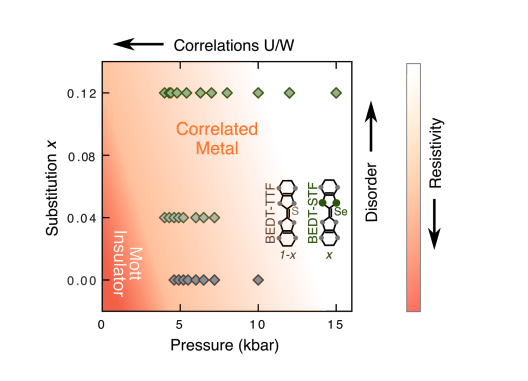
The effects of strong electronic correlations and disorder are crucial for understanding emergent phenomena such as unconventional superconductivity, metal-insulator transitions, and quantum criticality. Both factors are common in real materials, yet their individual impacts on how charge moves through a material remain unclear. To separate their effects, researchers independently varied the degree of randomness and the strength of electronic correlations, using chemical substitution to control disorder and physical pressure to adjust electronic correlations, while studying materials in a metallic state near a point where they could become insulators. This approach aims to provide a clearer understanding of how these two fundamental factors influence material behavior.
Residual Resistivity and Temperature Coefficient Relationship
Researchers have identified a universal relationship between residual resistivity and the temperature coefficient of resistivity in a wide range of materials where electrons strongly interact. They compiled resistivity data from numerous sources, including their own experiments and publicly available data, to increase statistical power and identify broad trends, studying materials such as heavy fermion materials, strontium ruthenate, moiré heterostructures, and organic conductors. Fitting low-temperature resistivity data to a quadratic function allowed them to extract the residual resistivity and the temperature coefficient, revealing a linear relationship when plotted against each other, suggesting a fundamental connection between them.
Disorder and Correlations Govern Charge Transport
Researchers have uncovered a surprising link between electronic correlations, disorder, and charge transport in materials nearing a Mott-insulating state, challenging conventional understanding of metallic behavior. Independently manipulating the degree of randomness and the strength of electronic correlations within their samples revealed a distinct correlation between disorder-dependent residual resistivity and electronic mass enhancement. Contrary to expectations, the results demonstrate that, at a fixed level of disorder, the residual resistivity increases linearly with the electronic mass enhancement, a scaling arising from fluctuations in the chemical potential. Analysis of multiple organic Mott systems, oxides, heavy-fermion compounds, and moiré materials confirms this relationship as a universal feature of correlated metals.
Increasing pressure suppressed insulating and superconducting behavior, stabilizing metallic resistivity at low temperatures, and allowing for detailed analysis. Further investigation showed that the residual resistivity is not simply determined by disorder, but also by the variance of chemical potential fluctuations, leading to an equation demonstrating a linear proportionality between the residual resistivity and a coefficient related to the square of the effective mass enhancement. These findings provide a new framework for understanding charge transport in strongly correlated materials and open avenues for designing materials with tailored electronic properties.
Resistivity Scales with Electronic Mass Enhancement
The research reveals a novel relationship between residual resistivity and electronic mass enhancement in correlated metals, materials where electron interactions significantly influence their properties. By independently tuning both disorder and electronic correlations within materials close to a Mott insulating state, the team found that residual resistivity increases linearly with electronic mass enhancement, a scaling arising from fluctuations in the chemical potential. Importantly, the researchers observed this relationship across a diverse range of materials, including organic Mott systems, oxides, heavy-fermion compounds, and moiré materials, suggesting its universality. This finding challenges conventional expectations and provides a new framework for understanding charge transport in strongly correlated systems.
🗞 Universal relation between residual resistivity and A coefficient in correlated metals
🧠 ArXiv: https://arxiv.org/abs/2508.21759