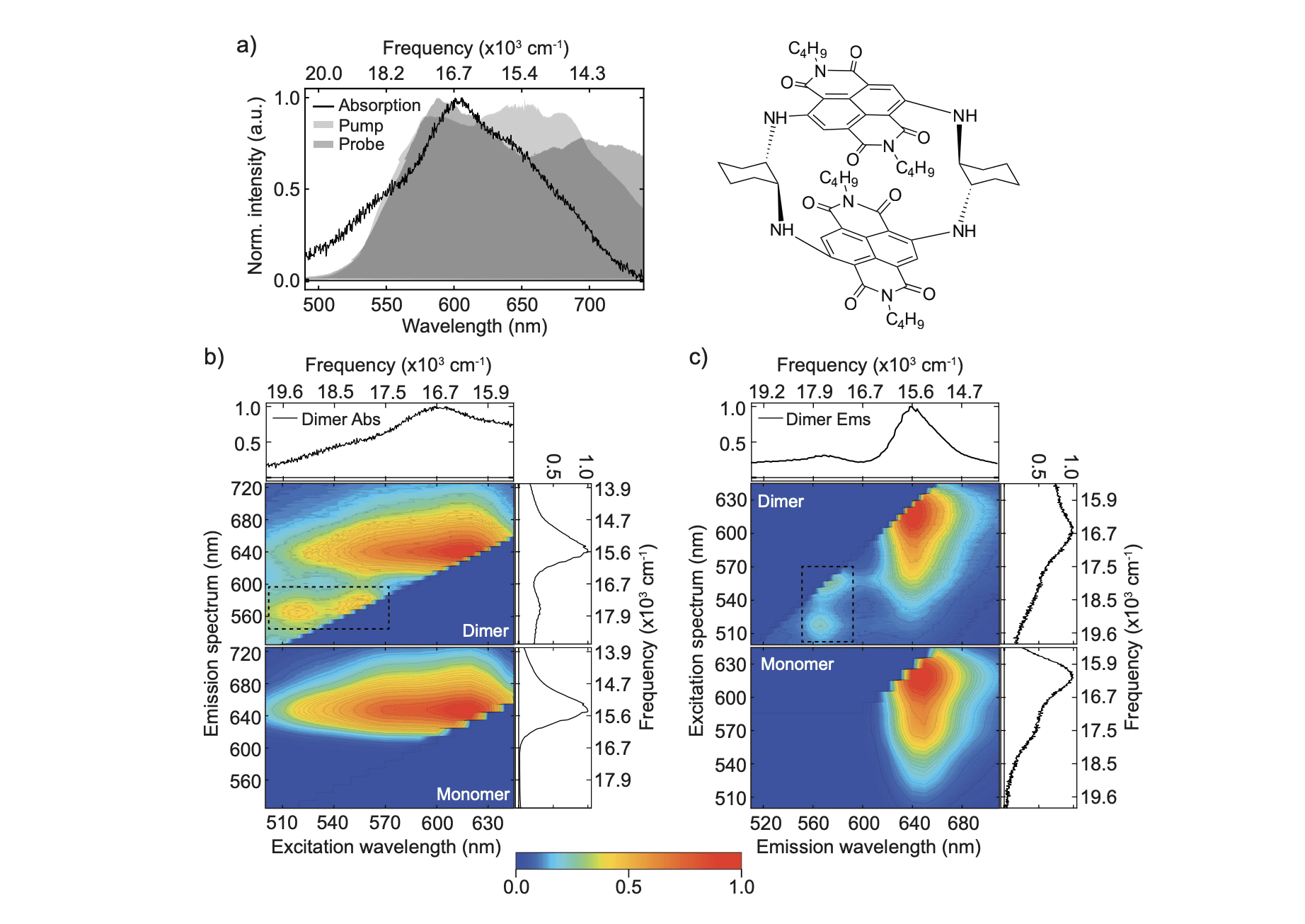
Singlet fission, a process where a single high-energy photon splits into two lower-energy excitations, holds immense promise for boosting the efficiency of solar cells and developing advanced quantum technologies. Sanjoy Patra, Atandrita Bhattacharyya, and colleagues from the Indian Institute of Science, alongside Ch. Mudasar Hussain, Vijay P. Singh from Jawaharlal Nehru University, and Supriyo Santra, Debashree Ghosh from the Indian Association for the Cultivation of Science, have shed new light on the intricate mechanisms driving this process within specifically designed molecules. Their research focuses on a novel class of contorted naphthalenediimide dimers, revealing evidence of a coherently coupled, excimer-like intermediate state that plays a crucial role in intramolecular singlet fission. By employing advanced spectroscopic techniques, the team demonstrates that molecular twisting and ruffling motions are central to the evolution of this intermediate, offering valuable insights for refining theoretical models and paving the way for the design of more efficient materials for light harvesting and quantum information processing.
Singlet Fission and Triplet State Dynamics
This research investigates singlet fission and exciton dynamics in molecular systems, particularly in dimers and related structures. Singlet fission is a process where a single excited state splits into two triplet excited states, a phenomenon with potential applications in improving solar cell efficiency and developing new optoelectronic devices. Researchers explore how molecular structure, electronic coupling, and vibrational modes influence these processes, focusing on the interplay between singlet fission, excimer formation, and charge transfer. Key concepts underpinning this work include singlet fission itself, excitons, electron-hole pairs acting as energy carriers, and exciplexes or excimers, which are excited dimers formed through molecular interactions.
A central challenge lies in distinguishing between excimer formation and singlet fission, as both processes can create multiple excited states. Charge transfer, the movement of electrons between molecules, and vibrational coupling, the interaction between electronic and vibrational modes, also play crucial roles in these dynamics. The research employs a range of advanced spectroscopic techniques to monitor excited state behavior. Transient absorption spectroscopy is central to tracking the dynamics of these states, using pump and probe pulses to measure changes in absorption. Polarization-resolved transient absorption spectroscopy provides information about the orientation of excited states and underlying molecular processes.
Two-dimensional electronic spectroscopy offers a detailed understanding of the excited state landscape by correlating different electronic transitions, with rapid scan techniques capturing fast dynamics. White light pump-probe spectroscopy captures a wider range of spectral features, and shot-to-shot detection improves signal-to-noise ratio. The team investigates several molecular systems, including naphthalene dimers, naphthalene-diimide derivatives with modified functional groups, and donor-acceptor complexes. Key findings reveal that distinguishing singlet fission from excimer formation requires careful analysis of kinetic parameters and polarization-resolved spectroscopy.
Vibrational modes can significantly promote or hinder singlet fission, and the strength of electronic coupling between molecules is a key determinant of efficiency. Modifying molecular structure allows for tuning electronic and vibrational properties, optimizing singlet fission. Maintaining coherence in excited states enhances efficiency, while non-Born-Oppenheimer effects and charge transfer competition can influence the process. This research provides a comprehensive investigation of singlet fission and exciton dynamics, leading to a deeper understanding of the underlying mechanisms and identifying key factors influencing efficiency. This knowledge is crucial for developing new materials and devices for solar energy conversion and other optoelectronic applications.
Tracking Singlet Fission Dynamics with Spectroscopy
Researchers developed a sophisticated experimental approach to investigate the intricate details of singlet fission, a process with potential applications in advanced photovoltaics and quantum computing. The team employed polarization-controlled white-light two-dimensional electronic spectroscopy and pump-probe spectroscopy to examine a newly synthesized class of contorted naphthalenediimide dimers, focusing on the mechanistic details of intramolecular singlet fission. This technique reveals the dynamics of electronic and nuclear motions governing the photophysical processes within these molecules. Scientists developed a method to track the evolution of electronic states with exceptional temporal resolution, achieving a 38 femtosecond instrument response function across a 200 nanometer probe bandwidth.
The optical setup utilizes white light continua generated in both pump and probe arms, coupled with chirped mirrors and glass wedges to minimize optical dispersion and maximize two-photon intensity. This allows for precise measurements of the ultrafast dynamics occurring during singlet fission, capturing the formation of intermediate states and the subsequent relaxation to triplet products. To directly observe electronic motion, researchers pioneered the use of broadband impulsive electronic polarization anisotropy, a technique that can track electronic reorientation during singlet fission. Polarization anisotropy experiments, utilizing high extinction ratios, directly report on the electronic dynamics, revealing minimal electronic reorientation throughout the process.
The data demonstrates a coherent picture of singlet fission, where strong electronic correlations between chromophores are maintained during the electronic evolution. Analysis of vibrational modes, using computational methods, identified skeletal movements crucial to the process, as observed in Raman spectra. Experiments employ meticulous data acquisition to overcome challenges posed by the low concentration and weak absorption of the NDI dimers. The team carefully controlled potential sources of error, including polarization-dependent reflection and fluctuations in the probe spectrum, ensuring the reliability of the measurements. All data required for interpretation and verification of the experimental results are provided, ensuring transparency and reproducibility.
Coherent Intermediate Drives Singlet Fission Efficiency
Researchers are gaining unprecedented insight into the process of singlet fission, a phenomenon with promising applications in advanced solar energy technologies and quantum computing. Their work focuses on understanding how molecules efficiently convert a single high-energy photon into two lower-energy triplets, a crucial step in enhancing photovoltaic performance and creating stable qubits. The team investigated a newly designed class of contorted naphthalenediimide dimers, molecules specifically engineered to facilitate this process through a favorable intramolecular pathway. Experiments reveal a surprisingly coherent intermediate stage in singlet fission, characterized by the formation of an excimer-like structure.
This intermediate arises within approximately 200 femtoseconds and subsequently relaxes to form the desired triplet state in around 2 picoseconds. Crucially, the researchers observed that inter-chromophore twisting and ruffling motions drive the evolution towards this excimer-like intermediate, providing a dynamic picture of the molecular rearrangements involved. Polarization anisotropy measurements directly tracked electronic motion during these steps, demonstrating minimal electronic reorientation alongside significant singlet-triplet mixing as the molecules transitioned away from their initial geometry. The data demonstrates a strong wavelength-dependent formation of this excimer-like intermediate, a previously unobserved phenomenon in intramolecular singlet fission.
Analysis of the molecular structure revealed a center-to-center distance suggesting strong orbital overlap and a significant role for charge-transfer states. Furthermore, the team observed Davydov splittings in the absorption spectrum, indicating strong electronic coupling between the two molecular sites. These findings not only refine existing theoretical models of singlet fission but also lay the foundation for broader investigations across diverse molecular platforms, potentially unlocking new avenues for efficient light harvesting and quantum information processing. The reduced molar extinction coefficient further supports the complex electronic interactions within the dimer.
👉 More information
🗞 Intramolecular Singlet Fission Through a Coherently Coupled Excimer-like Intermediate
🧠 ArXiv: https://arxiv.org/abs/2508.21568