

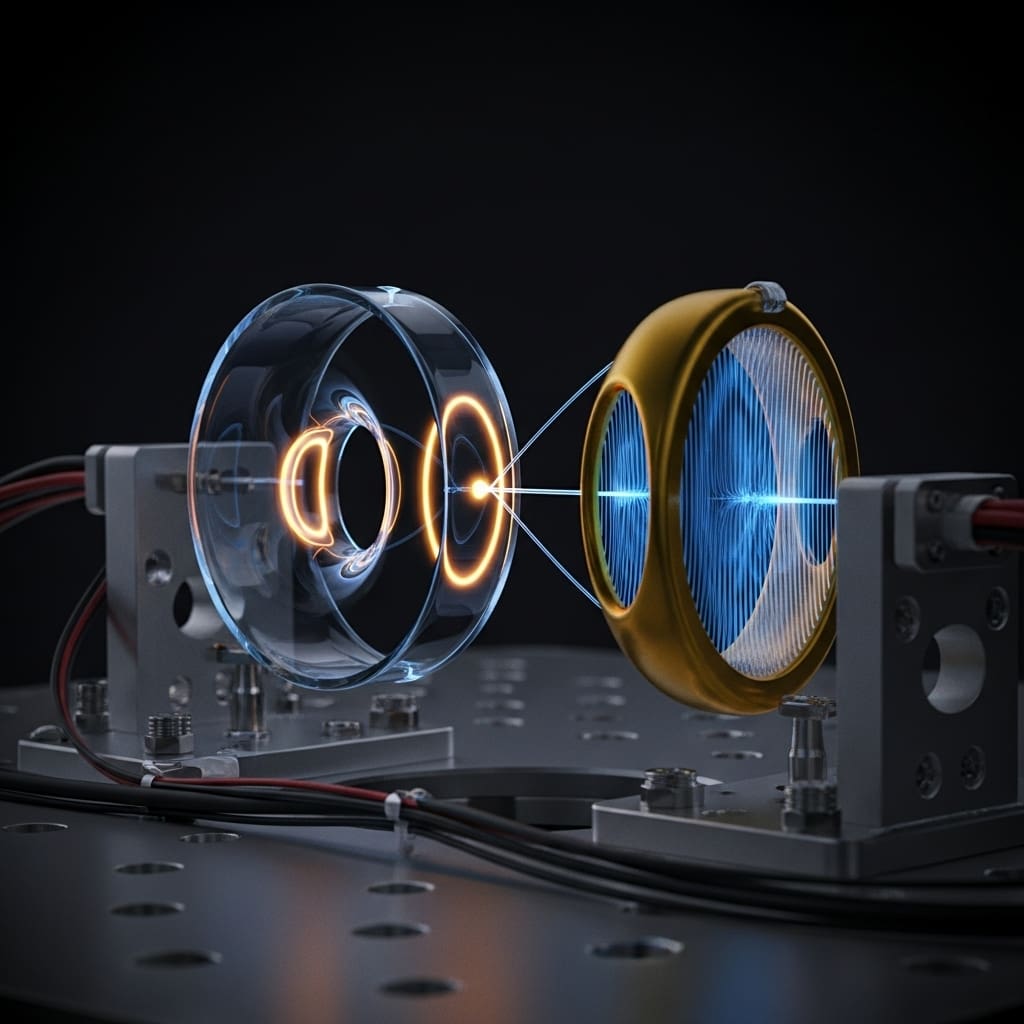
Scientists are tackling the challenge of efficiently bridging the gap between microwave and optical frequencies with a novel all-dielectric resonant transducer. Mihir Khanna, Yang Hu, and Thomas P. Purdy, from the University of Pittsburgh and Skyworks Solutions Inc., detail a system utilising lithium niobate to confine microwave photons and couple them to optical photons via the electro-optic effect. Their research, demonstrating percent-level photon number conversion efficiency at room temperature, represents a significant advance as it bypasses the limitations of traditional metal-electrode based devices, reducing noise and loss. This breakthrough establishes a promising platform for precise optical detection of microwave fields and opens avenues towards single-photon-level microwave-optical transduction , crucial for applications in quantum technologies and sensitive sensing.
Lithium Niobate Transducer for Microwave-Optical Conversion offers high
Scientists have unveiled a resonant electro-optic transducer capable of efficiently converting between microwave and telecom wavelength photons, representing a significant step towards advanced quantum technologies. Their innovative platform utilizes a bulk lithium niobate crystal, leveraging its substantial dielectric constant to confine microwave photons at the wavelength scale, a crucial element for enhanced interaction. By integrating this crystal within a high-finesse Fabry, Perot optical cavity, the researchers facilitated coupling between microwave and optical photons via the electro-optic effect, paving the way for precise signal transduction. The team successfully demonstrated triply resonant operation, simultaneously resonating microwave photons, optical pump photons, and upconverted optical photons within high-quality electromagnetic modes of the system, a feat essential for maximizing conversion efficiency.
This breakthrough device achieves photon number conversion efficiency at the percent level, a performance benchmark comparable to state-of-the-art technologies operating at room temperature. Importantly, this level of efficiency is sufficient to resolve the thermal occupation of the microwave mode, enabling more sensitive detection and analysis, all without the drawbacks of metal electrodes, which often introduce noise and loss. The research establishes an all-dielectric approach as a promising foundation for high-precision sensing of optically detected microwave fields, opening doors to applications requiring exceptional sensitivity and minimal interference. Furthermore, the work presents a viable pathway towards achieving single-photon-level microwave, optical transduction, a critical requirement for quantum communication and computation.
The core of this achievement lies in the device’s design, modeled as parametrically coupled harmonic oscillators, where microwave electric fields modulate the optical refractive index of lithium niobate within an optical cavity. This modulation generates sidebands on optical light, enabling the exchange of microwave and optical photons with remarkable efficiency, a process governed by the cooperativity, a dimensionless measure of transduction. Experiments revealed a single photon EO coupling rate of 1.5 ±0.3Hz, and a cooperativity of (1.7 ±0.8) × 10−2, figures that align with other leading room-temperature, continuous wave devices. By actively pumping the microwave mode, the researchers demonstrated strong coupling between the two optical modes, directly calibrating the EO coupling rate through optical normal mode splitting, a validation technique confirming the accuracy of their simulations. This all-dielectric approach circumvents the limitations of superconducting electrodes, offering improved optical power handling and reduced loss, and ultimately establishing a robust route towards efficient microwave, optical quantum transduction, with potential applications extending to quantum networking, precision metrology, and optical manipulation of microwave devices.
Lithium Niobate Cavity for Microwave-Optical Transduction enables efficient
Scientists engineered a resonant electro-optic transducer to efficiently convert between microwave and telecom wavelength photons, leveraging a bulk lithium niobate crystal for its large dielectric constant and resulting wavelength-scale confinement of microwave photons. This crystal was incorporated into a high-finesse Fabry, Perot optical cavity, enabling coupling between microwave and optical photons via the electro-optic effect, a crucial step in their transduction process. The research team demonstrated triply resonant operation, simultaneously resonating microwave photons, optical pump photons, and upconverted optical photons within high-quality factor electromagnetic modes, a key innovation for efficient signal conversion. To fabricate the device, the study diced a 4 × 12 × 8mm slab of lithium niobate (LN) from a 4mm thick, x-cut wafer, coating one side with a dielectric optical mirror.
This LN slab was then positioned between two aluminum ground planes separated by a ∼10mm air gap, deliberately chosen to be smaller than the free-space microwave wavelength to minimise radiative losses. The crystal was stood-off from one ground plane using 2mm thick blocks of low dielectric constant polystyrene, further optimising performance. Microwave signals were introduced via a loop antenna connected to port 1 of a vector network analyzer (VNA), while a 1550nm laser pumped the optical cavity, with reflected light collected by a high-speed photodetector connected to port 2 of the VNA. Experiments employed a curved mirror, mounted on a piezoelectric actuator, to fine-tune the air gap and lock the optical cavity, allowing precise control over resonance conditions.
The slab and ground plane were mounted on a 5-axis translation stage for coarse adjustment of the air gap and alignment of the optical mode with the microwave antinode. Measurements revealed an intrinsic quality factor of Qm,int = 1.3×10³ for the TM131 microwave mode at a frequency of ωm/2π ∼9GHz, demonstrating the high performance of the microwave components. By scanning either the cavity length or the laser wavelength, the team mapped the electro-optic response, identifying triply resonant conditions where the S21 transduction peak was maximized as the optical difference frequency (∆op) neared ωm/2π = 9.44GHz for the TM131 mode.
Triply resonant microwave-to-optical photon conversion demonstrated in a
Scientists have developed a resonant electro-optic transducer capable of efficiently converting between microwave and telecom wavelength photons. The research team demonstrated a platform utilising a bulk lithium niobate crystal, leveraging its large dielectric constant to confine microwave photons at wavelength scale, a crucial step towards advanced quantum technologies. By integrating this crystal within a high-finesse Fabry-Perot optical cavity, microwave photons effectively couple to optical photons via the electro-optic effect, paving the way for novel signal processing methods. Experiments revealed the ability to tune the system into triply resonant operation, where microwave, optical pump, and upconverted optical photons simultaneously resonate with high quality factor electromagnetic modes.
The device achieved a photon number conversion efficiency at the percent level, a performance comparable to state-of-the-art devices operating at room temperature, sufficient to resolve the thermal occupation of the microwave mode, and crucially, without the drawbacks of metal electrodes. Measurements confirm a single photon EO coupling rate of g0/2π = 1.5 ±0.3Hz, demonstrating a strong interaction between microwave and optical fields within the all-dielectric system. Further analysis showed a cooperativity, a dimensionless measure of transduction efficiency, of C = (1.7 ±0.8) × 10−2, aligning with other leading room-temperature, continuous wave devices. The team successfully pumped the microwave mode, strongly coupling the two optical modes and directly calibrating the EO coupling rate through optical normal mode splitting, results that closely matched simulations.
Tests prove the potential for pushing all-dielectric EO devices into the strong coupling and quantum regimes of operation, opening doors for single-photon-level microwave-optical transduction. This breakthrough delivers a promising platform for high-precision sensing of optically detected microwave fields and avoids the noise and loss typically associated with metallic electrodes. The all-dielectric approach enhances optical power handling and reduces loss, establishing a viable route towards efficient microwave, optical quantum transduction, a critical component for interconnecting superconducting quantum processors and enabling room-temperature fibre-optic communication channels. The research establishes a cm-scale lithium niobate crystal functioning simultaneously as a dielectric microwave resonator and part of a high-finesse Fabry, Perot optical cavity, a design validated through finite element simulations showing the electric field energy distribution of the TM131 microwave dielectric resonator mode.
Efficient Microwave-to-Optical Photon Conversion Demonstrated with High Fidelity
Scientists have developed a resonant electro-optic transducer capable of efficiently converting between microwave and telecom wavelength photons. The device utilizes a bulk lithium niobate crystal to confine microwave photons at a wavelength scale, leveraging its large dielectric constant for enhanced performance. By integrating this crystal into a high-finesse Fabry-Perot optical cavity, researchers facilitated coupling between microwave and optical photons via the electro-optic effect. The demonstrated system achieves triply resonant operation, simultaneously resonating microwave, optical pump, and upconverted optical photons within high-quality electromagnetic modes, resulting in a photon number conversion efficiency at the percent level at room temperature.
This efficiency is comparable to current state-of-the-art devices and is sufficient to resolve the thermal occupation of the microwave mode, all without relying on metal electrodes which can introduce noise and loss. The authors acknowledge limitations related to the microwave loss tangent of lithium niobate, though they anticipate improvements at cryogenic temperatures. Future work could explore cryogenic operation to further enhance cooperativity and power handling, building on existing successes with pulsed optical operation at low temperatures. This all-dielectric platform represents a promising avenue for high-precision optically detected microwave fields and a potential route towards single-photon-level microwave-optical transduction.
👉 More information
🗞 All-Dielectric Resonant Cavity Electro-Optic Transduction Between Microwave and Telecom
🧠 ArXiv: https://arxiv.org/abs/2601.13199

