On April 3, 2025, Felix Grezes published Reservoir Computing: A New Paradigm for Neural Networks, an in-depth literature review exploring how this innovative approach addresses long-standing challenges in recurrent neural networks while offering promising applications across fields such as natural language processing, computational biology, and physics.
Reservoir Computing emerged as a solution to challenges faced by Recurrent Neural Networks (RNNs), such as slow convergence and training difficulties. While RNNs are biologically plausible and capable of modeling dynamical systems, their traditional use posed significant computational hurdles. Reservoir Computing offers a theoretically sound and computationally efficient alternative, successfully applied across fields like natural language processing, computational biology, neuroscience, and physics. This survey explores the history of neural networks, describes reservoir computing’s theoretical foundations, and reviews recent applications in diverse scientific domains.
The Rise of Reservoir Computing
In recent years, reservoir computing has emerged as a groundbreaking approach in machine learning, particularly in the realm of robotics and artificial intelligence. This innovative technique, which draws inspiration from biological neural networks, has garnered significant attention for its ability to process complex temporal data with remarkable efficiency.
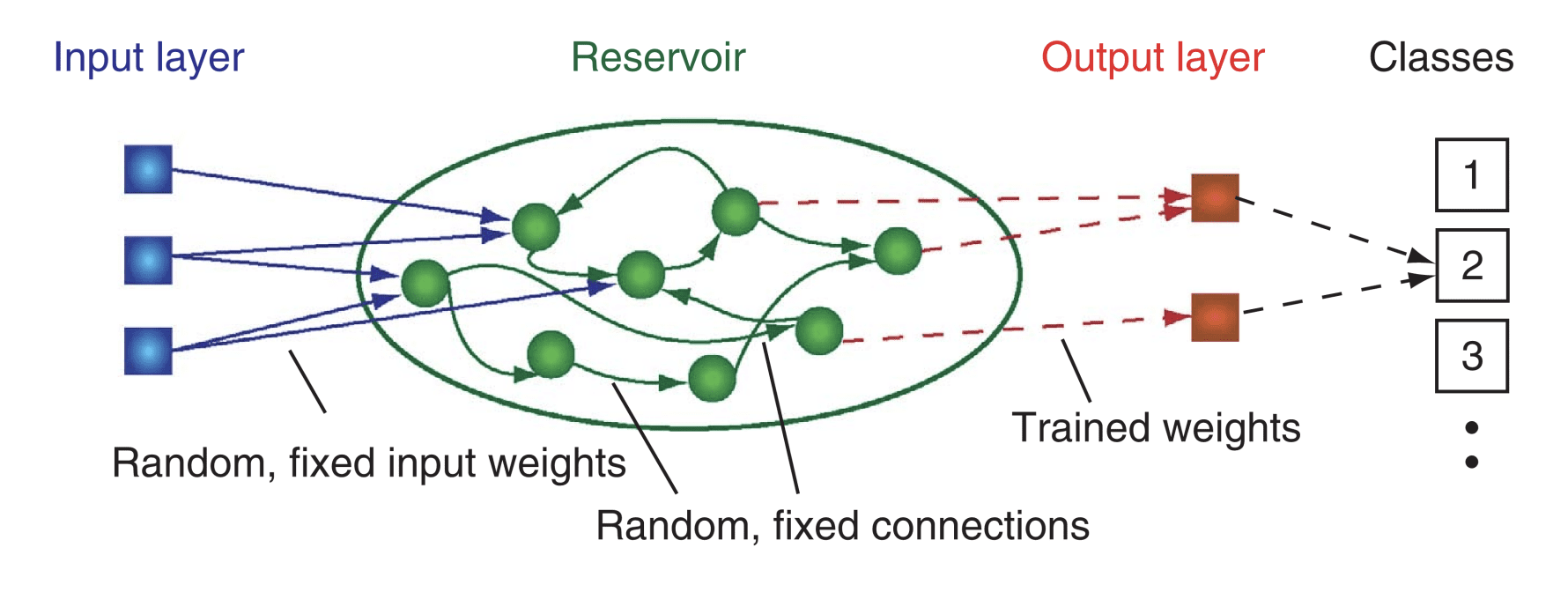
Reservoir computing operates by utilizing a large, fixed recurrent network—known as the reservoir—to transform input signals into high-dimensional representations. These representations are then processed by a simple readout layer, enabling the system to learn and adapt to dynamic patterns in real-time. This architecture not only simplifies the training process but also enhances computational efficiency, making it particularly suitable for applications requiring rapid processing and decision-making.
One of the most notable applications of reservoir computing is in speech recognition. Studies have demonstrated its effectiveness in handling continuous speech signals, such as those found in the DARPA TIMIT corpus, with high accuracy. For instance, research by Jalalvand et al. (2014) showcased how reservoir-based models could achieve robust performance in recognizing connected digits, even in challenging acoustic environments. This capability has significant implications for voice-controlled systems and human-robot interaction, where precision and speed are paramount.
Beyond speech recognition, reservoir computing has also found applications in robotics, particularly in tasks that require the processing of complex sensory-motor sequences. Dominey’s work (1995) highlighted how these systems could be trained using reinforcement learning to perform intricate sequential tasks, mimicking the way biological systems learn through trial and error. This adaptability underscores the potential for reservoir computing to revolutionize robotics by enabling machines to handle dynamic, real-world scenarios with greater autonomy.
Recent advancements in optoelectronic reservoir computing have further expanded the horizons of this field. Paquot et al. (2012) demonstrated how optical systems could be leveraged to create ultra-fast reservoirs, capable of processing information at unprecedented speeds. This development not only enhances computational efficiency but also opens new avenues for integrating reservoir computing into energy-efficient, large-scale systems.
Despite its potential, reservoir computing is not without challenges. The selection of optimal parameters and the need for further theoretical understanding remain critical research areas. However, ongoing studies, such as those by Lukosevicius and Jaeger (2009), continue to shed light on these issues, paving the way for more robust and scalable implementations.
In conclusion, reservoir computing represents a significant leap forward in machine learning, offering a powerful toolset for tackling complex, time-dependent problems. As research progresses, its applications are expected to expand across various domains, from robotics to telecommunications, promising to redefine how we approach artificial intelligence in the future.
🗞 Reservoir Computing: A New Paradigm for Neural Networks
🧠 DOI: https://doi.org/10.48550/arXiv.2504.02639