Researchers led by Giuseppe Barca from the University of Melbourne have taken home the prestigious Gordon Bell Prize in supercomputing for their groundbreaking simulation that pushed the boundaries of speed and accuracy in computationally demanding calculations. Using the Frontier supercomputer, the team conducted a quantum molecular dynamics simulation 1,000 times greater in size and speed than any previous simulation of its kind.
This achievement marks a significant milestone, as it is the first time-resolved quantum chemistry calculation to exceed an exaflop, performing more than a quintillion calculations per second with double-precision arithmetic. The team’s efforts were made possible by their development of EXESS, a new code specifically designed for exascale systems like Frontier. Collaborators on this project included researchers from AMD, QDX, and the Department of Energy’s Oak Ridge National Laboratory.
This breakthrough has far-reaching implications, particularly in the field of drug discovery, where high-accuracy quantum mechanics can now be used to simulate the physics of molecular systems with unprecedented precision.
Frontier Simulations: A Quantum Leap in High-Performance Computing
The 2024 Gordon Bell Prize in supercomputing has been awarded to a team of researchers led by the University of Melbourne for their groundbreaking work on quantum molecular dynamics simulations using the Frontier supercomputer. This achievement marks a significant milestone in high-performance computing, pushing the boundaries of speed and accuracy in computationally demanding calculations.
The team, which includes researchers from AMD, QDX, and the Department of Energy’s Oak Ridge National Laboratory, utilized the world’s most powerful supercomputer at the time to calculate a system containing over 2 million correlated electrons. This feat is 1,000 times greater in size and speed than any previous simulation of its kind. The achievement reflects the extraordinary effort of an international collaboration, demonstrating the potential of scientific computing to address critical challenges in chemistry, biology, and beyond.
Time-Resolved Quantum Chemistry Calculations: A New Benchmark
The team’s simulations achieved a new benchmark by exceeding an exaflop – more than a quintillion calculations per second – using double-precision arithmetic. This level of precision is computationally demanding but essential for many scientific problems. The 16 decimal places provided by double precision enable researchers to tackle larger, more complex scientific problems using leadership-class exascale supercomputers.
The achievement provides a blueprint for enhancing algorithms to address these challenges. As Giuseppe Barca, lead researcher of the team, noted, “This is a game changer for many areas of science, but especially for drug discovery using high-accuracy quantum mechanics.” Historically, researchers have been limited by computing power when simulating the physics of molecular systems with highly accurate models.
EXESS: A New Code for Exascale Systems
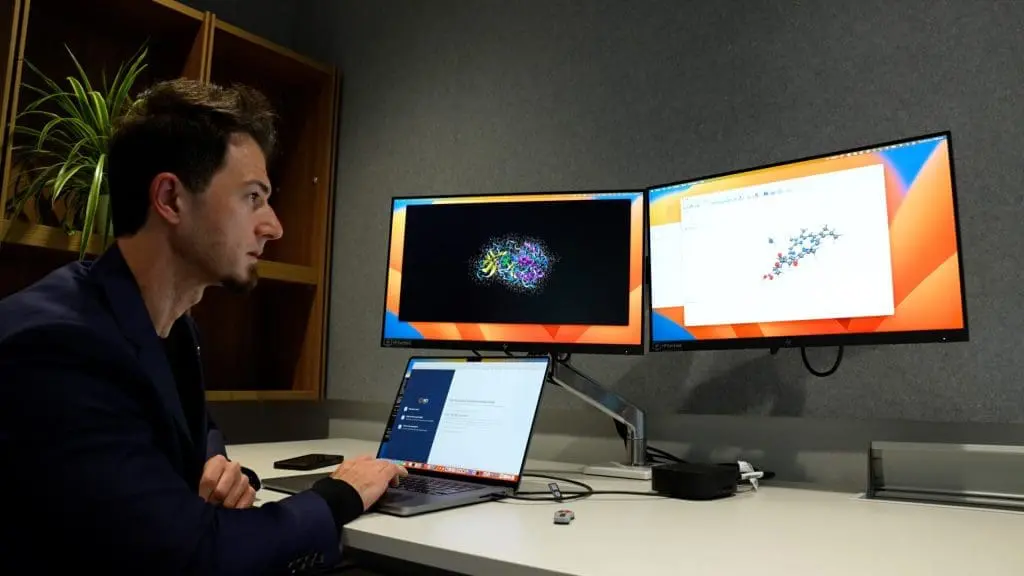
To overcome these limitations, Barca and his team developed EXESS, or the Extreme-scale Electronic Structure System, a new code specifically designed for exascale systems like Frontier. This code enabled the team to simulate atomic interactions in time steps – essentially snapshots of the system – with significantly improved latency compared to previous methods.
For example, time steps for protein systems with thousands of electrons can now be completed in as little as 1 to 5 seconds. This level of precision and speed is crucial for developing new, more advanced technologies, including improved drug therapeutics, medical materials, and biofuels.
Pushing the Limits of Computing
The team’s efforts on Frontier were a huge success, running a series of simulations that utilized 9,400 Frontier computing nodes to calculate the electronic structure of different proteins and organic molecules containing hundreds of thousands of atoms. As Dmytro Bykov, group leader in computing for chemistry and materials at ORNL, noted, “This is why we built Frontier, so we can push the limits of computing and do what hasn’t been done.”
The achievement demonstrates the potential of exascale supercomputers to tackle complex scientific problems that were previously inaccessible. As Barca said, “I cannot describe how difficult it was to achieve this scale both from a molecular and a computational perspective… But it would have been meaningless to do these calculations using anything less than double precision. So it was either going to be all or nothing.”
External Link: Click Here For More