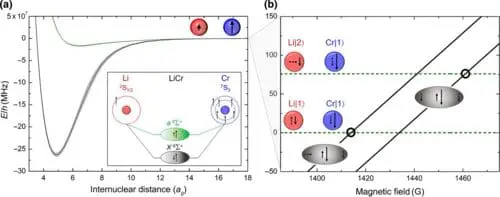
A team of international researchers has discovered a new class of ultracold paramagnetic polar molecules, combining lithium alkali and chromium transition metal elements. The team produced up to 50103 ultracold LiCr molecules, demonstrating their paramagnetic nature and the precise control of their quantum state. This research establishes LiCr as a prime candidate to realize ultracold gases of doubly polar molecules, which are significant for quantum simulation and computation, controlled quantum chemistry, and precision measurements. The study also advances our understanding of quantum chemistry by accurately predicting the properties of LiCr ground and excited electronic states.
What is the New Pathway to Quantum Gases of Paramagnetic Polar Molecules?
A team of researchers from the University of Firenze, Istituto Nazionale di Ottica del Consiglio Nazionale delle Ricerche, European Laboratory for NonLinear Spectroscopy, Campus BioMedico University of Rome, and the University of Warsaw have conducted a joint experimental and theoretical study exploring a novel class of ultracold paramagnetic polar molecules. These molecules combine lithium alkali and chromium transition metal elements, specifically focusing on the bosonic isotopologue 6Li53Cr.
The team leveraged on the Fermi statistics of the parent atomic mixture and on suitable Feshbach resonances recently discovered to produce up to 50103 ultracold LiCr molecules. These molecules were prepared within the least bound rotationless level of the LiCr electronic sextet ground state X6Sigma1. The team also developed new probing methods to thoroughly characterize the molecular gas, demonstrating the paramagnetic nature of LiCr dimers and the precise control of their quantum state.
The researchers investigated the stability of these molecules against inelastic processes and identified a parameter region where pure LiCr samples exhibit lifetimes exceeding 0.2 seconds. This research establishes LiCr as a prime candidate to realize ultracold gases of doubly polar molecules with significant electric and magnetic dipole moments.
How Does This Research Contribute to Quantum Simulation and Computation?
Quantum gases of doubly polar molecules represent appealing frameworks for a variety of cross-disciplinary applications. These applications encompass quantum simulation and computation, controlled quantum chemistry, and precision measurements. The researchers’ study of ultracold paramagnetic polar molecules contributes to these fields by providing a new pathway to create these gases.
The team’s work on LiCr molecules, which possess both an electric and a magnetic dipole moment, offers unprecedented opportunities to investigate quantum chemistry and many-body physics. A high phase-space density gas of such molecules will open up new venues in the context of quantum simulation and computation, as well as quantum controlled chemistry.
The researchers’ pioneering work on excited-state NaLi dimers, despite featuring weak electric and magnetic dipole moments, provided new insights into ultracold reactive collisions. This research exemplifies the potential of their work on LiCr molecules for advancing our understanding of quantum chemistry and physics.
What Challenges Does This Research Address?
The realization of degenerate gases of doubly polar ground-state molecules remains an unsurpassed challenge in the field. While direct laser cooling schemes have been successfully applied to doubly polar radicals, the only experimental realizations of quantum degenerate molecular gases exploit ultracold atomic mixtures.
In these mixtures, atom pairs are first converted into weakly bound molecules across a Feshbach resonance and later transferred to the absolute molecular ground state via stimulated Raman adiabatic passage. However, this two-step method has only been demonstrated on bialkali systems, whose ground state has zero electronic spin and thus negligible magnetic moment.
The researchers’ study addresses these challenges by exploring an alternative route towards ultracold doubly polar molecules. They propose binding an alkali atom with transition-metal chromium, which is expected to combine a high electronic spin with a strong dipolar character.
How Does This Research Advance Our Understanding of Quantum Chemistry?
The researchers’ study advances our understanding of quantum chemistry by accurately predicting the properties of LiCr ground and excited electronic states through state-of-the-art quantum chemical calculations. This ab initio model, able to reproduce the experimental LiCr high-spin octet scattering length, allows the researchers to identify efficient paths to coherently transfer weakly bound LiCr dimers to their absolute ground state.
The team’s research also identifies suitable transitions for the subsequent optical manipulation of these molecules. By thoroughly characterizing the molecular gas and demonstrating the paramagnetic nature of LiCr dimers, the researchers provide valuable insights into the behavior and control of quantum states.
The researchers’ work on LiCr molecules, with their significant electric and magnetic dipole moments, offers a new pathway to realize ultracold gases of doubly polar molecules. This research not only advances our understanding of quantum chemistry but also opens up new opportunities for quantum simulation and computation.
What is the Future of This Research?
The researchers’ study establishes LiCr as a prime candidate to realize ultracold gases of doubly polar molecules. This research opens up new opportunities for quantum simulation and computation, controlled quantum chemistry, and precision measurements.
The team’s work on LiCr molecules, with their significant electric and magnetic dipole moments, offers a new pathway to realize ultracold gases of doubly polar molecules. This research not only advances our understanding of quantum chemistry but also opens up new opportunities for quantum simulation and computation.
The researchers’ study advances our understanding of quantum chemistry by accurately predicting the properties of LiCr ground and excited electronic states through state-of-the-art quantum chemical calculations. This ab initio model, able to reproduce the experimental LiCr high-spin octet scattering length, allows the researchers to identify efficient paths to coherently transfer weakly bound LiCr dimers to their absolute ground state.
Publication Date: 2024-06-12
Authors: S. Finelli, A. Ciamei, B. Restivo, M. Schemmer, et al.
Source: PRX Quantum 5, 020358
DOI: https://doi.org/10.1103/PRXQuantum.5.020358