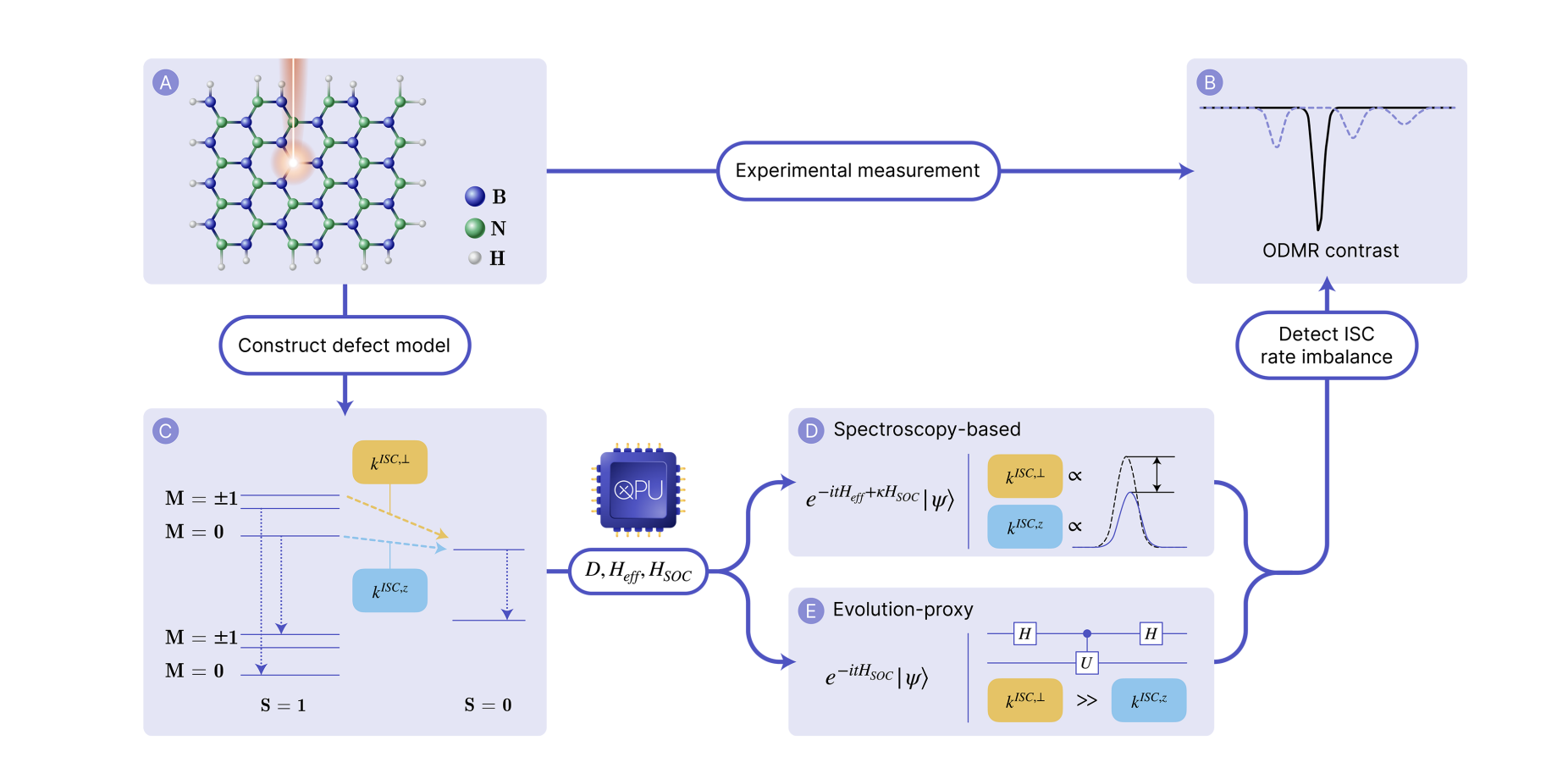
Spin defects in two-dimensional materials hold considerable promise for quantum sensing, but identifying defects with strong optical signals remains a significant challenge. Pablo A. M. Casares, Yanbing Zhou, and Utkarsh Azad, all from Xanadu, alongside colleagues including Chen Ling and Debasish Banerjee from the Toyota Research Institute of North America, present new quantum algorithms designed to detect defects suitable for this purpose rapidly. The team’s approach focuses on identifying imbalances in the rates of transitions between electronic states, a key indicator of strong optical response, without requiring computationally expensive direct calculations. By demonstrating the ability to detect these imbalances using a relatively small number of qubits, the researchers offer a faster and more efficient method for screening potential defects, ultimately accelerating the development of advanced quantum sensing devices.
Calculating Intersystem Crossing Rates with Quantum Methods
Researchers are developing new computational methods to calculate the rate of intersystem crossing (ISC) accurately, the process where a molecule changes between different spin states. Understanding ISC is crucial for predicting how molecules behave when exposed to light, with implications for fields like photochemistry and materials science. Their approach focuses on efficiently modeling the complex interactions that drive these transitions, aiming to overcome limitations in existing computational techniques. They are employing advanced methods to represent the electronic structure of molecules, allowing for more efficient calculations and reducing the computational burden.
A key element of their work involves carefully considering spin-orbit coupling, the interaction between an electron’s spin and its motion, which is a primary driver of ISC. The researchers utilize specific mathematical representations of the electronic wavefunctions and manipulate various operators that describe the spin properties of the molecule. They are also employing two-body density matrices, a technique that efficiently represents the electronic structure and reduces the computational cost. This coupled density functional method offers a significant advantage over traditional wavefunction-based methods, particularly through efficient calculations of total spin squared by decomposing it into simpler terms and utilizing symmetry properties.
The team is also exploring how to implement these calculations using quantum circuits, potentially leveraging the power of quantum computers. They are focusing on several optimizations to improve performance, including focusing on two-body interactions, exploiting molecular symmetry, and efficiently implementing mathematical operators. Identifying materials with strong ODMR signals is currently a process of trial and error, but these new algorithms promise to accelerate discovery by simulating the behavior of defects with greater accuracy and efficiency. The core challenge lies in accurately modeling how electrons transition between different spin states within these defects, a process governed by complex interactions. Instead of directly calculating these rates, which is computationally expensive, the algorithms focus on identifying changes in the material’s optical spectrum caused by these transitions.
One method assesses how the material evolves under the influence of spin-orbit coupling, looking for telltale signs of transitions between spin states. A second, more refined approach compares the material’s emission spectrum with and without spin-orbit coupling, allowing researchers to infer the intensity of transitions between different spin channels. By avoiding direct rate calculations, the team has dramatically reduced the resources needed for screening potential materials. They demonstrate that detecting these imbalances requires a surprisingly modest number of computational steps, opening the door to large-scale simulations. Furthermore, the researchers have developed techniques to amplify the subtle spectral changes caused by spin transitions, making them easier to detect. The team developed two algorithms, one assessing imbalances in rates of transitions between electronic states and the other analyzing changes in emission spectra when spin-orbit coupling is applied. Both methods aim to identify defects suitable for quantum devices by efficiently predicting ODMR activity. Applying these algorithms to the negatively charged boron vacancy in hexagonal boron nitride, the researchers demonstrate the ability to detect imbalances in transition rates using a relatively small number of computational resources. Importantly, the spectroscopy-based algorithm successfully reproduces known optical responses and confirms ODMR activity in this specific defect. While achieving optimal precision may necessitate increased computational demands for different defects, future work could focus on refining these parameters and expanding the application of the algorithms to a wider range of materials, ultimately contributing to the development of high-performing quantum devices.
🗞 Quantum algorithms to detect ODMR-active defects for quantum sensing applications
🧠 ArXiv: https://arxiv.org/abs/2508.13281