

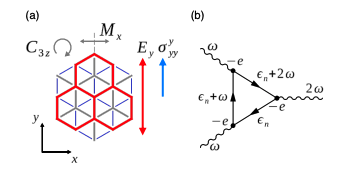
Second harmonic generation (SHG) holds promise as a powerful technique for identifying the stacking order of multilayer graphene, but its sensitivity to external factors has remained a significant challenge, now addressed by research led by Patrick Johansen Sarsfield from the National Graphene Institute, University of Manchester, and Takaaki V. Joya and Takuto Kawakami from the Department of Physics, University of Osaka, along with colleagues. The team investigates how encapsulation and doping affect the SHG signal produced by these materials, revealing characteristic infrared features that act as stacking-order fingerprints for both trilayer and tetralayer polytypes, arising from a strong double resonance effect. Importantly, they demonstrate that while tetralayers consistently exhibit a stronger SHG response than trilayers, the signal in the terahertz regime is highly susceptible to environmental conditions and accidental doping, highlighting the necessity of a spectral approach to accurately determine stacking order. This work establishes that single-frequency measurements are insufficient for reliable identification, as external influences can readily induce comparable signals in otherwise centrosymmetric graphene structures.
Graphene Stacking Dictates Optical Fingerprints
Researchers have discovered that the arrangement of graphene layers significantly impacts its optical properties, specifically its second harmonic generation (SHG). They have identified spectral “fingerprints” for distinguishing between different stacking arrangements in tetralayer and trilayer graphene, exploring how external factors influence the SHG signal, which arises when light interacts with the material and creates new frequencies. The team demonstrated that certain features within the SHG signal remain stable even when the material’s environment changes, offering a reliable way to identify the stacking order of the graphene layers. The investigation revealed that mixed stacking tetralayer graphene, where layers are not perfectly aligned, produces a substantially stronger SHG response compared to other tetralayer configurations.
This difference stems from the unique symmetry breaking within the mixed stacking arrangement, which enhances the material’s nonlinear optical properties. By carefully analyzing the SHG signal, researchers pinpointed specific peaks that act as reliable indicators of the mixed stacking arrangement, even when the material is subject to varying environmental conditions. They found similar, though less pronounced, stable features in trilayer graphene, demonstrating that SHG can be used to characterize stacking order in these materials as well.
Graphene Stacking Order Revealed by Second Harmonics
This research systematically investigates second harmonic generation (SHG) in multilayer graphene, specifically tetralayers and trilayers, to identify robust “fingerprints” of stacking order. The team discovered that certain SHG characteristics in the infrared regime are relatively insensitive to external factors like substrate interactions or encapsulation, arising from a double resonance effect. Notably, tetralayers consistently exhibit a significantly stronger SHG response than trilayers, linked to more favorable energy-matching conditions. The study also demonstrates that analyzing the full spectrum of the SHG signal, rather than just its overall intensity, provides a more reliable way to determine the stacking order, even in the presence of impurities. This spectral approach allows researchers to identify specific features that are characteristic of different stacking arrangements. These findings are significant because they provide a robust method for identifying and characterizing graphene stacking, which is crucial for tailoring its properties for advanced optical and electronic applications.
🗞 Second Harmonic Generation by Multilayer Graphenes and its Dependence on Stacking Order and Encapsulation Environment
🧠 ArXiv: https://arxiv.org/abs/2508.15668


