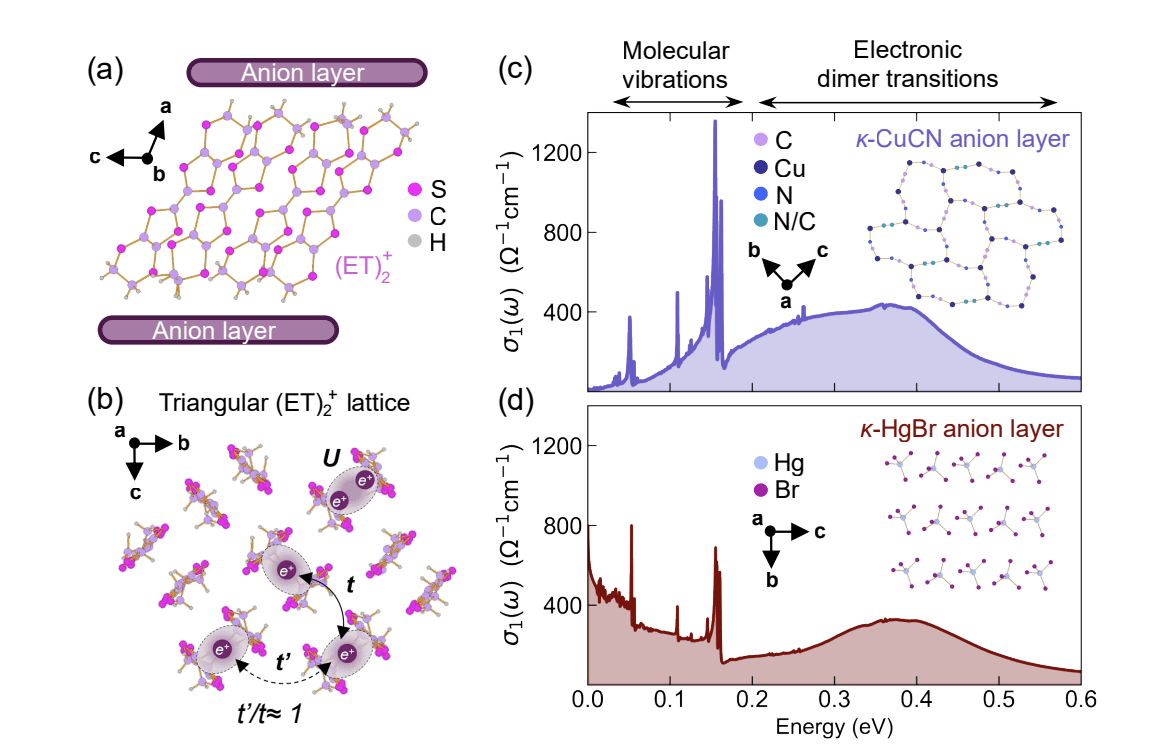
Geometric frustration, a phenomenon that hinders the formation of conventional magnetic order, represents a crucial yet difficult-to-control aspect of quantum spin liquid systems, and researchers are now demonstrating a new method to address this challenge. M. Tepie, F. Glerean, and colleagues from Harvard University, alongside collaborators at the Ruđer Bošković Institute, Universität Stuttgart, and the University of Tokyo, have successfully used light to manipulate frustration within two promising organic materials. The team coherently drives molecular vibrations with mid-infrared pulses, observing a coupling between these local vibrations and broader, nonlocal vibrations within the materials’ structure, and they measure the resulting electronic response using ultrafast techniques. This research establishes a pathway to dynamically control frustration in these complex materials, potentially unlocking new avenues for exploring and harnessing the exotic properties of quantum spin liquids.
Researchers coherently drive molecular vibrations with mid-infrared pulses in two organic quantum spin liquid candidates, insulating κ-(BEDT-TTF)Cu2(CN)3 and metallic κ-(BEDT-TTF)Hg2Br8. The team then probes their electronic response through ultrafast reflectivity measurements, seeking to understand how vibrational control influences these complex materials. This approach aims to manipulate the interactions within these systems and potentially unlock new functionalities arising from their unique quantum states, offering a pathway towards greater control over their properties.
First-Principles Calculations of Organic Conductors
Researchers perform detailed computational studies to understand the electronic structure of organic conductors, specifically materials like κ-(BEDT-TTF)₂X, which exhibit intriguing properties such as superconductivity and insulating behavior. These calculations, based on fundamental physical laws, aim to create accurate models that predict how these materials behave. The team employs Density Functional Theory, a quantum mechanical method, to describe the electronic structure of the materials. To simplify the calculations, they represent the core electrons of atoms using pseudopotentials and include corrections for van der Waals interactions, essential for accurately describing these organic materials.
They use Wannier functions to construct a simplified basis for describing the electronic bands, making it easier to extract parameters for effective models. Tools like Phonopy and Phono3py are used to calculate phonon frequencies and vibrational properties. The calculations are performed using the Quantum ESPRESSO package, employing the Perdew-Burke-Ernzerhof functional. Researchers carefully control the density of points used in the calculations and ensure the results are stable, determining parameters like bandwidth, on-site Coulomb repulsion, and nearest-neighbor transfer integrals. Accurate modeling is vital for understanding the materials’ properties, and the inclusion of van der Waals interactions is crucial for reliable results. The calculated parameters are compared with experimental data, such as crystal structures from the Cambridge Structural Database, to validate the accuracy of the calculations. This research provides a detailed methodological report describing the computational techniques used to build accurate theoretical models of complex organic materials, aimed at researchers in condensed matter physics and materials science.
Mid-Infrared Light Controls Magnetic Frustration
Researchers have discovered a new method for dynamically controlling the behavior of electrons in organic spin liquids, potentially paving the way for new quantum technologies. These materials exhibit unusual magnetic properties due to strong interactions between electrons and a tendency towards magnetic frustration, where electrons struggle to settle into a simple, ordered arrangement. This frustration influences their electronic and magnetic behavior, but has proven difficult to manipulate. The team successfully used precisely timed pulses of mid-infrared light to directly influence the geometric frustration within these materials.
By resonantly driving molecular vibrations, they induced a cooperative motion between the layers of the material, effectively tuning the strength of electron interactions and the degree of frustration. This represents a significant advancement, as previous methods focused on altering electronic interactions without directly modulating frustration itself. The results demonstrate that this light-based control is effective across a range of temperatures, offering a versatile approach to manipulating the material’s properties. The magnitude of control achieved is substantial, with a measurable change in the fundamental parameters governing electron behavior.
This level of control could allow scientists to steer these materials towards exotic quantum states, including those featuring unique excitations known as spinons and triplons, which are predicted to have potential applications in quantum computing. Furthermore, this dynamic tuning of frustration may provide a pathway to induce and explore superconductivity in these organic materials. By carefully controlling the interplay between frustration and electron interactions, researchers hope to unlock new insights into the mechanisms driving unconventional superconductivity and potentially create materials with enhanced superconducting properties. This research establishes a promising new direction for controlling correlated electron systems and opens exciting possibilities for future materials design.
Mid-Infrared Control of Quantum Frustration
This research demonstrates a method for influencing geometric frustration within organic materials exhibiting quantum spin liquid behavior. By employing mid-infrared pulses to stimulate molecular vibrations, the team observed a coupling between these local vibrations and broader structural modes within the materials, κ-(ET)₂CuCN and κ-(ET)₂HgBr. This coupling effectively modulates the strength of electronic interactions and, crucially, the degree of geometric frustration present in the triangular lattice structure of these compounds. The findings establish a new pathway for dynamically controlling frustration, a key parameter governing the magnetic properties of these materials, and open possibilities for steering them towards novel quantum states.
The researchers estimate that the induced changes in geometric frustration fall within the 1-10% range, offering a measurable degree of control. While acknowledging the complexity of directly calculating the precise displacement of atoms, the team highlights the potential for exploring the phase diagram of light-induced superconductivity and detecting renormalized spinon and triplon excitations using spectroscopic techniques. Future work could focus on further refining this control and investigating the resulting impact on the materials’ quantum properties.
👉 More information
🗞 Photoinduced Frustration Modulation in -type Quantum Spin Liquid Candidates
🧠 ArXiv: https://arxiv.org/abs/2508.14034