As the specter of quantum computers capable of deciphering even encrypted internet communications looms, researchers worldwide are racing to develop a quantum internet that could revolutionize data security through tap-proof communication enabled by quantum mechanical phenomena such as superposition and entanglement.
The advent of a high-performance quantum internet hinges on overcoming the current limitations of high costs, energy consumption, and complexity, which have hindered the scaling of quantum networks.
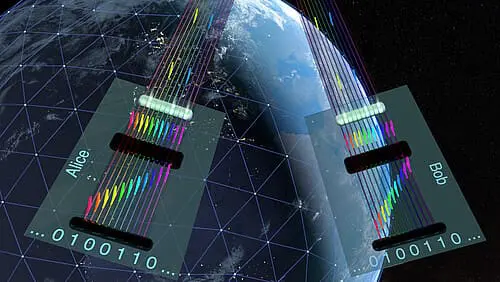
Recent breakthroughs in frequency-bin coding and entanglement-based quantum key distribution, leveraging different light frequencies or “colors” to encode quantum states, promise to increase security and resource efficiency, potentially paving the way for scalable quantum networks that could connect a more significant number of users over greater distances.
This emerging technology, driven by innovations in optical technologies and photonic quantum bits, holds significant implications for the future of secure communication, particularly in critical sectors such as banking and healthcare, where the integrity of data transmission is paramount.
The Quantum Leap in Data Security: Unlocking the Potential of a High-Performance Quantum Internet
In an era where data security is constantly threatened, the advent of quantum computers poses a significant challenge to encrypted files sent over the internet. The potential for these powerful machines to decode even the most secure communications in virtually no time has sparked a race among researchers worldwide to develop quantum networks that could revolutionize the way we communicate securely. At the heart of this endeavor is a quantum internet, a global network that would leverage quantum mechanical phenomena such as superposition and entanglement, along with cryptographic quantum protocols, to guarantee tap-proof communication.
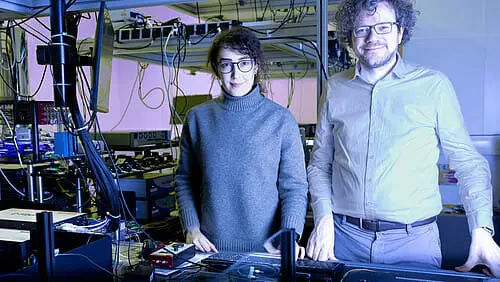
However, despite its promising potential, quantum internet development faces significant hurdles. High costs, coupled with high energy consumption and the complexity of necessary technologies, have hindered the scaling of quantum networks. Against this backdrop, researchers at the Institute of Photonics at Leibniz University Hannover are pioneering a novel approach to entanglement-based quantum key distribution, using frequency-bin coding to increase security and resource efficiency.
Breaking Down the Complexity: Frequency-Bin Coding
The method developed by the researchers utilizes different light frequencies, or colors, to encode respective quantum states. This innovative technique has two primary advantages. Firstly, frequency is more robust against noise compared to polarization, which means it is less susceptible to disturbances caused by environmental factors such as temperature fluctuations and mechanical vibrations in optical fibers. Secondly, by using frequency as a degree of freedom, the complexity of the process is reduced, thereby decreasing costs.
A Leap in Efficiency: Reduced Costs and Increased Security
One of the most significant breakthroughs achieved by the researchers is the ability to measure quantum states of light particles using only one detector instead of four highly sensitive photon detectors. This feat was accomplished through a method called frequency-to-time transfer, which maps frequency components into the photon’s arrival time at the detector. The outcome is a substantial reduction in costs for standard telecommunications components, from around 100,000 Euro to a quarter of that amount. Moreover, the vulnerability to detector attacks diminishes, making the system more secure.
Adaptive Frequency Division Multiplexing: A Dynamic Approach
The researchers’ method employs not just one but several channels simultaneously, a technique known as adaptive frequency division multiplexing. This approach increases the key distribution rate without the need for additional technical devices, allowing the performance of the quantum network to adapt dynamically to the current load. The potential for this method to enable dynamic, resource-minimized quantum key distribution between multiple users is vast, making quantum networks scalable.
Real-World Implications: Securing Critical IT Infrastructure
The development of quantum networks is poised to have a profound impact on critical IT infrastructure, particularly in sectors such as banking and healthcare, where data security is paramount. By providing a new quality of connectivity, capacity, range, and security of quantum communication, these networks could revolutionize the way sensitive information is protected.
Future Directions: The Need for Further Research
While significant strides have been made, there remains a need for further research into the interaction of nanophotonics with quantum optics. This would facilitate the development of additional methods and components for generating a wide range of quantum states for the multidimensional coding of quantum information. With continued innovation, the potential for quantum networks to transform data security and communication is vast.
External Link: Click Here For More