Precise measurement of magnetic fields underpins a wide range of technologies, from medical imaging to navigation, and researchers are continually seeking more sensitive and compact devices. I. Shalev, K. Levi, and R. Malkinson, along with colleagues at the Institute of Applied Physics, The Hebrew University of Jerusalem, have now created a novel sensor that significantly improves magnetic field detection. Their work combines the unique properties of nitrogen-vacancy (NV) centers in diamond with rubidium vapor cells, resulting in a hybrid device, a ‘comagnetometer’, that excels at determining both the strength and direction of magnetic fields. This innovative approach achieves over a ten-fold improvement in accuracy and paves the way for portable, highly sensitive magnetometry with applications in diverse fields, offering a versatile platform for integrated multi-modal sensing.
NV-Rb Hybrid Magnetic Field Sensing
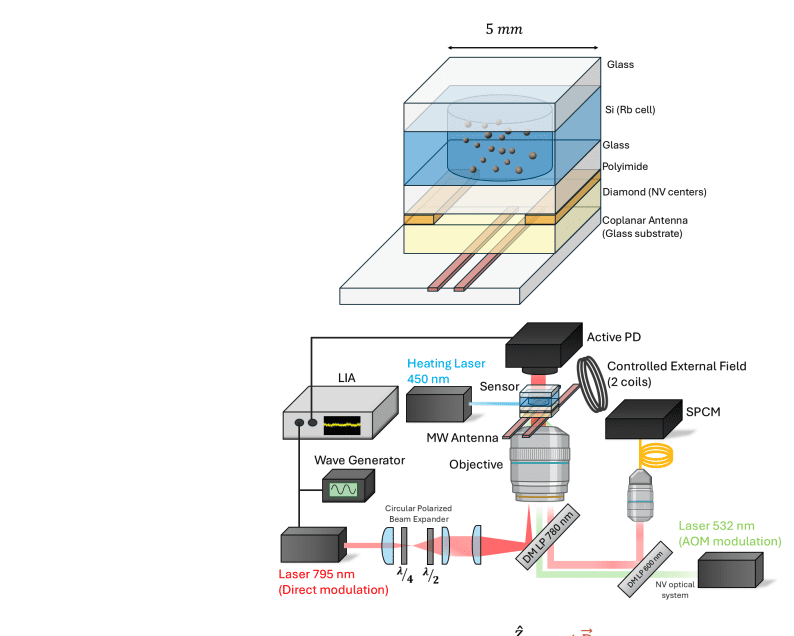
Recent advances in chip-scale quantum sensing have produced platforms that combine unprecedented sensitivity with extreme miniaturization, and researchers have now demonstrated a hybrid sensor integrating nitrogen-vacancy (NV) centers in diamond with rubidium (Rb) vapor to achieve enhanced magnetic field measurements. This innovative comagnetometer leverages the strengths of both approaches, combining the high-resolution vector magnetic sensing of NV centers with the exceptional scalar field sensitivity of Rb vapor, resulting in a more complete and accurate picture of the magnetic field’s magnitude, direction, and spatial distribution. A millimeter-scale Rb vapor cell is positioned alongside a diamond containing NV centers, enabling coordinated optical and microwave control of both quantum systems for integrated field estimation.
The hybrid approach addresses limitations inherent in each individual technology; while NV centers excel at determining the direction of a magnetic field with high spatial resolution, Rb vapor cells traditionally offer superior sensitivity in measuring the field’s overall strength. By combining data from both sensors, the team significantly reduces uncertainty in magnetic field vector estimation, achieving a greater than 10 dB improvement in performance compared to using either technology alone. This represents a substantial leap in sensitivity, allowing for the detection of weaker magnetic fields and more precise measurements of field gradients.
The integrated system operates by simultaneously measuring the magnetic field using both the NV centers and the Rb vapor, then combining the data through a sophisticated vector field estimator. Simulations and experimental results validate the effectiveness of this approach, demonstrating improved magnitude sensitivity without sacrificing the angular accuracy provided by the NV centers. This novel combination paves the way for portable, highly sensitive magnetometry with applications ranging from fundamental research into quantum phenomena to practical applications like medical imaging and materials science. The development of this integrated platform represents a significant step towards multi-modal quantum sensing, capable of measuring multiple physical quantities with high spatial and temporal resolution.
The authors acknowledge that the current demonstration focuses on illustrating a viable integration approach rather than achieving state-of-the-art sensitivity. Future improvements are anticipated through technical refinements such as noise reduction, enhanced light collection, and optimized laser and microwave power, without altering the fundamental system structure. This integrated platform offers a versatile route towards portable, sensitive magnetometry and opens possibilities for novel sensing modalities by capitalizing on the complementary strengths of solid-state and atomic quantum sensors.
👉 More information
🗞 Quantum Co-Magnetometer Using Diamond Nitrogen-Vacancy Centers and Rubidium Cells
🧠 ArXiv: https://arxiv.org/abs/2508.15638