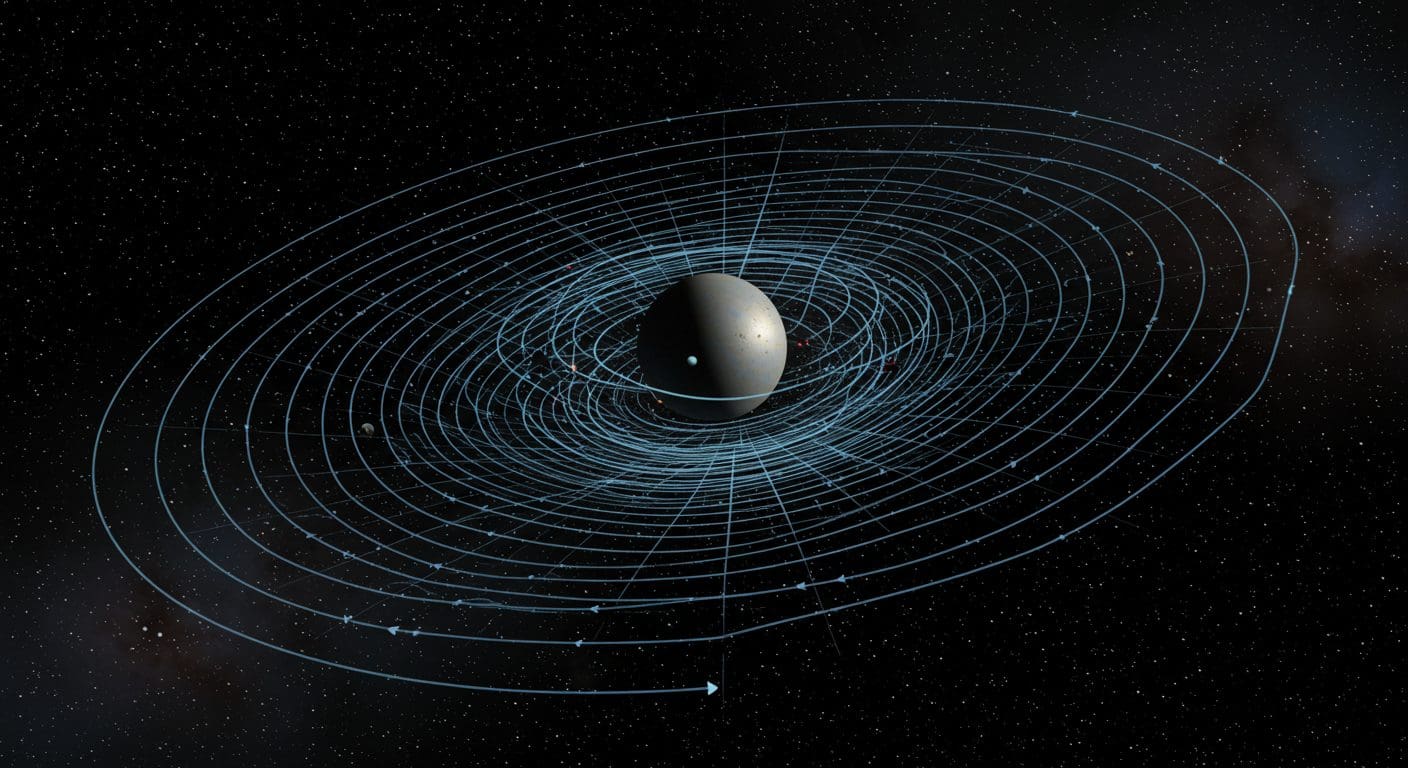
Entanglement, a fundamental property of quantum mechanics, plays an increasingly important role in understanding gravity and the structure of spacetime, and recent work by Artem Averin, along with collaborators from the Arnold Sommerfeld Center for Theoretical Physics at Ludwig Maximilians University, provides a significant step forward in this area. The team proves a generalised version of the Ryu-Takayanagi formula, a key equation linking entanglement to the geometry of spacetime, extending its applicability beyond previously understood limits. This achievement establishes a functional integral expression for entanglement entropies, offering a practical method for their calculation and, crucially, a pathway to study field theories without relying on a holographic dual, a long-sought goal in theoretical physics. By connecting entanglement calculations to the underlying phase space of a theory, this research not only confirms existing holographic proposals but also opens new avenues for exploring the relationship between quantum information and the fundamental laws of the universe.
Work applies to a field theory defined on a region of spacetime, and the selection of a surface within this region specifies a particular configuration for calculations. Researchers recently established a mathematical expression for calculating the density of states within such a system, and this has now been used to establish limits on the volume of the relevant space. These limits formalize a long-standing idea about the maximum amount of entropy possible in a given region, known as the gravitational entropy bound.
Entanglement Entropy from Diffeomorphism Invariance and Paths
This paper presents a new derivation of holographic entanglement entropy, a measure of quantum connectedness, based on a fundamentally different approach than traditional methods. The central idea is to derive entanglement entropy from first principles within a quantum mechanical framework that emphasizes summing over all possible states and leverages the symmetry of field theories. The authors begin with a functional integral, a mathematical tool for calculating probabilities, to represent the density matrix, leading to an expression for entanglement entropy. A key insight is that the existence of the Ryu-Takayanagi formula, a well-known result in the field, isn’t a coincidence, but a consequence of the way summation works in the functional integral combined with the symmetry of the underlying theory.
A significant contribution is that this approach doesn’t require the AdS/CFT correspondence, a specific duality between gravity and quantum field theories. This means it potentially provides a more general framework for understanding entanglement entropy in quantum gravity, even in situations where a holographic dual isn’t known. The framework explicitly connects entanglement entropy to the geometry of phase space, the space representing all possible states of a system, offering a potentially deeper understanding of its physical origin.
Entanglement Entropy Formula Extends Beyond Holography
Researchers have developed a generalized formula for calculating entanglement entropy, a measure of quantum connectedness, within a broad class of physical theories. This work extends the well-known Ryu-Takayanagi formula, originally derived for theories with a specific holographic duality, to encompass theories lacking this property. The breakthrough lies in expressing entanglement entropy as a sum over all possible paths within a specific region of the theory’s phase space, offering a more universal approach to its calculation. The team’s method utilizes a functional integral, a mathematical tool for summing over all possible configurations of a system, to derive a precise expression for entanglement entropy.
This approach not only reproduces the established Ryu-Takayanagi formula in cases where it applies, providing an independent verification of its validity, but also provides a means to calculate entanglement entropy in more general, non-holographic theories. This is significant because it expands the range of physical systems where this crucial quantum property can be meaningfully defined and studied. A key innovation is the connection between entanglement entropy and the phase space of the theory, the space representing all possible states of the system. By linking entropy calculations to paths within this phase space, researchers gain new insights into the underlying structure of the theory and its quantum properties.
This connection allows for the application of integral geometry to the study of entanglement and potentially to understanding the microstates of black holes. The results demonstrate that the team’s approach provides a robust and versatile method for calculating entanglement entropy, applicable to a wider range of physical theories than previously possible. The ability to calculate this fundamental property in non-holographic theories opens new avenues for exploring quantum gravity and the nature of spacetime.
Entanglement Entropy Formula Independent of Coordinates
This research presents a generalized formula for calculating entanglement entropy in quantum field theories that remains consistent regardless of coordinate changes. The team derived a functional integral expression for these entropies, offering a practical method for their evaluation, even in theories lacking a direct connection to gravity or a holographic boundary. This approach builds upon previous work establishing a link between phase space geometry and the gravitational entropy bound, demonstrating how the mathematical structure of possible states within a theory constrains its behaviour. Notably, the derived formula reproduces existing proposals for calculating entanglement entropy, including the Ryu-Takayanagi formula and its various extensions, providing independent validation of these established conjectures and reinforcing the broader connection between entanglement, geometry, and quantum gravity.
👉 More information
🗞 Proof of a Generalized Ryu-Takayanagi Conjecture
🧠 ArXiv: https://arxiv.org/abs/2508.14877