
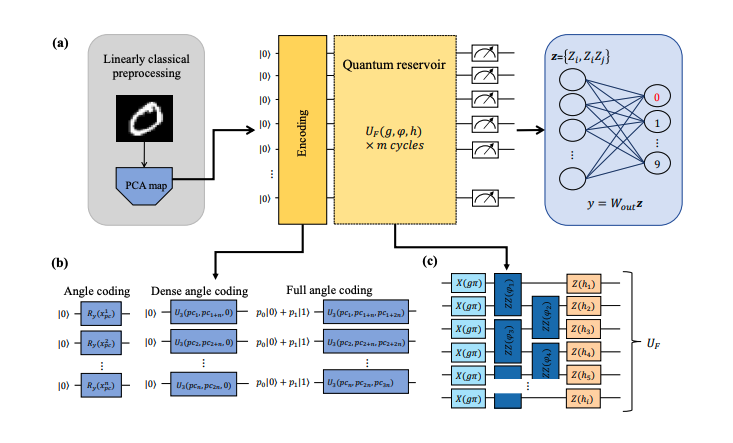
Machine learning increasingly demands powerful algorithms capable of handling complex data, yet current methods often struggle with training stability and susceptibility to noise. Researchers, led by Zhang-Qi Yin from the Beijing Institute of Technology and Da., Ltd., now present a new approach to machine learning using the unique properties of discrete time crystals. Their work introduces a noise-robust algorithm that leverages the dynamics of these time crystals as a ‘reservoir’ for processing information, bypassing traditional training challenges. The team demonstrates impressive performance in both simulated and experimental image classification tasks using superconducting processors, revealing a strong link between the time crystal’s underlying physics and the algorithm’s accuracy, and establishing a new pathway for designing robust machine learning systems suitable for near-term quantum computers.
Many-body localization enhances quantum reservoir computing
The convergence of machine learning and quantum computing has yielded quantum machine learning as a promising research area. Existing quantum machine learning algorithms often struggle with training and susceptibility to noise. Researchers introduce a new, gradient-free quantum reservoir computing algorithm that harnesses the unique dynamics of discrete time crystals. The team first calibrates the reservoir’s essential properties, including its memory, nonlinearity, and ability to scramble information. Quantum reservoir computing leverages the complex behaviour of quantum systems to map input data into a higher-dimensional space, making patterns easier to identify.
This work focuses on many-body localization, a state of matter where quantum systems remain stable even when interacting, preventing information loss. This stability is crucial for creating reliable quantum reservoirs. Discrete time crystals, exhibiting periodic behaviour in time without external driving, are investigated as potential reservoirs due to their inherent temporal order. The research also explores methods to improve resilience to noise and errors inherent in quantum hardware. The results demonstrate that many-body localization creates stable and predictable dynamics within the quantum reservoir, leading to improved performance and robustness.
The existence of edge modes, special states within many-body localized systems, further enhances this robustness. The team highlights the importance of data in quantum machine learning and explores data-driven approaches to improve performance. Discrete time-crystalline order, enabled by quantum many-body scars, contributes to the system’s stability. The team proposes several avenues for future research, including exploring different types of many-body localized systems, developing new training algorithms, and scaling up the system to handle more complex problems. They also suggest combining this approach with other quantum machine learning algorithms and applying it to specific tasks like image recognition and time series analysis. Overcoming challenges like scalability, decoherence, and error correction remains crucial, alongside developing new algorithms and efficient data encoding methods. Ultimately, this work presents a comprehensive overview of quantum reservoir computing, focusing on leveraging many-body localization and discrete time crystals to build robust and powerful quantum machine learning systems.
Time Crystals Power Scalable Quantum Computing
Researchers have developed a new approach to quantum machine learning that sidesteps the challenges of traditional methods, offering a potentially more scalable and robust solution for complex tasks. This work centres on quantum reservoir computing, a technique that uses the natural dynamics of quantum systems as a computational resource, avoiding the need for intensive, gradient-based optimisation. Unlike many existing quantum machine learning algorithms, this method does not require extensive tuning of quantum parameters, offering a significant advantage as quantum processors grow in size and complexity. The team harnessed the unique properties of discrete time crystals, systems exhibiting long-lived, stable oscillations, as the core of their quantum reservoir.
These time crystals undergo distinct phase transitions, and the researchers discovered a strong correlation between these transitions and the reservoir’s ability to process information effectively. Specifically, the system demonstrated the strongest information processing capabilities when operating near the boundary between different dynamical phases, suggesting a key design principle for optimising quantum reservoirs. They meticulously calibrated the reservoir’s memory, nonlinearity, and information scrambling capabilities, revealing how these properties contribute to its overall performance. The algorithm was successfully applied to image classification tasks, achieving high accuracy even in the presence of noise, a major hurdle for current quantum systems.
Importantly, the results from noisy simulations and experiments on superconducting quantum processors closely matched ideal simulations, demonstrating the robustness of the approach. This noise resilience is particularly noteworthy, as it suggests the algorithm can maintain performance even with the imperfections inherent in real-world quantum hardware. This research establishes a fundamental link between many-body non-equilibrium phase transitions and the performance of quantum machine learning algorithms. By leveraging the inherent dynamics of quantum systems, this approach offers a promising pathway towards building more efficient and robust quantum machine learning tools, particularly in the near-term, noisy intermediate-scale quantum (NISQ) era. The findings provide new design principles not only for quantum reservoir computing but also for a broader range of quantum machine learning algorithms, potentially accelerating progress in this rapidly evolving field.
Time Crystals Enable Robust Machine Learning
This research introduces a new machine learning algorithm based on a reservoir computing approach, utilising the unique dynamics of discrete time crystals as its core component. The team demonstrates that this algorithm is both gradient-free and robust to noise, addressing key challenges in existing machine learning methods. Importantly, the study establishes a correlation between the performance of the algorithm and the physical properties of the time crystal, specifically linking classification accuracy to non-equilibrium phase transitions within the system. Experimental validation on superconducting processors confirms the algorithm’s accuracy and noise resilience, even as system size increases.
The findings demonstrate comparable performance to classical machine learning techniques, such as multilayer perceptrons, while offering a potentially advantageous approach for quantum machine learning in the near term. Future work could investigate alternative time crystal models and explore the application of this reservoir computing approach to processing inherently quantum data, such as identifying entangled states and classifying quantum phases. This research provides new design principles for reservoir computing and offers a pathway towards harnessing quantum many-body systems for practical machine learning tasks.
👉 More information
🗞 Robust and Efficient Quantum Reservoir Computing with Discrete Time Crystal
🧠 ArXiv: https://arxiv.org/abs/2508.15230