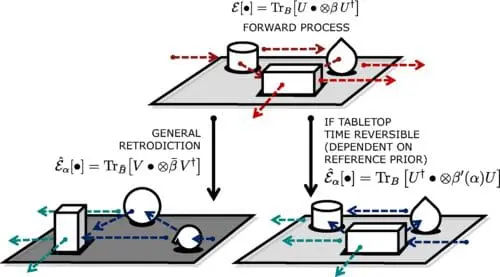
Researchers have explored the concept of irreversibility in thermodynamics and information theory, focusing on the role of dilations in reversing physical processes. They identified two ways to define a reverse channel: the Bayesian retrodiction and the Petz recovery map in quantum formalism. The team found these two methods to be identical in both classical and quantum formalism when accounting for correlations between the system and the bath. They also studied special classes of maps, including product-preserving maps and tabletop time-reversible maps, establishing several general results and detailed characterizations.
What is the Role of Dilations in Reversing Physical Processes?
The concept of irreversibility, which is crucial in both thermodynamics and information theory, is naturally studied by comparing the evolution of a forward channel with an associated reverse channel. This concept was first systematically studied in the context of thermodynamics, which is captured by the second law. This law stipulates the impossibility of putting all the energy to fruition, leading to the necessary generation of heat or more generally, entropy. Eventually, information theory became the setting in which to study irreversibility. A process is considered irreversible for an agent when the agent is unable to retrieve from the output all the information about the input. In turn, a theory of optimal retrieval of information was developed both in classical and in quantum theories.
There are two natural ways to define this reverse channel. Using logical inference, the reverse channel is the Bayesian retrodiction, the Petz recovery map in the quantum formalism of the original one. Alternatively, we know from physics that every irreversible process can be modeled as an open system. One can then define the corresponding closed system by adding a bath dilation, trivially reverse the global reversible process, and finally remove the bath again. The researchers proved that the two recipes are strictly identical, both in the classical and in the quantum formalism, once one accounts for correlations formed between the system and the bath.
What are the Special Classes of Maps in Reversing Physical Processes?
Having established the identical nature of the two recipes, the researchers defined and studied special classes of maps. These include product-preserving maps, for which no such system-bath correlations are formed for some states, and tabletop time-reversible maps, when the reverse channel can be implemented with the same devices as the original one. They established several general results connecting these classes and a very detailed characterization when both the system and the bath are one qubit.
In particular, they showed that when reverse channels are well defined, product preservation is a sufficient but not necessary condition for tabletop reversibility. They also demonstrated that the preservation of local energy spectra is a necessary and sufficient condition to generalized thermal operations. This is of interest for the structure of the theory of reversibility in physical processes.
How is Irreversibility Studied in Different Fields?
Irreversibility is ubiquitous in real life. In science, it was first studied systematically in the context of thermodynamics. This is captured by the second law, which stipulates the impossibility of putting all the energy to fruition, leading to the necessary generation of heat or more generally, entropy. Eventually, information theory became the setting in which to study irreversibility. A process is irreversible for an agent when the agent is unable to retrieve from the output all the information about the input. In turn, a theory of optimal retrieval of information was developed both in classical and in quantum theories.
Meanwhile, the field of stochastic thermodynamics developed quantitative approaches to irreversibility based on statistical comparisons between the process under study and its associated reverse process. But how to define the latter? In the case of fully reversible deterministic processes, the reverse process is obviously the dynamics played backwards. For isothermal evolutions driven Hamiltonian evolution while the system is in contact with a thermal bath, a possible and very natural reverse process consists in driving the evolution backwards in the presence of the same bath.
What are the Different Recipes for Reversing Physical Processes?
There are two natural ways to define this reverse channel. Using logical inference, the reverse channel is the Bayesian retrodiction, the Petz recovery map in the quantum formalism of the original one. Alternatively, we know from physics that every irreversible process can be modeled as an open system. One can then define the corresponding closed system by adding a bath dilation, trivially reverse the global reversible process, and finally remove the bath again.
Recently, it was proposed to define the reverse process using the Bayesian recipe for information retrieval, also known as Bayesian inversion or retrodiction. This recipe requires only choosing a reference state which plays the role of a Bayesian prior. The connection between reverse processes and Bayesian logic had not been noticed in the context of classical stochastic thermodynamics. In quantum thermodynamics, one of the main tools for information recovery had been used first occasionally, then systematically, the Petz recovery map.
How are the Two Recipes for Reversing Physical Processes Related?
In this work, after a review of known material on reverse processes, the researchers started by proving that the two recipes by dilation and by retrodiction are identical, both in the classical and the quantum case. The fact that the two proposed general recipes coincide, combined with the knowledge that all the previously known special cases can be recovered with these recipes, shows that we have the definition of the reverse process under control.
Next, they brought up the observation that a process and its associated reverse process may be very different. It is indeed well known in the quantum case that implementing the reverse Petz of a channel may require very different resources than those needed to implement the channel itself. The cases mentioned above of the reversible and the isothermal processes, whose reverses are what one would expect and can be implemented with the same control and the same environment, seem to be the exception. Based on this observation, they set to study which processes have a reverse that can be implemented with the same or similar resources. They shall say that the latter processes possess tabletop reversibility.
Publication Date: 2024-02-26
Authors: Clive Cenxin Aw, Lin Htoo Zaw, Maria Balanzó-Juandó, Valerio Scarani, et al.
Source: PRX Quantum 5, 010332
DOI: https://doi.org/10.1103/PRXQuantum.5.010332