Physicists from Aalto University in Finland, led by postdoctoral researcher Bayan Karimi and professor Jukka Pekola, have made a groundbreaking discovery that sheds light on the mysterious thermal energy loss of qubits. Qubits, the basic elements of quantum computers and ultrasensitive detectors, are prone to coherence loss due to thermal dissipation in their electrical circuits. Despite rapid progress in developing high-quality qubits, the source of this energy loss remained unknown until now.
The research team, which included international collaborators from the University of Madrid, the University of Washington, and Niels Bohr Institute in Copenhagen, used a surprisingly simple experimental setup to measure thermal dissipation directly. They found that previously unattributed energy loss can be traced back to thermal radiation originating at the qubits and propagating down the leads.
This breakthrough discovery has significant implications for the development of more efficient qubits, which are crucial for advancing quantum computing technology. The study’s findings, published in Nature Nanotechnology, will enable researchers to better understand how their qubits decay, ultimately leading to more complex calculations unachievable with classical computing environments.
Qubit Coherence Decay: Unraveling the Mystery of Thermal Dissipation
The quest for efficient quantum computing and ultrasensitive detectors has long been hindered by an unresolved question: how and where does thermal dissipation occur in superconducting qubits? Researchers from Aalto University, Finland, have made a groundbreaking discovery, theoretically and experimentally demonstrating that qubit coherence loss can be directly measured as thermal dissipation in the electrical circuit holding the qubit.
At the heart of advanced quantum computers and ultrasensitive detectors are superconducting Josephson junctions, the basic elements of qubits. Despite rapid progress in developing high-quality qubits, the mystery of thermal dissipation has persisted. Bayan Karimi, a postdoctoral researcher at Aalto University, notes that understanding this loss is crucial for advancing quantum technology.
The Josephson Effect and Supercurrents
The transmission of supercurrents is made possible by the Josephson effect, where two closely spaced superconducting materials can support a current with no applied voltage. This phenomenon allows qubits to operate efficiently, but it also introduces thermal radiation originating at the qubits and propagating down the leads. Karimi likens this radiation to the warmth radiating from a campfire, which can be felt even in cold ambient air.
Tracing Thermal Dissipation
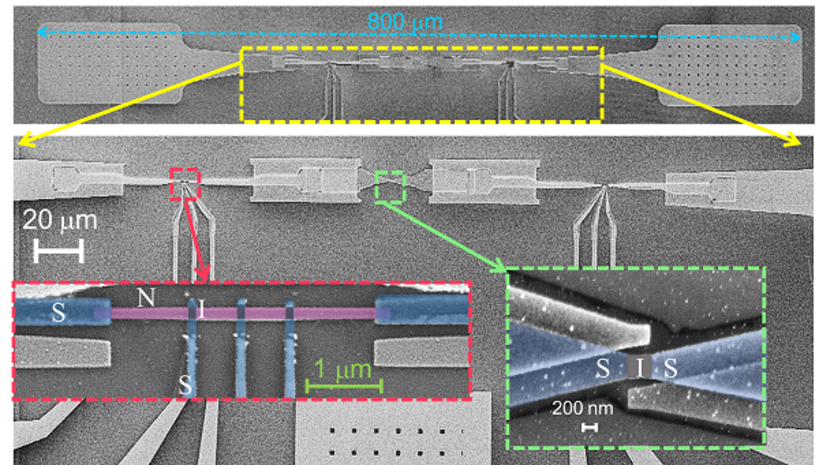
Physicists have previously observed energy loss in large arrays of hundreds of Josephson junctions placed in a circuit. However, by tracing their way backward to simpler experiments, Karimi and his team were able to isolate the effects of tweaking the voltage at a single Josephson junction. By placing an ultrasensitive thermal absorber next to this junction, they passively measured the very weak radiation emitted from this junction at each phase transition in a broad range of frequencies up to 100 gigahertz.
Implications for Quantum Computing
The discovery has significant implications for quantum computing, as qubits with longer coherence times allow for more operations, leading to more complex calculations unachievable in classical computing environments. By understanding how thermal dissipation occurs, researchers can better design and optimize their qubits, paving the way for more efficient and powerful quantum devices.
Experimental Setup and Collaboration
The experimental setup used a single Josephson junction, observed using a scanning electron micrograph. The research was accomplished in partnership with colleagues from the University of Madrid, the University of Washington, and Niels Bohr Institute in Copenhagen, Denmark. The fabrication of the devices utilized the cleanrooms of OtaNano, Finland’s national research infrastructure for micro- and nanotechnologies. The work was supported by the Research Council of Finland via the Quantum Technology Finland (QTF) Centre of Excellence and THEPOW consortium.
The full paper, “Bolometric detection of Josephson radiation,” was published in Nature Nanotechnology on August 22nd, providing a detailed account of the research and its findings.
External Link: Click Here For More